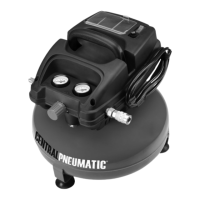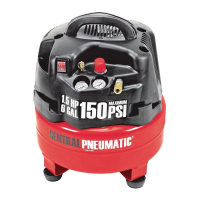
EasyManua.ls Logo

Central Pneumatic 62380 - User Manual

Central Pneumatic 62380
20 pages
Print Icon
To Next Page IconTo Next Page
Loading...
Visit our website at: http://www.harborfreight.com
Email our technical support at: productsupport@harborfreight.com
6
GAL
oilless
air compressor
REV 14h
Owners Manual & Safety Instructions
Save This Manual Keep this manual for the safety warnings and precautions, assembly,
operating, inspection, maintenance and cleaning procedures� Write the product’s serial number in the
back of the manual near the assembly diagram (or month and year of purchase if product has no number)�
Keep this manual and the receipt in a safe and dry place for future reference�
When unpacking, make sure that the product is intact
and undamaged� If any parts are missing or broken,
please call 1-888-866-5797 as soon as possible�
Copyright
©
2014 by Harbor Freight Tools
®
All rights reserved�
No portion of this manual or any artwork contained herein may be reproduced in
any shape or form without the express written consent of Harbor Freight Tools
Diagrams within this manual may not be drawn proportionally� Due to continuing
improvements, actual product may differ slightly from the product described herein�
Tools required for assembly and service may not be included�
Read this material before using this product.
Failure to do so can result in serious injury.
SAVE THIS MANUAL.

Questions and Answers

  • K
    Katherine Harris MDAug 18, 2025
    Why won't my Central Pneumatic Air Compressor start?
    • M
      Mr. Richard CarrAug 18, 2025
      If your Central Pneumatic Air Compressor doesn't start or restart, several factors could be at play. First, verify that the tank isn't already pressurized. If it is, the compressor will kick in when needed. Ensure the power cord is securely plugged in and that the power supply matches the compressor's requirements. Check the outlet for power, resetting the circuit breaker if necessary. Also, the thermal overload switch might have tripped; in that case, turn off the compressor, let it cool, and press the reset button. It's also possible that the building's power supply circuit tripped, so reset the circuit or replace the fuse. If you're using an extension cord, make sure it's not too long or too thin. Finally, if none of these steps work, a qualified technician should inspect the unit.
  • J
    Jeffrey TaylorAug 21, 2025
    Why is my Central Pneumatic 62380 not building enough pressure?
    • C
      Calvin AndersonAug 21, 2025
      If your Central Pneumatic Air Compressor is not building enough air pressure, start by checking and cleaning or replacing the air filters. A technician should service the check valve, if needed. Ensure the compressor is large enough for the job by verifying that the accessory CFM is met by the compressor. Inspect all fittings for leaks using a soap solution and tighten as necessary, without overtightening. If the hose or hose connections are too narrow, replace them with wider ones. Also, consider that high altitude can reduce air output, requiring a compressor with greater output.
  • Y
    ybradleyAug 23, 2025
    Why does my Central Pneumatic 62380 Air Compressor keep tripping the circuit breaker?
    • K
      Kaitlin WallAug 23, 2025
      If your Central Pneumatic Air Compressor is blowing fuses or tripping the circuit breaker repeatedly, there are a few potential causes. Ensure you're using the correct size and type of fuse, and consider using a time-delay fuse. Try disconnecting other electrical appliances from the circuit or running the compressor on its own dedicated circuit. Also, verify that you're using the correct gauge wire and length of extension cord. If the issue persists, a defective check valve or unloader might be the culprit, requiring a visit to a service center.
  • P
    Paul WrightAug 26, 2025
    What to do if my Central Pneumatic 62380 is overheating?
    • D
      Dr. Danny ReynoldsAug 26, 2025
      If your Central Pneumatic Air Compressor is overheating, start by checking the inlet and outlet filters and clean or replace them as needed. The environment may be unusually dusty, requiring more frequent filter maintenance or relocation of the unit. Eliminate any extension cords being used. Make sure the unit is positioned on a level surface.
  • S
    Sherri BakerAug 27, 2025
    What causes the thermal overload protector to cut out repeatedly on my Central Pneumatic Air Compressor?
    • C
      caseytaylorAug 28, 2025
      If the thermal overload protector on your Central Pneumatic Air Compressor is cutting out repeatedly, check the voltage with a voltmeter to ensure it's not too low. Make sure the compressor has proper ventilation and the room temperature isn't too high; move it to a well-ventilated area if needed. Also, verify that you're using the correct gauge wire and length of extension cord.
  • R
    Ronald JohnsonAug 30, 2025
    Why is my Central Pneumatic 62380 Air Compressor building pressure so slowly?
    • Y
      Yesenia OrtizAug 30, 2025
      If your Central Pneumatic Air Compressor is building pressure too slowly, first, check that the circuit matches the compressor's requirements. If the working environment is too cold, move the compressor to a warmer location. Listen for air leaking from the safety valve; if it's leaking, replace it with an identical valve with the same rating, but do not attempt to seal or tamper with it. Finally, check all fittings with a soap solution for air leaks and tighten as needed, without overtightening.
  • J
    jenniferwyattSep 1, 2025
    Why does my Central Pneumatic 62380 start and stop so often?
    • A
      Ashley WoodsSep 1, 2025
      If your Central Pneumatic Air Compressor starts and stops excessively, begin by checking all fittings for leaks using a soap solution and tighten as needed, without overtightening. Also, ensure the compressor is large enough for the job by verifying that the accessory CFM is met by the compressor; if it doesn't reach the required CFM, a larger compressor is needed.
  • N
    Nicholas ReedSep 3, 2025
    Why is my Central Pneumatic 62380 Air Compressor so noisy and vibrating a lot?
    • C
      Christopher RomeroSep 3, 2025
      If your Central Pneumatic Air Compressor is producing excessive noise and vibration, check all fittings for leaks using a soap solution and tighten as needed, without overtightening. Also, make sure the unit is positioned on a level surface.
  • C
    Crystal McclureSep 6, 2025
    Why is there moisture in the air coming from my Central Pneumatic Air Compressor?
    • M
      Megan WilsonSep 6, 2025
      If there is moisture in the discharge air of your Central Pneumatic Air Compressor, it could be due to too much moisture in the air. Consider installing an inline air filter/dryer, and/or relocate the compressor to a less humid environment. Excessive water in the air tank due to high humidity can also cause this issue; drain the tank and move to an area with less humidity, using an air line filter.
  • B
    Brittany Wheeler DVMSep 8, 2025
    Why does the safety valve keep popping on my Central Pneumatic Air Compressor?
    • C
      Caitlin NguyenSep 8, 2025
      If the safety valve on your Central Pneumatic Air Compressor is popping, pull on the test ring of the safety valve. If it continues to pop, replace it.

Summary

Warning Symbols and Definitions

Danger and Warning Alerts

Indicates hazardous situations that could result in death, serious injury, or moderate injury.

Caution and Notice Alerts

Addresses practices not related to personal injury and minor or moderate injury risks.

General Safety Warnings

Work Area Safety

Ensures a clean, well-lit environment and keeps children and bystanders away.

Electrical Safety

Guidelines for safe use of electrical components, cords, and preventing shock.

Personal Safety

Emphasizes alertness, common sense, and wearing protective equipment during use.

Compressor Use and Care

Instructions on proper operation, maintenance, and storage to ensure safety.

Service Requirements

Specifies that repairs should be done by qualified personnel using identical parts.

Air Compressor Safety Warnings

Fire, Explosion, and Injury Risks

Avoid flammable liquids, sparks, flames, and directing air streams at people or animals.

Safe Operation and Handling

Covers unattended operation, ventilation, hot surfaces, and moving the unit safely.

Component and Air Line Safety

Do not tamper with components, use rated air lines, and drain the tank daily.

Extension Cord Guidelines

Recommendations for selecting appropriate extension cords based on amperage and length.

Additional Safety Precautions

OSHA and Labeling

Adherence to OSHA guidelines for industrial use and maintaining safety labels.

Pacemaker and Toy Warnings

Consult physician if you have a pacemaker; keep product away from children.

California Proposition 65 Warnings

Warnings regarding lead content in brass components and power cord.

Grounding and Electrical Safety

Grounding Fundamentals

Ensures proper grounding for electric shock prevention and correct plug usage.

Extension Cords & Outlets

Guidelines for using 3-wire extension cords and compatible outlets.

Symbology Definitions

Definitions of common symbols like PSI, CFM, CSA, UL, and electrical current types.

Compressor Specifications

Electrical Rating

Specifies the voltage, frequency, and amperage rating of the compressor.

Air Outlet Size

Details the thread size for air outlet connections.

Air Pressure Ratings

Defines the shut-off and restart pressure levels for the compressor.

Air Tank Capacity

Indicates the volume of the air tank.

Air Flow Capacity

Provides SCFM ratings at different pressure points.

Sound Level

Specifies the noise level of the compressor at a given distance.

Instructions for Putting Into Use

Functions Overview

Identifies and labels the main components and controls of the compressor.

Breaking in the Compressor

Air Connection Setup

Portable Air Supply Setup Diagram

Portable Air Supply Components

Details components like air hose, filter, regulator, lubricator, and coupler for portable setup.

Stationary Air Supply Setup Diagram

Stationary Air Supply Components

Details components for stationary setup like vibration pads, main air lines, and branch lines.

Operating Instructions

Area Setup and General Operation

Instructions for setting up the work area and general compressor operation steps.

Pressure Adjustment and Tool Use

How to adjust pressure and connect/use air tools with the compressor.

Post-Operation Procedures

Steps for shutting down, unplugging, closing valves, and bleeding air after use.

Emergency Depressurization

Automatic Shut off System

Maintenance and Servicing

Maintenance Warnings

Warnings regarding service by qualified technicians and using undamaged equipment.

Cleaning, Lubrication, and Schedule

Procedures for cleaning, bearing lubrication, and recommended maintenance checks.

Draining Moisture from the Tank

Checking the Safety Valve

Troubleshooting Common Issues

Compressor Not Starting or Restarting

Identifies causes and solutions for compressor start-up problems.

Slow Pressure Build-up

Addresses issues causing slow pressure build-up in the compressor.

Insufficient Air Pressure

Solutions for when the compressor is not building enough air pressure.

Tripped Fuses or Breakers

Troubleshooting for repeated fuse blows or circuit breaker trips.

Troubleshooting Overheating and Cycling

Troubleshooting Noise and Moisture

Addresses excessive noise, vibration, and moisture in discharge air.

Safety Valve and Continuous Running Issues

Troubleshooting for safety valve pops and the compressor running continuously.

Air Leaks and Tank Issues

Solutions for air leaks from pump/fittings and issues with the air tank.

Parts List and Diagram

Parts List Disclaimer

Disclaimer regarding user qualifications for repairs and parts replacement.

Component Identification

Lists and identifies all parts of the compressor with part numbers and quantities.

Assembly Diagram

Limited 90 Day Warranty

Central Pneumatic 62380 Specifications

General IconGeneral
BrandCentral Pneumatic
Model62380
CategoryAir Compressor
LanguageEnglish

Related product manuals