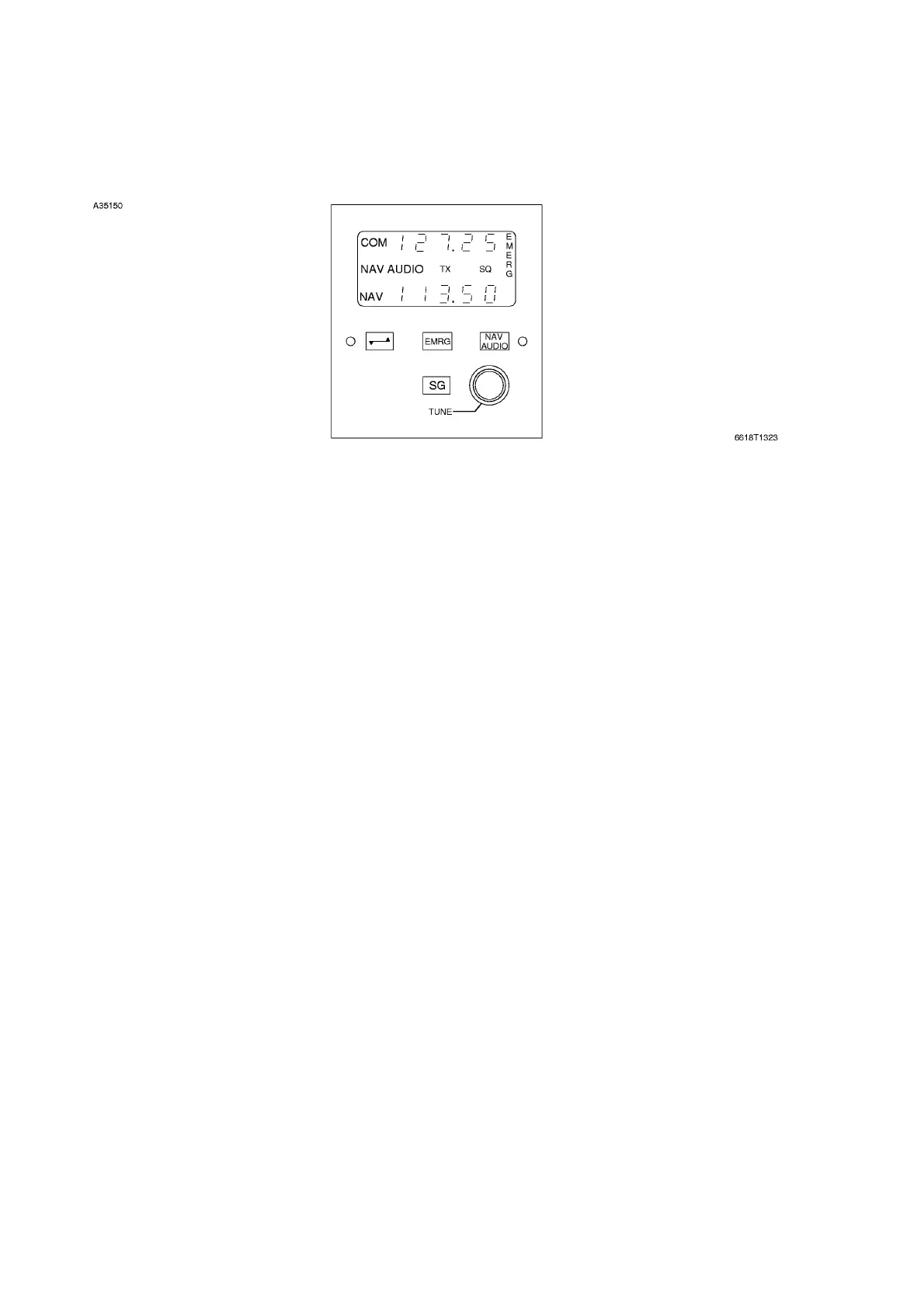
In normal mode the SRC acts as an additional tuning source for the radio system. COM 1 and NAV 1
may be tuned by the SRC in this mode. The SRC verifies that the COM 1 RCZ-833 or the NAV 1
RNZ-850 (integrated COM and NAV units, respectively) are tuned to the correct frequency by
checking the frequency echoed on the radio service bus (RSB). If the tuned frequency is incorrect,
the frequency displayed on the SRC will be dashed out. If the appropriate RMU is illuminated, the
frequency change will be seen to appear in the active display. In normal mode, the radios which are
tunable by the SRC (COM 1 and NAV 1) may be also tuned from the applicable RMU. If tuned from
the RMU, the frequency will also be tuned on the SRC.
In emergency mode, operation of the SRC is identical on the part of the operator. The internal tuning
of the system differs in that it does not read and compare frequencies on the RSB. Frequencies that
are set in the SRC are transmitted to the appropriate NAV or COM unit and that frequency is tuned.
When tuning the standby radio control, COM frequencies are displayed on the top line and NAV
frequencies on the bottom. An arrow cursor, which appears to the left of the displayed frequencies
may be toggled between the NAV and COM frequencies by pressing the double arrow (transfer)
switch. The line on the which the arrow appears is then tunable by the tuning knobs on the SRC.
The SQ push button toggles the COM squelch open and closed. When the squelch is open, SQ is
annunciated in the right center part of the display.
When the EMER button is selected on the audio panel, the NAV AUDIO push button toggles the NAV
AUDIO off and on. When NAV AUDIO is on, it is summed in with the COM audio. NAV AUDIO will be
annunciated at the center left of the display.
Any time the COM transmitter is being keyed, the TX annunciator in the center of the display will
appear.
STANDBY RADIO CONTROL UNIT
Figure 3-11
Cessna Citation XLS - Instrumentation & Avionics








 To Next Page