EasyManua.ls Logo

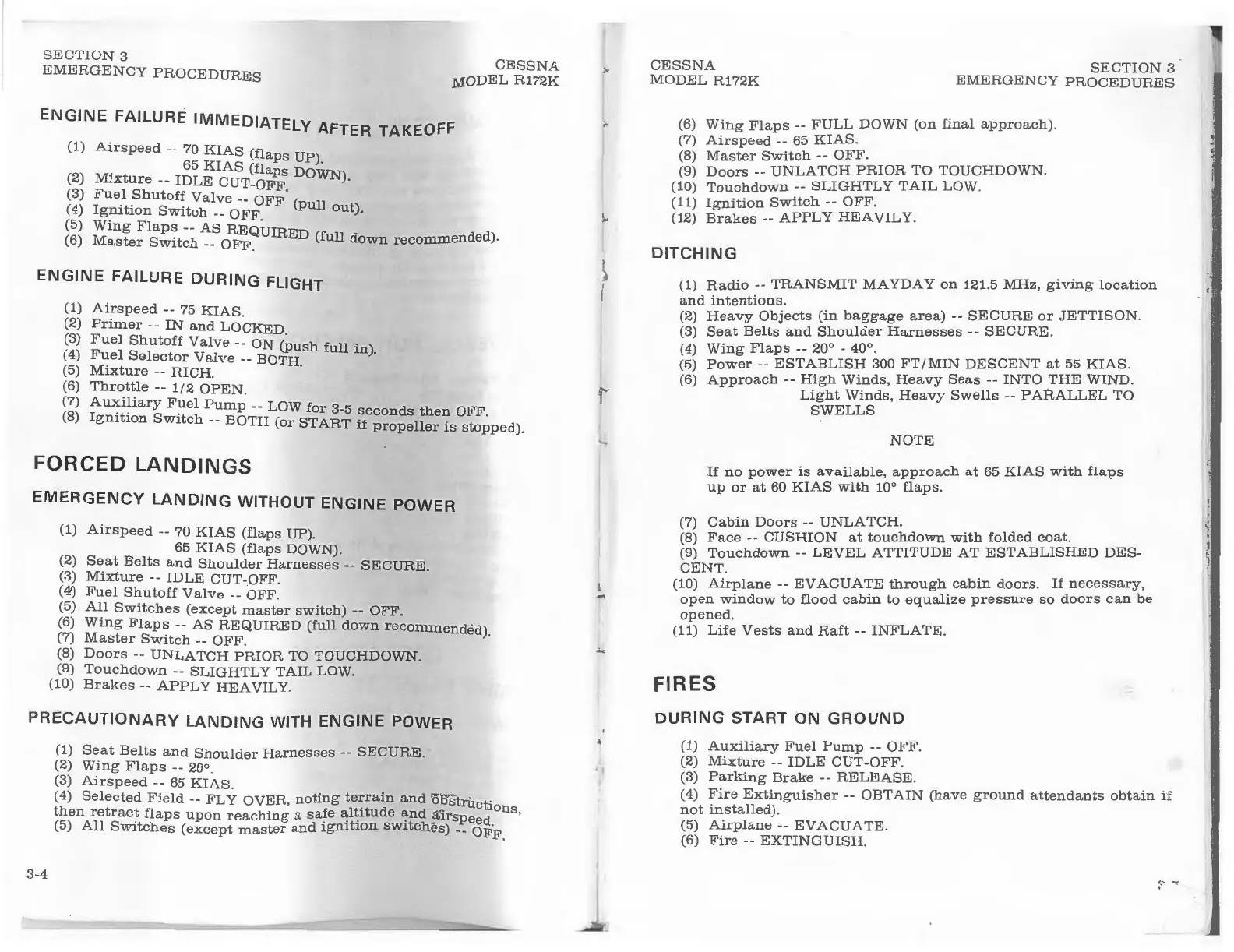
Cessna Hawk XP - Engine Failure Immediately After Takeoff; Engine Failure During Flight; Forced Landings; Ditching

Cessna Hawk XP
24 pages
Print Icon
To Next Page IconTo Next Page
To Previous Page IconTo Previous Page
Loading...
SECTION
3
CESSNA
MODEL
R172K
EMERGENCY
PROCEDURES
ENGINE
FAILURE
IMMEDIATELY
AFTER TAKEOFF
(1)
Airspeed
-- 70
KIAS
(flaps
UP)
65
KIAS
(flaps
DOWN
(2)
Mixture
--
IDLE
CUT-OFF
).
(3)
Fuel
Shutoff
Valve
__
OFF.
(4)
Ignition
Switch
__
OFF.
(pull
out).
(5)
Wing
Flaps
--
AS
REQUIRED
d)
(6)
Master
Switch
__
OFF.
(full
down
recommende
·
ENGINE
FAILURE
DURING
FLIGHT
(1)
Airspeed
-- 75
KIAS.
(2)
Primer
--
IN
and
LOCKED.
(3)
Fuel
Shutoff
Valve
--
ON
(push
full
· )
(4)
Fuel
Selector
Valve
-- BOTH. m ·
(5)
Mixture
--
RICH.
(6)
Throttle
--
1/2
OPEN.
(7)
Auxi~iary
Fuel
Pump
-- LOW
for
3-5
seconds
then
OFF.
(8)
Igmt10n
Switch
--
BOTH
(or
START
if
propeller
is
stopped).
FORCED
LANDINGS
EMERGENCY
LANDING
WITHOUT
ENGINE
POWER
(1)
Airspeed
--
70
KIAS
(flaps
UP).
65
KIAS
(flaps
DOWN).
(2)
Seat
Belts
and
Shoulder
Harnesses
--
SECURE.
(3)
Mixture
--
IDLE
CUT-OFF.
(4')
Fuel
Shutoff
Valve
--
OFF.
(5)
All
Switches
(except
master
switch)
--
OFF.
(6)
Wing
Flaps
--
AS
REQUIRED
(full
down
recommended).
(7)
Master
Switch
--
OFF.
(8)
Doors
--
UNLATCH
PRIOR
TO
TOUCHDOWN
.
(9)
Touchdown
--
SLIGHTLY
TAIL
LOW.
(10)
Brakes
--
APPLY
HEAVILY.
PRECAUTIONARY
LANDING
WITH
ENGINE
POWER
3-4
(1)
Seat
Belts
and
Shoulder
Harnesses
--
SECURE.
(2)
Wing
Flaps
-- 20°.
(3)
Airspeed
--
65
KIAS.
( 4)
Selected
Field
--
FLY
OVER
noting
terrain
and
obstruct·
' . d .
ions
then
retract
flaps
upon
reaching
a
safe
!J:ltitu e
~nd
airspeed
'
(5)
All
Switches
(except
master
and
igmt10n
switches)
__
OF
.F
l
I
CESSNA
MODEL
R172K
SECTION
3
EMERGENCY
PROCEDURES
(6)
Wing
Flaps
--
FULL
DOWN
(on
final
approach).
(7)
Airspeed
--
65
KIAS
.
(8)
Master
Switch
--
OFF.
(9)
Doors
--
UNLATCH
PRIOR
TO
TOUCHDOWN.
(10)
Touchdown
--
SLIGHTLY
TAIL
LOW.
(11)
Ignition
Switch
--
OFF
.
(12)
Brakes
--
APPLY
HEAVILY
.
DITCHING
(1)
Radio
--
TRANSMIT
MAYDAY
on
121.5
MHz
,
giving
location
and
intentions.
(2)
Heavy
Objects
(in
baggage
area)
--
SECURE
or
JETTISON.
(3)
Seat
Belts
and
Shoulder
Harnesses
--
SECURE.
(4)
Wing
Flaps
-- 20° - 40°.
(5)
Power
--
ESTABLISH
300
FT/MIN
DESCENT
at
55
KIAS.
(6)
Approach
--
High
Winds,
Heavy
Seas
--
INTO
THE
WIND.
Light
Winds,
Heavy
Swells
--
PARALLEL
TO
SWELLS
NOTE
If
no
power
is
available
,
approach
at
65
KIAS
with
flaps
up
or
at
60
KIAS
with
10°
flaps.
(7)
Cabin
Doors
--
UNLATCH.
(8)
Face
--
CUSHION
at
touchdown
with
folded
coat.
(9)
Touchdown
--
LEVEL
ATTITUDE
AT
ESTABLISHED
DES-
CENT
.
(10)
Airplane
--
EVACUATE
through
cabin
doors.
If
necessary
,
open
window
to
flood
cabin
to
equalize
pressure
so
doors
can
be
opened.
(11)
Life
Vests
and
Raft
--
INFLATE.
FIRES
DURING
START
ON
GROUND
(1)
Auxiliary
Fuel
Pump
--
OFF
.
(2)
Mixture
--
IDLE
CUT-OFF.
(3)
Parking
Brake
--
RELEASE.
(4)
Fire
Extinguisher
--
OBTAIN
(have
ground
attendants
obtain
if
not
installed).
(5)
Airplane
--
EVACUATE.
(6)
Fire
--
EXTINGUISH.

Related product manuals