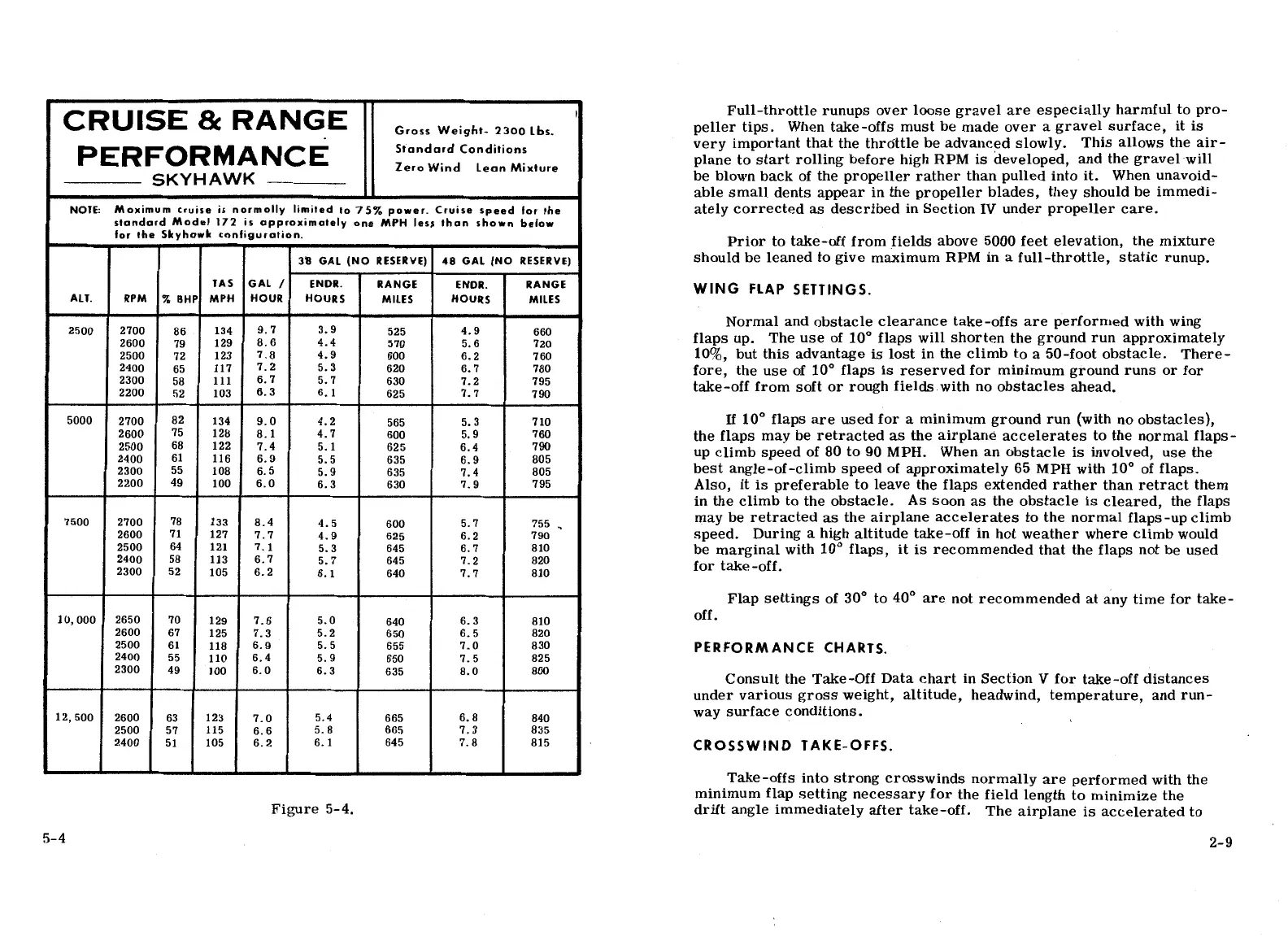
CRUISE & RA NGE
Full-throttle
runups
over loose
gravel
are
especially
harmful to
pro-
Gross
Weight-
2300
Lbs.
peller tips.
When
take-offs
must
be made
over
a
gravel
surface,
it
is
standard
conditions
very
important that the thróttle
be
advanced slowly.
This allows the
air-
PERFOR M
A
NCE
Zero Wind
Lean
Mixture
plane to
start
rolling
before
high
RPM is
developed,
and the gravel will
SKYH
AWK
be blown
back of
the
propeller
rather than
pulled into
it.
When
unavoid-
able small
dents
appear
in
the
propeller
blades, they
should
be
immedi-
NOTE:
Moximum cruise
is
normolly limited
to
75% power.
Cruise
speed for
sh.
ately
corrected as
described
in
Section
IV
under
propeller
care.
standard Model
172
is
approximately one
MPH
Iess than
shown
below
for the Skyhawk configuration
Prior
to
take-off
from
fields
above
5000 feet
elevation, the
mixture
311
GAL
(NO
RESERVE)
48
GAL (NO
RESERVE)
should be leaned
to
give
maximum
RPM
in a
full-throttle, static runup.
TAS GAL
/
ENDR. RANGE
ENDR.
RANGE
WING FLAP
SETTINGS.
ALT.
RPM
%
BHP
MPH
HOUR HOURS MILES
HOURS MILES
----------..-..-------.......
-.-........-..........-..
Normal
and obstacle
clearance
take-offs
are performed with wing
2500
2700
86
134
9.7 3.9
525
4.9
660
2600
79
129
8.6
4.4
570
5.6
720
flaps
up.
The
use
of
10°
flaps
will shorten
the
ground run
approximately
2500
72
123
7.8
4.9
600 6.2
760
10°/o,
but
this advantage
is lost
in the
climb to
a
50-foot
obstacle.
There-
2400
65
117
7.2
5.3
620
6.7
780
fore,
the use of
10°
flaps
is
reserved
for minimum ground
runs or for
take-off
from
soft
or
rough
fields with
no obstacles
ahead.
5000
2700
82
134
9.0
4.2
565
5.3
710
If
10°
flaps are
used for
a
minimum
ground run (with
no
obstacles),
2600
75
128 8.1
4.7
600
5.9 760
the
flaps
may
be
retracted
as
the
airplane
accelerates to
the
normal
flaps-
25
62355
6 4
up climb speed of 80 to 90 MPH.
When an obstacle
is
involved,
use the
2300
55
108 6.5
5.9
635
7.4 805
best
angle-of-climb
speed of
approximately 65
MPH
with
10°
of flaps.
2200
49
100
6.0
6.3
630
7.9 795
Also,
it
is
preferable
to leave the flaps extended rather than
retract
them
in the climb to
the obstacle.
As soon
as the obstacle is
cleared,
the flaps
7500
2700
78
133 8.4
4.5 600
5.7 755
may
be retracted
as
the
airplane accelerates to
the normal
flaps-up
climb
2600
71
127
7.7
4.9 625
6.2 790
speed.
During
a
high
altitude
take-off
in hot weather
where
climb
would
2500
64
121 7.1
5.3 645
6.7 810
be
marginal
with
10°
flaps, it is recommended
that the
flaps
not be used
40000
552
1
53 66.2
65
7 66
IOr
take-Off.
Flap
settings
of
30°
to
40°
are not
recommended
at
any
time for
take-
10,000 2650
70
129
7.6
5.0
640
6.3
810
Off.
2600
67 125
7.3
5.2
650
6.5 820
2500
61
118
6.9
5.5
655
7.0
830
PERFORMANCE CHARTS.
2400
55
110
6.4 5.9
650
7.5
825
2300
49
100
6.0 6.3
635
a.o
800
Consult the
Take-Off
Data
chart
in
Section
V for
take-off
distances
----
-.--- ----
-..--.
under
various gross
weight,
altitude, headwind,
temperature,
and
run-
12,500
2600
63
123
7.0
5.4 665
6.8
840
way
surface
conditions.
2500
57
115
6. 6
5.
8
665 7. 3 835
2400
51 105
6.2
6.1 645
7.8
815
CROSSWIND
TAKE-OFFS.
Take-offs
into
strong
crosswinds
normally
are
performed
with
the
minimum flap setting necessary
for
the field
length to
minimize
the
Figure
5-4. drift angle
immediately
after
take-off.
The
airplane
is
accelerated
to
5-4
2-9



 To Next Page