30
Adjustments
STEP 2 Test the Safety Reversal System
Withouta properlyinstalled safetyreversal system,persons (particularly small children) could be
SERIOUSLY INJURED or KILLED bya closing garage door.
l Safety reversal system MUST be tested every month.
l After ANY adjustments are made, the safetyreversal system MUST be tested. Door MUST reverse
on contact with 1-1/2" (3.8 cm) high object(or 2x4 laid flat) on the floor.
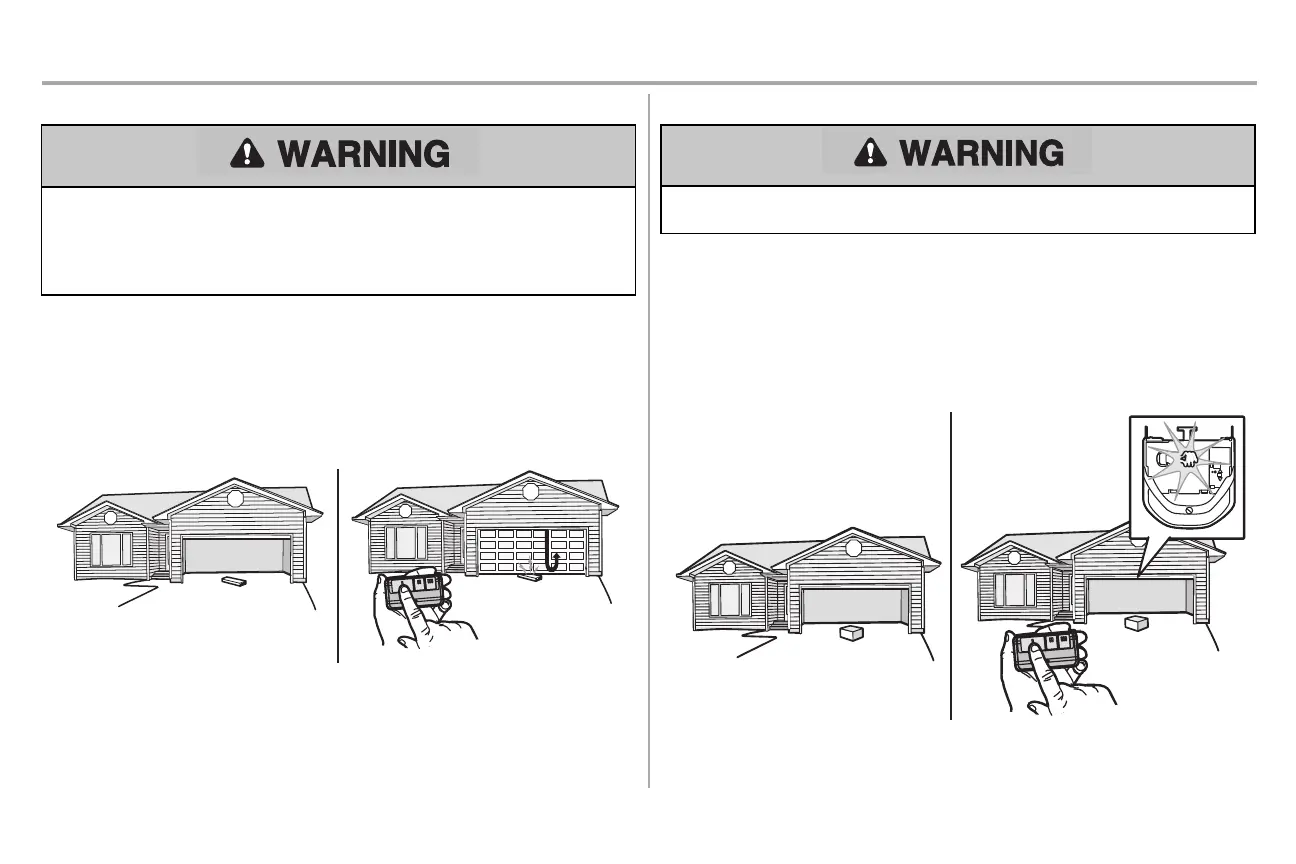
1. With the door fully open, place a 1-1/2 inch (3.8 cm) board (or a 2x4 laid flat) on the floor,
centered under the garage door.
2. Operate the door in the down direction. The door MUST reverse on striking the obstruction.
If the door stopsand does not reverse on the obstruction, the down travel needs to be increased (refer to
Adjustment Step 1). Repeat the test.When the door reverses on the 1-1/2" (3.8 cm) board (or 2x4 laid
flat), remove the obstruction and run the opener through 3 or 4 complete travel cycles to test adjustment.
If the garage door opener continues to fail the safety reversal test, call a trained door systemstechnician.
STEP 3 Test the Protector System
®
Withouta properlyinstalled safetyreversing sensor, persons (particularly small children) could be
SERIOUSLY INJURED or KILLED bya closing garage door.
1. Open the door. Place the garage door opener carton in the path of the door.
2. Pressthe remote control push button to close the door. The door will not move more than an inch
(2.5 cm), and the garage door opener lightswill flash 10 times.
The garage door opener will not close from a remote control if the LED in either safety reversing sensor
is off(alerting you to the fact that the sensor is misaligned or obstructed). If the garage door opener
closes the door when the safetyreversing sensor isobstructed (and the sensors are no more than 6
inches [15 cm]above the floor), call for a trained door systems technician.


 To Next Page