Need help?
Do you have a question about the Champion 100496 and is the answer not in the manual?
Contact information and support resources for the generator, including phone and website.
Explains the meaning of DANGER, WARNING, and CAUTION symbols used throughout the manual.
Essential safety guidelines for operating the generator, covering hazards from exhaust, moving parts, electricity, and heat.
Covers safe handling of fuel, starting procedures, avoiding overloads, and general operational care to prevent damage.
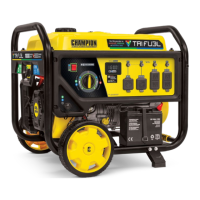
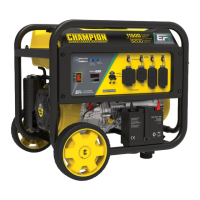
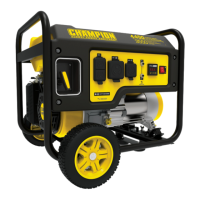
Details the main external components of the generator and their functions.
Explains the functions of the power panel, including engine switch, intelligauge, and circuit breakers.
Lists and illustrates components of the wheel kit for generator assembly.
Lists other included items such as oil and oil funnel.
Steps for removing the generator from its shipping carton and preparing for assembly.
Guides on installing the support leg, wheel kit, and handle onto the generator.
Provides instructions and precautions for adding the correct type and amount of engine oil.
Details the correct type of fuel and safe procedure for filling the generator's fuel tank.
Explains the importance and method of properly grounding the generator for electrical safety.
Guidelines for safely positioning the generator in a well-ventilated area, away from hazards.
Recommendations for using surge protectors to safeguard electronic devices from voltage fluctuations.
Step-by-step instructions on how to safely start the generator engine using the choke and recoil starter.
Procedures for safely connecting and disconnecting electrical loads to the generator.
Instructions for properly stopping the generator engine after use.
Guidance on calculating power needs, avoiding overloads, and managing loads effectively.
Explains how altitude affects engine performance and options for high altitude carburetor jets.
Instructions for checking and changing the engine oil, including oil type and capacity.
Covers spark plug inspection, gap setting, and replacement.
Procedures for cleaning the air filter and maintaining the spark arrester for optimal performance.
Guidelines for cleaning the exterior of the generator safely without using water.
Information on engine adjustments, governor tampering, and a detailed maintenance schedule.
Proper methods for cleaning the generator exterior and preparing it for storage.
Lists engine displacement, start type, and generator wattage, phase, and frequency.
Specifies fuel capacity, recommended fuel type, and oil capacity/type.
Details spark plug gap and valve clearance requirements.
Information on optimal operating and storage temperature ranges for the generator.
Provides a visual representation of the generator's electrical system and a key for wire colors.
A visual guide showing the location of all replaceable parts on the generator.
A comprehensive list of all parts, including part numbers, descriptions, and quantities.
An illustrated diagram of the generator's engine components for identification.
A detailed list of engine parts, their numbers, descriptions, and quantities.
Identifies common operational issues, their causes, and recommended solutions.
Provides contact information for further technical assistance and service.
Outlines the limited warranty period, registration requirements, and qualifications.
Details what is covered, exclusions, and limitations of the warranty.
Provides address, phone numbers, and website for warranty service and support.
Explains the owner's and manufacturer's responsibilities for emission control systems.
Details the warranty period and coverage for exhaust and evaporative emission parts.
Defines the scope and period of the emission control system warranty.
Outlines procedures for repair or replacement of warranted emission-related parts.
Lists the systems and specific parts covered under the emission control warranty.
Instructions on how to obtain warranty service for emission-related issues.
 General
| Brand | Champion |
|---|---|
| Model | 100496 |
| Category | Portable Generator |
| Language | English |

 To Next Page