____________________________________________________________________________________
Page 2 Allied Healthcare Products, Inc.
General Mechanical Principles
CHEMETRON OUTLET STATION DESIGN
Chemetron outlets are designed internally and externally to
help assure safety and reliability in the delivery of medical
gases and vacuum services. A carefully engineered system of
safety keying is used between back box, face plate and
adapter. An oxygen adapter, for instance, cannot be inserted
into a vacuum outlet station. An air face plate cannot be
attached to an oxygen back box.
Though not illustrated, the Chemetron DISS* outlet stations
are designed with most if the same features as the Chemetron
quick connect outlet stations with the exception of the primary
valve body assembly (see component parts p.3). For example,
an installed system of Chemetron (NCG) DISS outlets may be
changed to a Chemetron quick connect system by changing
the primary valve body assembly and faceplate. This is true
for all series Chemetron (NCG) outlets of quick connect or
DISS design. For series 238, 248, 148, 236, 246, and 146
outlet stations see Modernization Kits, Form #49-00-0001.
*Diameter Index Safety System. Ref. Compressed gas
Association, Inc., 1235 Jefferson Davis Highway, Arlington,
Virginia 22202, Pamphlet V-5.
OPERATION
Pressure gas systems are normally designed to deliver 50-55
psig to all station outlets, with the exception of Nitrogen
normally being 150-180 psgi. Vacuum systems should be
maintained at minimum 12-15” Hg at the outlet station farthest
away from the vacuum pumps.
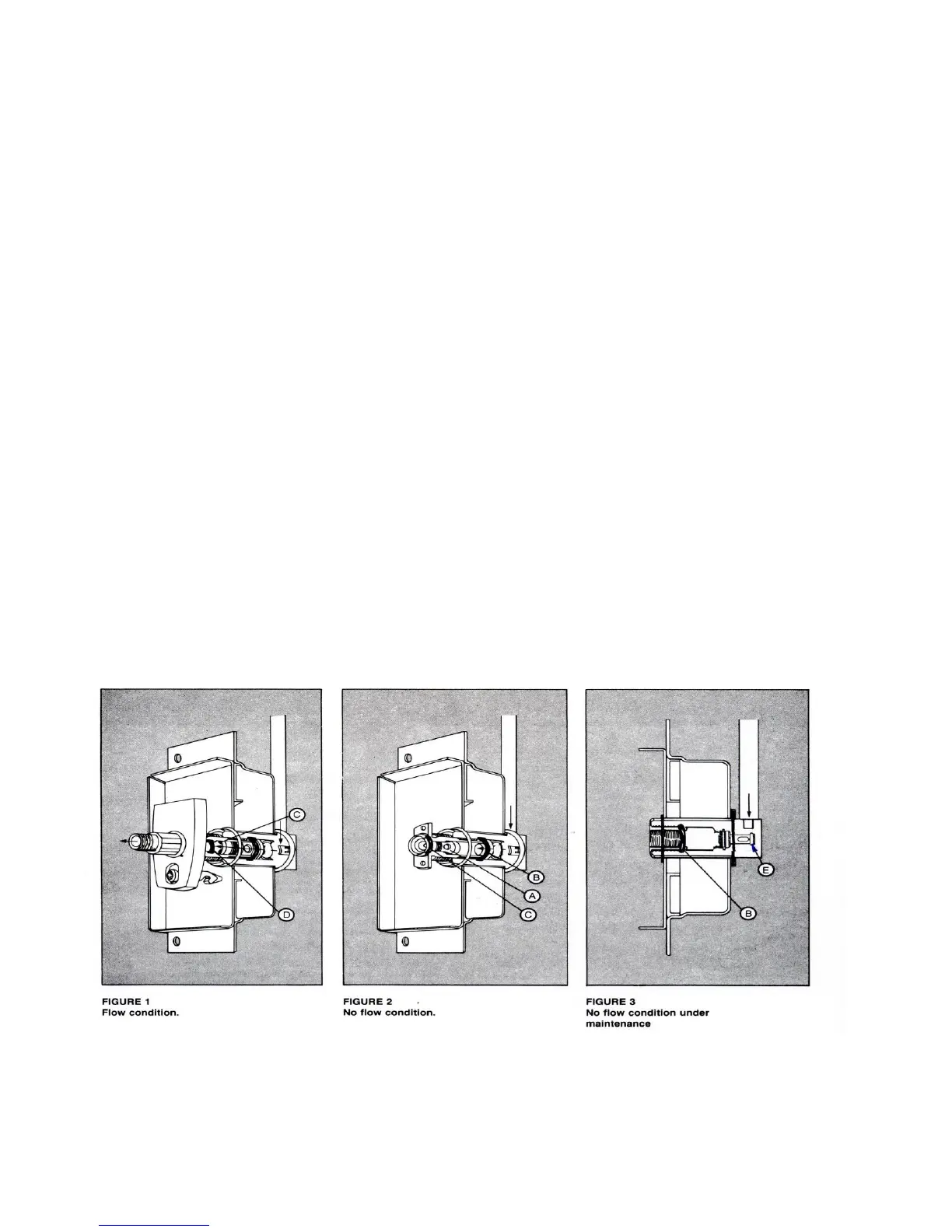
When not in use, gas is in a non-flowing state within the outlet
station, sealed by O-rings in the poppet (A) and the valve body
(C). O-ring (B) seals the valve body within the outlet base
housing - Figure 2.
Inserting the adapter pushes the poppet inward, permitting gas
to flow through the adapter. Leakage is prevented by the O-
ring © encircling adapter (D) - Figure 1.
When the primary valve body is removed for inspection and
servicing, line gas pressure forces the secondary check valve
(E) tight against the seat, sealing the gas against loss during
the period of maintenance – Figure 3.
Vacuum outlet stations do not incorporate secondary check
valves. A flat object such as a quarter may be used to seal the
vacuum flow during service of the primary valve body.


 To Next Page