Seats and Restraints 3-45
.
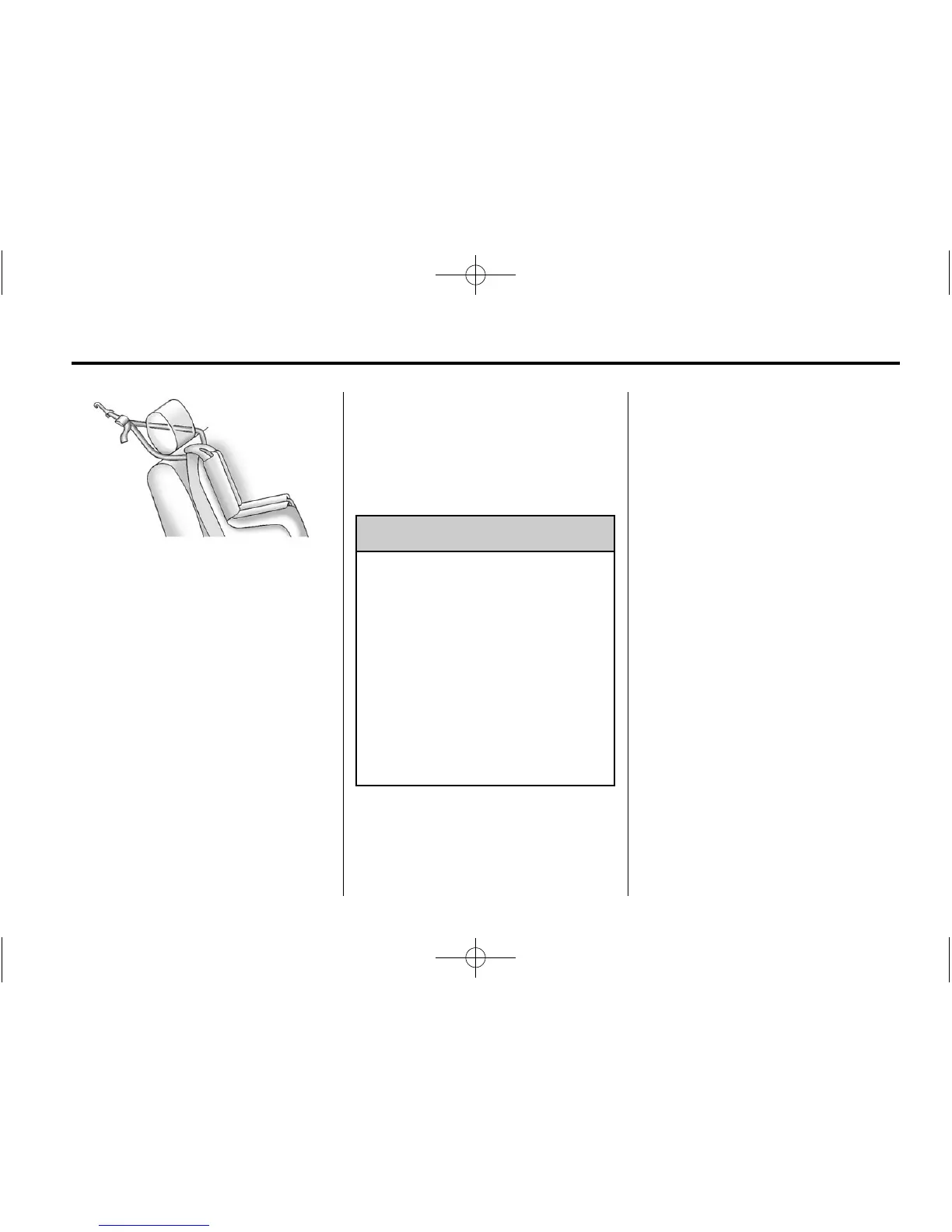
If the position you
are using has an
adjustable headrest
or head restraint and
you are using a dual
tether, raise the
headrest or head
restraint and route
the tether under the
headrest or head
restraint and around
the headrest or head
restraint posts.
3. Before placing a child in the
child restraint, make sure it is
securely held in place. To check,
grasp the child restraint at the
LATCH path and attempt to
move it side to side and back
and forth. There should be no
more than 2.5 cm (1 in) of
movement for proper installation.
Replacing LATCH System
Parts After a Crash
{
WARNING
A crash can damage the
LATCH system in the vehicle.
A damaged LATCH system may
not properly secure the child
restraint, resulting in serious
injury or even death in a crash.
To help make sure the LATCH
system is working properly after a
crash, see your dealer to have
the system inspected and any
necessary replacements made as
soon as possible.
If the vehicle has the LATCH system
and it was being used during a
crash, new LATCH system parts
may be needed.
New parts and repairs may be
necessary even if the LATCH
system was not being used at the
time of the crash.
Securing Child Restraints
(Rear Seat)
When securing a child restraint in
a rear seating position, study the
instructions that came with the
child restraint to make sure it is
compatible with this vehicle.
If the child restraint has the LATCH
system, see Lower Anchors and
Tethers for Children (LATCH
System) on page 3‑39 for how and
where to install the child restraint
using LATCH. If a child restraint is
secured in the vehicle using a
safety belt and it uses a top tether,
see Lower Anchors and Tethers for
Children (LATCH System) on
page 3‑39 for top tether anchor
locations.












 To Next Page