
 Need help?
Do you have a question about the Chicago Electric MIG 170 and is the answer not in the manual?
Instruction to keep the manual for future reference and safety warnings.
Explains safety alert symbols and their meanings to avoid injury.
Provides essential safety precautions and best practices for welder operation.
Instructions for proper welder grounding to prevent electric shock.
Prohibition of using extension cords with this welder.
Guidelines for selecting and installing replacement power cords.
Explanation of common symbols used in the manual and on the welder.
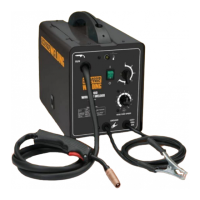
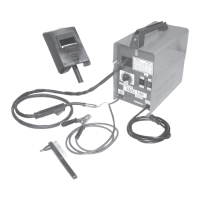
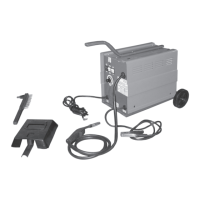
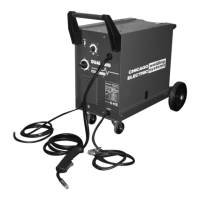
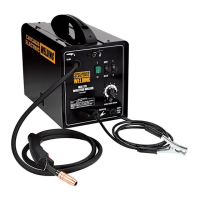
Technical details and operating parameters of the MIG 170 welder.
Step-by-step instructions for assembling the welding face shield.
Guidance on attaching the correct power plug for the welder.
Instructions for setting up the welder for flux-core wire welding.
Instructions for setting up the welder for solid core wire welding.
How to adjust the feed tensioner for optimal wire feeding.
Instructions for setting up the feed roller to match wire size.
Steps for securing wire, feeding it through liners, and preparing the torch.
Critical safety warnings before applying power to the welder.
Procedure to test wire feeding after powering on the welder.
How to check and adjust wire drive tension.
Installing the correct contact tip and nozzle for welding.
Essential protective gear and safety advice for basic welding.
Explains the differences and applications of flux-core and MIG welding.
Overview of indicators, switches, and dials on the control panel.
Details on power cord, torch cable, and ground cable connections.
Explains duty cycle limitations and how to avoid overheating.
Describes the welder's internal thermal protection and cooling process.
Recommended settings for flux-core welding based on material and thickness.
Recommended settings for MIG welding based on material and thickness.
Importance of practice welds and cleaning weld surfaces.
Procedures for clamping workpieces and setting wire speed/current.
Critical danger of asphyxiation from shielding gas and necessary precautions.
Steps for connecting power and positioning the torch before starting.
Techniques for stringer and weave beads, and torch angle control.
Understanding and applying drag angle and stickout for quality welds.
How to evaluate a test weld and make adjustments.
Procedures for safely shutting down the welder and closing gas valves.
Methods for cleaning slag and preparing welds for inspection.
Procedure to test weld strength and brittleness.
Identifying and correcting inadequate, proper, and excess weld penetration.
How to increase or decrease workpiece heat and penetration.
Troubleshooting excessive, inadequate penetration, and bend problems.
Addressing issues with weld adherence and managing slag.
Identifying and resolving porosity and excessive spatter in welds.
Correcting crooked/wavy beads and burn-through.
Procedures for inspecting and cleaning the welding torch nozzle and contact tip.
Solutions for problems with wire feeding and bird's nests.
Troubleshooting unstable arcs and weak arc strength.
Diagnosing problems with welder power, function, and arc ignition.
Manufacturer's statement on repairs and warranties.
Schematic showing the electrical connections of the welder.
A comprehensive list of all parts included with the welder.
 General
| Output Current | 30 - 170 A |
|---|---|
| Duty Cycle | 20% @ 170A |
| Welding Capacity | 1/4 inch |
| Wire Size | 0.023 in. - 0.035 in. |
| Input Voltage | 120/240 V |



 To Next Page