
 Need help?
Do you have a question about the Chicago Pneumatic CP9121 and is the answer not in the manual?
Defines the tool type and critical air supply requirements for operation.
Details lubrication procedures and recommended maintenance schedule for tool longevity.
Lists key performance metrics, models, and operational parameters.
Explains guard placement and provides declarations on noise and vibration levels.
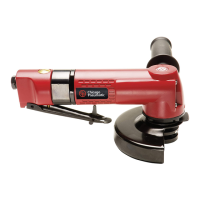
This document is an operator's manual for Chicago Pneumatic angle grinders, specifically models CP9120, CP9121, and CP9122, designed for 4", 5", and 4.5" wheels respectively. It provides essential information for the safe and effective operation, maintenance, and repair of these pneumatic tools.
The primary function of these tools is grinding. They are equipped with a spindle that can accommodate various grinding wheels, making them suitable for a range of grinding tasks. The manual explicitly states that no other use for these tools is permitted, emphasizing their specialized design and intended application.
For proper usage, the manual outlines specific air supply requirements. The tool needs to be supplied with clean, dry air at 90 psig (6.3 bar). It warns that higher pressure will drastically reduce the tool's life, highlighting the importance of adhering to the recommended pressure. Users are instructed to connect the tool to the air line using specified pipe, hose, and fitting sizes, which are illustrated in a diagram. A crucial safety and operational note is to avoid installing a quick coupler directly into the sander throttle handle, indicating a potential issue with direct connection that could affect performance or safety.
Lubrication is a key aspect of maintaining the tool's performance and longevity. The manual recommends using an air line lubricator with SAE #10 oil, adjusted to deliver two drops per minute. If an air line lubricator is not available, users are advised to add air motor oil directly to the inlet once a day. This regular lubrication ensures the internal components operate smoothly and reduces wear.
The manual also provides detailed instructions for maintenance, which are crucial for extending the tool's lifespan and ensuring its continued safe operation. It recommends disassembling and inspecting the tool every three months if it is used daily. During this inspection, any damaged or worn parts should be replaced. The manual points out that high-wear parts are underlined in the parts list, making it easier for users to identify components that require more frequent attention. To minimize downtime, the manual suggests having specific service kits readily available: a Tune-Up Kit and a Bevel Gear Kit. These kits contain common replacement parts, facilitating quick repairs and reducing the time the tool is out of service.
A significant portion of the manual is dedicated to safety information, particularly concerning noise and vibration. While specific values are provided, the manual emphasizes that these are declared values obtained under laboratory conditions and are suitable for comparison with other tools tested under the same standards. It explicitly states that these declared values are not adequate for use in individual risk assessments, as actual exposure values in a workplace may be higher. Factors such as the user's working style, the workpiece, workstation design, exposure time, and the user's physical condition can all influence actual exposure and risk. Chicago Pneumatic disclaims liability for consequences arising from the use of declared values instead of actual exposure values in individual risk assessments.
The manual warns that the tool may cause hand-arm vibration syndrome if its use is not adequately managed. To mitigate this risk, it recommends a program of health surveillance. This program aims to detect early symptoms related to noise or vibration exposure, allowing for management procedures to be modified to prevent future impairment. This proactive approach to health and safety underscores the manufacturer's commitment to user well-being.
The manual also includes a section on guard position, illustrated with diagrams showing how the guard swivels. This feature allows users to adjust the guard for optimal protection and access during various grinding tasks. The ability to swivel the guard enhances both safety and versatility, enabling the tool to be adapted to different working angles and conditions.
In summary, this operator's manual provides comprehensive guidance for the Chicago Pneumatic CP9120, CP9121, and CP9122 angle grinders. It covers their intended function as grinding tools, details essential usage features such as air supply and lubrication, and outlines critical maintenance procedures including regular inspections and the use of service kits. Furthermore, it places a strong emphasis on safety, particularly regarding noise and vibration, and advises on measures to protect user health. The inclusion of guard adjustment instructions highlights the tool's adaptability and user-centric design.
 General
| Type | Angle Grinder |
|---|---|
| Air Inlet Thread Size | 1/4 in |
| Minimum Hose Size | 3/8 in |
| Air Inlet Size | 1/4 inch |
| Spindle Thread | 5/8 inch - 11 UNC |


 To Next Page