
 Need help?
Do you have a question about the CHINT NP2 Series and is the answer not in the manual?
Details minimum distances between mounting hole centers for various pushbutton types.
Provides installation dimensions for NP2 pushbutton control boxes, including cable hole sizes.
Presents comprehensive overall dimensions for different NP2 pushbutton models and their control boxes.
Specifies wire selection, terminal tightening torque, and wire strip length for safe connections.
Outlines step-by-step instructions for installing metal and plastic head pushbutton types.
The CHINT NP2 Series Pushbutton is an industrial control component designed for use in various electrical circuits. It serves as a control element for electromagnetic starters, contactors, relays, and other electrical circuits, providing a means to initiate or stop operations. Pushbuttons with integrated indicators also offer visual feedback, signaling the status of the controlled circuit.
The primary function of the NP2 Series Pushbutton is to provide a reliable interface for controlling industrial electrical systems. It acts as a momentary or maintained contact switch, depending on the specific type, allowing operators to send control signals to connected equipment. When pressed, the pushbutton makes or breaks an electrical circuit, thereby activating or deactivating the associated machinery or process. The inclusion of indicator lights in some models enhances its functionality by providing immediate visual confirmation of the circuit's state, which is crucial for operational awareness and safety in industrial environments.
The NP2 Series Pushbutton is engineered for ease of installation and robust performance in industrial settings. Its design accommodates both AC and DC operating voltages, making it versatile for a wide range of applications. The pushbuttons are suitable for installation in control panels, with specific mounting hole diameters and panel thickness requirements to ensure a secure fit. Different types of pushbuttons, such as flat, knob, handle, key, and mushroom types, are available to suit various operational needs and user preferences. Some models also feature self-locking mechanisms for applications requiring maintained contact.
For installation, the manual provides detailed instructions covering minimum distances between mounting holes for different pushbutton types, ensuring proper spacing and accessibility within a control box. The diameter of the mounting hole for panel mounting buttons is precisely specified, along with suitable panel thicknesses for both metal and plastic head types. This attention to detail facilitates accurate and secure integration into existing or new control systems.
The installation process varies slightly between metal head and plastic head type buttons. For metal head buttons, the operation head is inserted from the front of the panel, and the base is screwed in from the back, with careful attention to tightening screws evenly to avoid jamming. For plastic head buttons, the base is removed first, then the nuts are tightened to a specified torque.
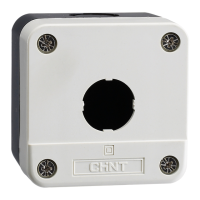
When using pushbutton control boxes, the manual outlines cable hole sizes and installation dimensions for different box models. It also specifies that users may need to perforate cable holes as needed, emphasizing the importance of protecting these holes and screw holes for overall enclosure protection, especially when IP40 protection is required. This ensures that the control box maintains its protective integrity against dust and other environmental factors.
Regular maintenance is crucial for ensuring the long-term reliability and safe operation of the NP2 Series Pushbutton. The manual recommends conducting maintenance once a month. Key maintenance tasks include:
The manual also includes a troubleshooting guide to address common issues that may arise during the product's lifespan. For instance, if the button cannot be operated smoothly, it suggests checking for foreign objects like dust or greasy dirt on the operation head or pushing rod of the contact assembly. The recommended solution involves removing these foreign objects, ensuring a dry and clean environment, and applying proper lubricant to moving surfaces if necessary.
If the indicator light is not bright enough or not on at all, the troubleshooting guide advises checking if the input voltage complies with the rated operating voltage. It also recommends inspecting the circuit for any short circuits or disconnections. These maintenance and troubleshooting guidelines are designed to help users identify and resolve issues efficiently, thereby extending the operational life of the pushbutton and maintaining system integrity.
Overall, the CHINT NP2 Series Pushbutton is designed for robust industrial control, offering a range of types and features to meet diverse application requirements, supported by clear installation instructions and essential maintenance guidelines to ensure reliable and safe operation.
 General
| Rated Voltage | 230/400V AC |
|---|---|
| Rated Current | 6A, 10A, 16A, 20A, 25A, 32A, 40A, 50A, 63A |
| Contact Configuration | 1P, 2P, 3P, 4P |
| Protection Degree | IP20 |
| Product Category | Miniature Circuit Breaker (MCB) |
| Number of Poles | 1, 2, 3, 4 |
| Breaking Capacity | 6kA |
| Mechanical Life | 20000 cycles |
| Electrical Life | 10, 000 operations |
| Mounting Type | DIN Rail |
| Standards | IEC 60898-1 |

 To Next Page