The CHNT TNDZ TNSZ Series Pillar Type AC Automatic Voltage Regulators are designed to stabilize load voltage in various settings, particularly in areas experiencing significant grid voltage fluctuations or seasonal variations. These regulators ensure a stable power supply for connected devices, maintaining the output voltage within a specified deviation range from the rated value.
Function Description
The voltage regulator operates as a closed-loop control system, comprising a column regulator, a compensating transformer, and a controller or control circuit. This electrical device automatically adjusts to stabilize the output voltage. It offers both a mains function and a voltage regulation function. The mains function allows the device to directly output the grid voltage without regulation, while the voltage regulation function actively stabilizes the output voltage.
Usage Features
- Automatic Voltage Stabilization: The primary function is to automatically stabilize the load voltage. When the supply voltage fluctuates, the regulator adjusts to maintain a stable output.
- Mains Function: The device can bypass voltage regulation and directly output the mains voltage when stabilization is not required.
- Manual Voltage Regulation (for TNSZ-150~320 and TNSZ-350~600 products): Users can manually adjust the output voltage using "Step up" or "Step down" buttons. In this mode, the product does not have an automatic voltage regulation function, and the output voltage may deviate from the rated value.
- Overvoltage and Undervoltage Protection: The device includes protection mechanisms against overvoltage and undervoltage conditions, which trigger alarms and disconnect output to prevent damage.
- Delay Protection: After power-on or switching modes, the regulator incorporates a delay before outputting voltage, ensuring stable operation.
- LCD Display (for TNSZ-30~320): Provides real-time information on input voltage, output voltage, and output current for each phase.
- Panel Indicators (for TNSZ-350~600): Features indicators for power supply, voltage stabilization, mains, and fault conditions, offering visual feedback on the device's status.
- Self-Reset Function (for TNSZ-30~320 and TNSZ-350~600): Allows the product to restart automatically after an output cut-off, or when the input breaker is turned off and then on again.
Installation Conditions:
- Altitude: Installation site altitude must not exceed 2,000m.
- Ambient Temperature: Upper limit of ambient air temperature is 40 °C, with an average temperature within 24 hours not exceeding 35 °C. The lower limit is -5 °C.
- Indoor Use: Designed for indoor use only.
- Parallel Use: Prohibited from being used in parallel.
- Mounting Surface: Inclination of the mounting surface to the horizontal plane must not exceed 5°.
- Environment: Installation site should be free from shaking, shock, dampness, condensation, inflammable and explosive gases, and corrosive gases.
- Supply Voltage Waveform: The waveform of the supply voltage should be approximately sinusoidal. For three-phase regulators, input supply voltages should be approximately symmetrical.
Transportation and Storage Conditions:
- Transportation: During transportation, the product should not be placed upside down, on its side, or exposed to rain. It should also be protected from severe vibration and impact.
- Storage: Must be stored indoors in an environment free from rain or snow, with good air circulation, no exposure to sunlight or corrosive gases. Relative humidity (at 25 °C) should not exceed 95%, and the temperature should be between -25 °C and 55 °C.
Maintenance Features
- Regular Cleaning: All parts of the voltage regulator, especially the electric brush, coil surface, sliding guide rail, and transmission parts, should be thoroughly cleaned to remove dust and dirt.
- Lubrication: Mechanical transmission parts, such as the reducer and drive chain, require regular application of N320 gear oil. It is recommended to replace the oil in the reducer every 3 months.
- Electric Brush Replacement: Worn or damaged electric brushes should be replaced promptly to ensure reliable contact. If large sparks occur, power should be cut off, and the voltage regulator cleaned. If there is a gap between the electric brush and the coil, 0# sandpaper can be used to ensure reliable contact.
- Component Repair/Replacement: Broken-down or damaged components should be repaired or replaced in a timely manner.
- Control Motor Wiring: Wiring for the control motor must strictly adhere to regulations, and an incorrect phase sequence is prohibited.
- Pre-Power Connection Inspection: Before connecting power, verify that the input supply voltage is consistent with the nameplate's input voltage range. Ensure no phase loss and reliable grounding of the enclosure.
- Maintenance Cycle: The maintenance cycle varies based on the environment but should not exceed six months. During maintenance, the power switch at the front end of the voltage regulator and at the input end must be turned off to ensure no voltage is present.

 Need help?
 General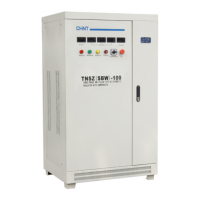

 To Next Page