Cisco Systems, Inc.
All contents are Copyright © 1992–2002 Cisco Systems, Inc. All rights reserved. Important Notices and Privacy Statement.
Page 9 of 12
Protocols
The Cisco 7200 Series Router supports the following standard Internet protocols:
• Layer 2 and Layer 3 protocols—Address Resolution Protocol (ARP), IPCP, IP forwarding, IP host, IP Multicast,
PPP-over-ATM, TCP, Telnet, Trivial File Transfer Protocol (TFTP), User Datagram Protocol (UDP), transparent
bridging, virtual LAN (VLAN), MPLS, and IPv6
• Layer 3 routing protocols—EIGRP, IGRP, IS-IS, OSPF, BGP, PIM, and RIP
• Network management and security—AAA, CHAP, FTP, RADIUS, SNMP, PAP, and TACACS
• RFC 1483: Multiprotocol Encapsulation over ATM AAL 5
• RFC 1577: Classical IP and ARP over ATM AAL 5
• ARP—Determines the destination MAC address of a host using its known IP address
• BOOTP—Usesconnectionlesstransport layer (UDP); allows the switch(BOOTPclient) to get its IP addressfrom
a BOOTP server
• Internet Control Message Protocol (ICMP)—Allows hosts to send error or control messages to other hosts; is a
required part of IP; for example, the ping command uses ICMP echo requests to test if a destination is alive and
reachable
• IP or IP over ATM—Suite used to send IP datagram packets between nodes on the Internet
• TCP—A reliable, full-duplex, connection-oriented end-to-end transport protocol running on top of IP; for
example, the Telnet protocol uses the TCP/IP protocol suite
• Packet Internet groper (ping)—Tests the accessibility of a remote site by sending it an ICMP echo request and
waiting for a reply
• TFTP—Downloads network software updatesand configurationfiles (Flashcode) to workgroup switch products
• Reverse Address Resolution Protocol (RARP)—Determines an IP address knowing only a MAC address; for
example, BOOTP and RARP broadcast requests are used to get IP addresses from a BOOTP or RARPD server
• SerialLine Internet Protocol(SLIP)—A version ofIP that runsoverserial links,allowingIP communications over
the administrative interface
• PPP—Provides host-to-network and switch-to-switch connections over synchronous and asynchronous circuits
• SimpleNetwork ManagementProtocol(SNMP)—Agents thatprocess requests fornetwork managementstations
and report exception conditions when they occur; requires access to information stored in a MIB
DC-input cable 14 AWG recommended minimum, with at least
3 conductors rated for at least 140 F (60 C)
Same as Cisco 7204VXR
Frequency 50/60 Hz Same as Cisco 7204VXR
Airflow ~80 cfm Same as Cisco 7204VXR
Power dissipation ~370W max. configuration Same as Cisco 7204VXR
Heat dissipation 370W (1262 BTUs) Same as Cisco 7204VXR
Table 7
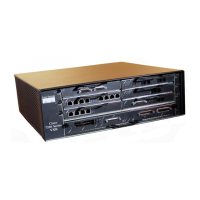
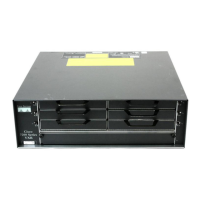
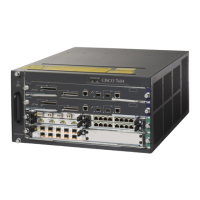
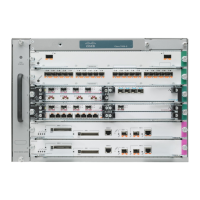
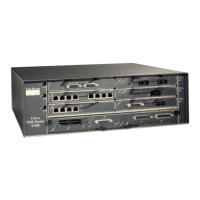
Cisco 7204VXR Cisco 7206VXR




 To Next Page