EasyManua.ls Logo

Cisco Webex Wireless Phone 840 - User Manual

Cisco Webex Wireless Phone 840
12 pages
Print Icon
To Next Page IconTo Next Page
Loading...
Phone Setup
Phone Battery Installation, on page 1
Battery Contact Damage Prevention, on page 5
Phone Battery Charging, on page 6
Phone Configuration, on page 8
Phone Battery Installation
You must read the information in the Product Safety and Security chapter of the User Guide, before you install
or charge the battery, or use the phone.
Before you can use your phone, you must install and charge the battery. The battery may already be installed
in your phone, or you may have to install it yourself.
To maximize the battery storage capacity and lifespan, fully charge the battery before you turn on and set up
the phone.
Related Topics
Product Safety and Security
Install the Battery
Don't install the battery in a dusty or wet environment.
The steps to install the battery are the same for both the Webex Wireless Phone 840 and Webex Wireless
Phone 860. However, the battery contacts are in different locations on these models, as shown in the following
illustration. The illustrations in the steps are of the Webex Wireless Phone 860.
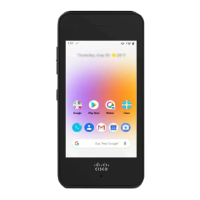
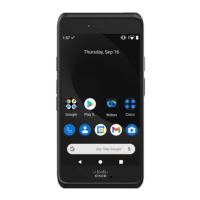
Figure 1: Battery Contact Location on the Webex Wireless Phone 840 and Webex Wireless Phone 860
Phone Setup
1
Question and Answer IconNeed help?

Do you have a question about the Cisco Webex Wireless Phone 840 and is the answer not in the manual?

Overview

This document describes the setup, configuration, and maintenance of the Webex Wireless Phone 840 and 860 series. It covers initial battery installation, battery removal, hot swapping, battery contact damage prevention, battery charging, and phone configuration for Wi-Fi networks and TFTP servers.

Function Description

The Webex Wireless Phone 840 and 860 are wireless communication devices designed to connect to an organization's Wi-Fi network and call control system. They support voice calls and other phone activities, offering mobility within a Wi-Fi enabled environment. The phones are designed for ease of use, with features like a hot swap battery for continuous operation during battery changes.

Important Technical Specifications

  • Battery Type: Rechargeable battery.
  • Charging Options:
    • USB cable with AC power adapter (approximately 3 hours for full charge).
    • USB cable with computer (approximately 8 hours for full charge).
    • Desktop chargers (for phone and spare battery, approximately 3 hours for full charge).
    • Multichargers (for multiple phones or batteries, approximately 3 hours for full charge).
  • Charging Temperature Range: 50–86°F (10–30°C) for optimal results. Charging outside this range may result in longer charge times or incomplete charge cycles.
  • Storage Temperature: Approximately 65°F (20°C) in dry conditions.
  • Wi-Fi Network Compatibility: Supports broadcasted, nonbroadcast, and hidden Wi-Fi networks.
  • Security Modes: Supports None, Pre-shared key (PSK), Protected Extensible Authentication Protocol (PEAP), Extensible Authentication Protocol (EAP) Transport Layer Security (EAP-TLS), and EAP Tunneled Transport Layer Security (EAP-TTLS).
  • TFTP Server Configuration: Allows manual configuration of TFTP server addresses if DHCP option 150 or 66 is not provided by the network.
  • Internal Battery (Webex Wireless Phone 860 and 860S only): Provides minimum power during a hot swap to keep the phone on. The Webex Wireless Phone 840 and 840S do not have an internal battery and thus do not support the hot swap feature.

Usage Features

  • Battery Installation:
    1. Align the two plastic battery tabs with the battery compartment slots.
    2. Use the tab and slot contact point as a pivot to lower the battery into the compartment.
    3. Press down until the battery clip snaps into place.
  • Battery Removal: Follows a reversed procedure of installation.
    1. To disengage the battery clip, gently use a fingernail to depress the clip towards the top of the phone. Avoid using tools or prying, as this can break the clip.
    2. Lift the battery gently about an eighth of an inch (a few millimeters) out of the compartment using a fingernail.
    3. Release the battery clip and grab the battery with fingers.
    4. Use the battery tabs and compartment slots as a pivot point to raise the battery edge out. Avoid sliding the battery across the compartment to prevent contact damage.
    5. Gently withdraw the battery tabs from the slots and lift the battery out. Ensure no part of the battery drags across the contacts.
  • Hot Swap Feature (Webex Wireless Phone 860 and 860S only): Allows battery replacement without powering off the phone.
    • The internal phone battery provides minimum power during the swap.
    • Can be performed during voice calls or active phone screens.
    • If the new battery lacks proper charge or the internal battery isn't awake/charged, the hot swap may fail, leading to a low battery alert and phone shutdown.
    • Hot Swap Procedure:
      1. Remove the existing battery.
      2. Install the new battery within 60 seconds.
  • Phone Configuration:
    • Administrator Setup: The administrator can set up the phone, potentially locking access to configuration menus.
    • User Setup: Users can configure the phone for Wi-Fi and connect to the call control system using provided information.
    • Wi-Fi Profile Configuration:
      1. Swipe up to show installed applications.
      2. Tap Settings > Network & internet > Wi-Fi.
      3. Tap the desired Wi-Fi network name.
      4. For PSK, enter the passphrase.
      5. For PEAP, EAP-TLS, or EAP-TTLS, select the EAP method and configure certificates, authentication methods, identity, and password as required.
      6. Tap Connect.
    • Nonbroadcast/Hidden Wi-Fi Network Configuration: Similar steps to broadcast networks, but requires specific settings for hidden networks.
    • TFTP Server Configuration:
      1. Access the Cisco Phone app.
      2. For release 1.2, tap Overflow : menu; for release 1.3 or newer, tap Drawer menu.
      3. For release 1.2, select Settings > Phone information > Security; for release 1.3 or newer, select User settings > Phone information > Security.
      4. Enter the Local Phone Unlock Password (default is **#).
      5. Swipe the Alternate TFTP slider to the right to enable.
      6. Enter TFTP server addresses and tap OK.
      7. Tap the back arrow twice to save changes and exit.
  • User Settings: Configure ringtones, automatic noise cancellation, and pair Bluetooth devices.

Maintenance Features

  • Battery Contact Damage Prevention: Avoid sliding or dragging the battery over contacts during insertion or removal, as this can damage them. Damaged contacts can lead to power issues (phone not powering on, random shutdowns).
    • Regularly check contacts for dirt or substances that might prevent proper electrical connection.
    • Ensure contact fingers are straight and at the same height relative to the contact base.
  • Battery Storage: Store batteries in dry conditions at approximately 65°F (20°C).
  • Battery Recharge for Storage: If storing the phone or battery for longer than one month, recharge them every six months. Never store a phone without the main battery for longer than one month.
  • Low Battery Warning: The phone displays an "Invalid Battery Shutdown" message before shutting down if the battery is depleted.
  • Charging Best Practices:
    • Charge batteries within the recommended temperature range (50–86°F / 10–30°C).
    • If both a phone and spare battery are in a desktop charger, the phone takes priority for charging.
    • Do not let the main battery or internal battery (for 860/860S) fully deplete for extended periods.

Cisco Webex Wireless Phone 840 Specifications

General IconGeneral
BrandCisco
ModelWebex Wireless Phone 840
CategoryCordless Telephone
LanguageEnglish

Related product manuals