How to Perform Planned Maintenance 7-15
Section 7. Planned Maintenance and Lubrication
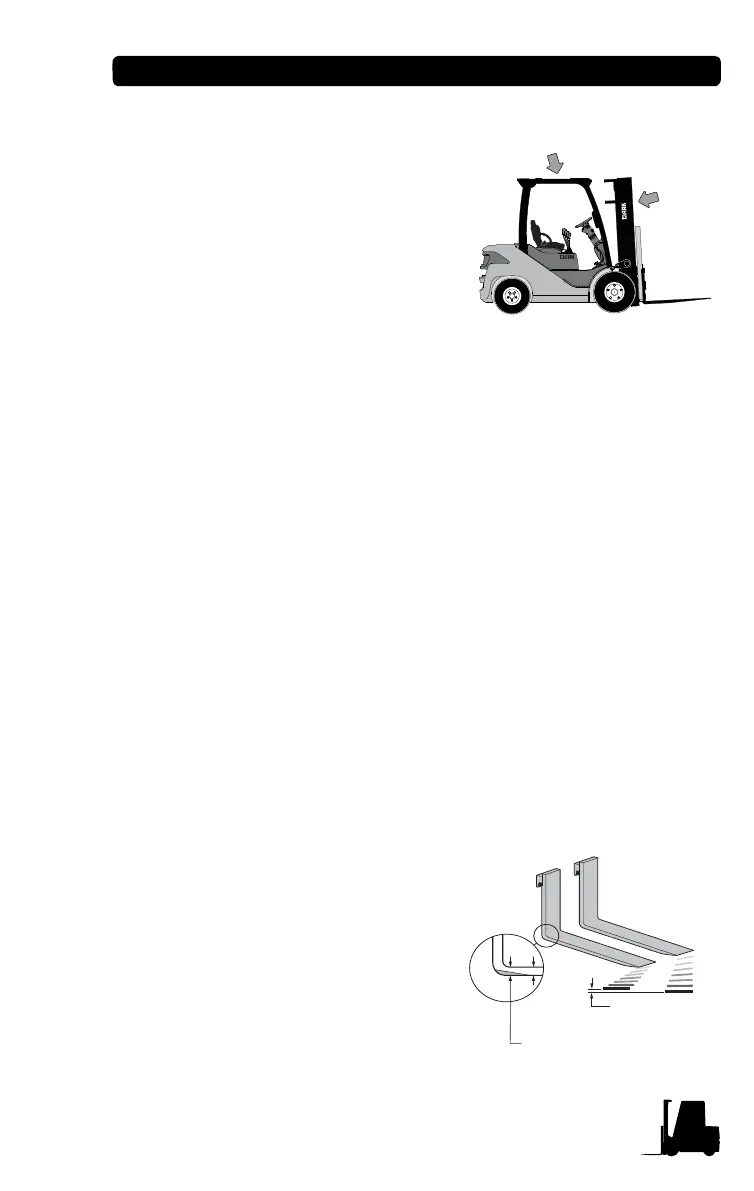
Overhead Guard
Be sure that the driver's overhead
guard and any safety devices are in
place, undamaged, and attached
securely.
Check the overhead guard for
damage. Be sure that it is properly
positioned and all mounting fasteners
are in place and tight.
The overhead guard must not be modified from CLARK specification.
Load Handling Components
Inspect the upright assembly, load backrest (LBR), rails, carriage,
rollers, lift chains, and lift and tilt cylinders. Look for obvious wear
and maintenance problems and damaged or missing parts. Check
for any loose parts or fittings. Check for leaks, damaged or loose
rollers, and rail wear (metal flaking). Carefully check the lift chains for
wear, rust, corrosion, cracked or broken links, stretching, etc. Check
that the lift and carriage chains are correctly adjusted to have equal
tension. Check that the lift chain anchor fasteners and locking means
are in place and tight. Inspect all lift line hydraulic connections for
leaks.
Uprights and lift chains require special attention and
maintenance to remain in safe operating condition. Refer
to “Lift Chain Maintenance” in this Section for additional
information.
Forks
Inspect the load forks for cracks,
breaks, bending, and wear. The fork
top surfaces should be level and
even with each other. The height
difference between both fork tips
should be no more than 1.5% of the
blade length.
A
10% of "A" is max.
wear allowed
1.5% is max.
height difference


 To Next Page