Section 1. General Safety Rules
Tip-Over 1-13
Tip-Over
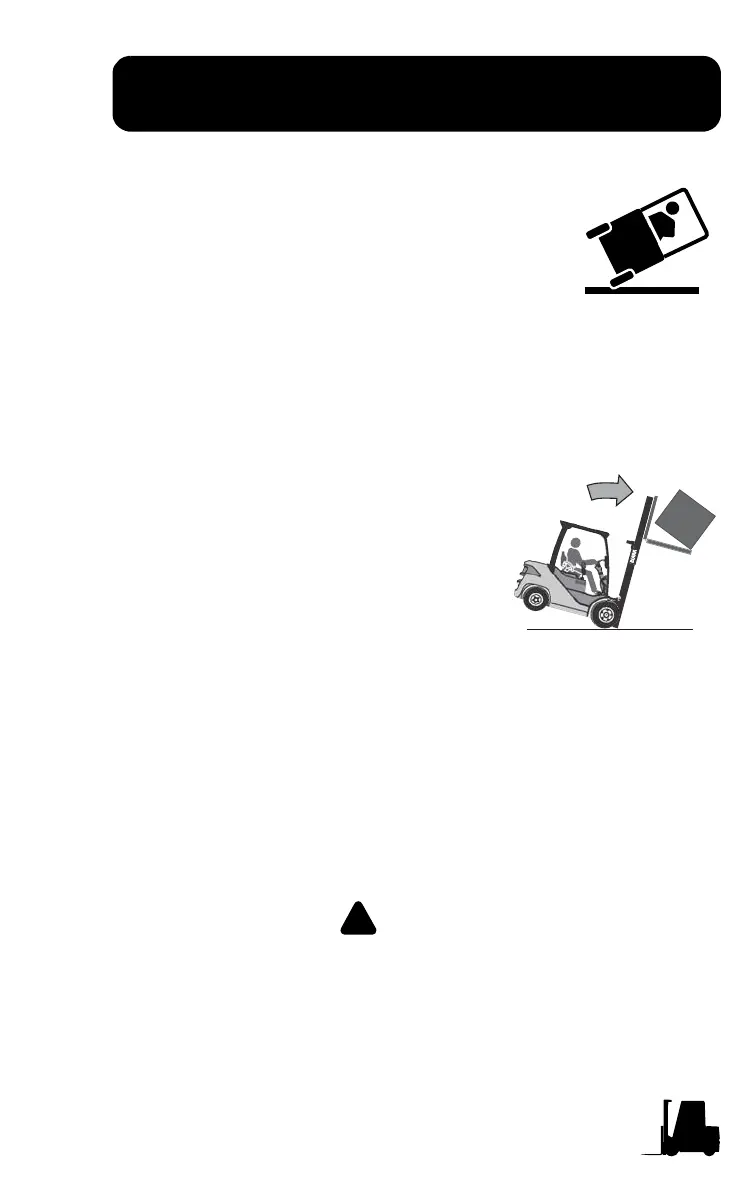
Lateral Tip-over
• Lateral tip-over can occur with a combina-
tion of speed and sharpness of turn. This
combination will exceed the stability of the
truck. This condition is even more likely with
an unloaded truck.
• With the load or upright raised, lateral tip-
over can occur while turning and/or braking
when traveling in reverse or accelerating
and turning while traveling forward.
• Lateral tip-over can occur loaded or
unloaded by turning on an incline or ramp.
Longitudinal Tip-over
• Longitudinal tip-over can occur with
a combination of overloading and
load elevated also with capacity load
and elevated. This combination will
exceed the stability of the truck. This
condition is even more likely with
excessive forward tilt, braking in for-
ward travel or accelerating rearward.
• Longitudinal tip-over can occur by
driving with the load down slope on a steep grade.
• Never travel with a load elevated more than necessary.
Lateral and longitudinal tip-over can occur if the truck is driven over
objects on the floor or ground, off the edge of improved surfaces, or
into potholes in the road surface, or by running into overhead objects
or collisions.
An off dock type of tip-over can occur if the truck is steered too close
to the dock edge, driven off the edge of the dock or ramp, or if the
highway truck or trailer rolls away from the dock or is driven away
during loading.
WARNING
The conditions listed above can be further aggravated by
overloading, excessive tilt, or off center loads.
Lift truck tip-over can cause serious injury or death if the
operator is trapped between the truck and the ground.


 To Next Page