
 Need help?
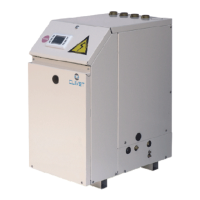
Do you have a question about the CLIVET WSHN-EE 51 and is the answer not in the manual?
Details about the unit's serial number label and its importance for identification.
Key safety precautions, potential hazards, and risk management.
Defines danger zones and safe handling procedures.
Hazards associated with installation and critical electrical system safety.
Specific safety measures for refrigerant and water circuits.
Details on filters, flow switches, and antifreeze measures.
Principles for designing and performing electrical installations.
Technical data including voltage, current, and power input.
Essential checks before initiating the start-up sequence.
Verification of systems and crankcase heater operation before start-up.
Verifying compressor operation, water flow rates, and pressures.
Details on set point adjustments, compensations, and corrections.
Classification of alarms and procedures for resetting them.
Guidance on identifying, understanding, and handling alarms.
Detailed list of alarm codes and their specific causes.
Recommended schedule and checklist for professional maintenance inspections.
Causes and solutions for high and low-pressure alarms during cooling.
Troubleshooting steps for compressor, faulty probes, and pump issues.
Causes and solutions for high and low-pressure alarms during heating.
Capacities, power inputs, EER, and COP for cooling and heating.
Defines the temperature and head limits for cooling and heating operations.
 General
| Category | Heat Pump |
|---|---|
| Model | WSHN-EE 51 |
| Power Supply | 400V / 3Ph / 50Hz |
| EER | 3.1 |
| Refrigerant | R410A |


 To Next Page