TOTAL NETWORK SOLUTIONS
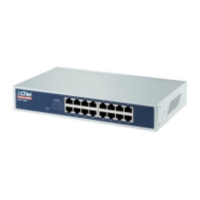
CNSH-1600 - Sixteen (16) port 10/100Mbps Fast Ethernet Switch
CNSH-1601 - Sixteen (16) port + One (1) Fiber port
www.cnetusa.com
CNSH-1600 / CNSH-1601 July 2002 PS-0289-B5
Specifications are subject to change without notice Trademarks & Trade Names belong to their owners
The CNSH-1600 and CNSH-1601 are multi-purpose Switches capable of bridging 10 and 100Mbps segments and greatly expanding available
bandwidth. Expanding bandwidth is achieved by each of the Sixteen (16) ports creating an independent 100Mbps or 10Mbps network segment. In
addition, each port is equipped with a built-in Auto-Negotiation function capable of automatically setting itself to operate at the fastest possible speed –
ranging from 10Mbps to 200Mbps! The CNSH-1601 also comes with One (1) 100BASE-FX Fiber port with an SC type connector. Fiber port is most
frequently used for backbone connectivity capable of transmitting data up to 2km.
KEY FEATURES
•= Independent bandwidth for each port.
•= 10/100Mbps TP ports with Auto-Negotiation supported.
•= Bridging capability for 100Mbps and 10Mbps
segments.
•= Provides Store-and-Forward forwarding scheme.
•= Auto MDI/MDIX function supported.
•= IEEE 802.3x Flow-Control supported for Full-Duplex
operation.
•= Back-Pressure Flow-Control supported for Half-
Duplex operation.
•= 4M bits Buffer Memory.
•= 8K MAC Address Table.
•= Supports QoS function on each port, based on
802.1p/802.1q VLAN Tag priority and TCP/IP
Header’s TOS/DS.
•= Four (4) Trunk groups supported.
•= Aging function supported, the aging time is about 300
sec.
•= Broadcast Storm control supported.
•= Supports Port-Based Home VLAN Allow home
networks to share a common server or router.
•= Desktop size with rack mounting capability.
PRODUCT SPECIFICATIONS
Models 16-Port Switch 16-Port Switch with 1 Fiber port
Standards IEEE 802.3: 10BASE-T
IEEE 802.3u: 100BASE-TX
IEEE 802.3: 10BASE-T
IEEE 802.3u: 100BASE-TX/100BASE-FX
Ports Sixteen (16) port 100BASE-TX/10BASE-T Fifteen (15) port 100BASE-TX/10BASE-T
One (1) port 100BASE -FX
Media Support 100BASE-TX: Category 5 TP
10BASE-T: Category 3, 4 or 5 TP
100BASE-TX: Category 5 TP
10BASE-T: Category 3, 4 or 5 TP
100BASE-FX: 62.5/125µm Multi-Mode Fiber cable
Bandwidth 100BASE-TX: 200/100Mbps via Auto-Negotiation
10BASE-T: 20/10Mbps via Auto-Negotiation
100BASE-TX: 200/100Mbps via Auto-Negotiation
10BASE-T: 20/10Mbps via Auto-Negotiation
100BASE-FX: 200/100Mbps via DIP-switch
Forwarding/Filtering Rate 148810 packets/second per port @ 100Mbps, maximum
14881 packets/second per port @ 10Mbps, maximum
Latency 8.5 µsec @100Mbps, minimum
67 µsec @ 10Mbps, minimum
MAC Addresses 8K Six (6)-byte entries maximum, Self-Learning
Buffer Memory 4M bits
Duplex Modes Auto-Negotiation Full-Duplex and Half-Duplex via DIP- switch on Fiber port
Auto-Negotiation for TP ports
Auto-MDIX All TP ports support Auto-MDI/MDIX function
Switches Two (2) for Home VLAN setting
Four (4) for TRUNK setting
Two (2) for Home VLAN setting
Four (4) for TRUNK setting
One (1) for 100 Half/Full-Duplex (100BASE-FX)
LED Indicators One (1) for Power
One (1) per port for Link/ACT
One (1) per port for Full-Duplex or Collision
Two (2) for Home VLAN status
Four (4) for TRUNK Group status
Power Supply Internal full range switching power supply
Input voltage: 100 ~ 240 +/-10%V AC, 50/60 Hz
Power Consumption 9.9W maximum
Environment Operating Temperature: 0° ~ 45°C (32° ~ 113°F)
Storage Temperature: -20° ~ 70°C (-4° ~ 158°F)
Humidity: 10% ~ 90% Non-Condensing
Certifications FCC Class A, CE Mark and TUV approved
Dimensions 250 x 150 x 43 mm (9.8 x 5.9 x 1.7 inches) 250 x 150 x 43 mm (9.8 x 5.9 x 1.7 inches)

 Need help?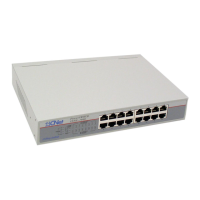

 To Next Page
 General