20 • Important: Always read and follow operating instructions.
Infl ation
NEVER exceed tire manufacturer's recom-
mended air pressure. Tires can explode,
especially if inflated beyond these limits.
Use clip-on air chuck, keep hands, arms
and entire body back from inflating tire.
Avoid distraction during inflation. Check
tire pressure frequently to avoid over infla-
tion. Excessive pressure can cause tires to
explode, causing serious injury or death to
operator or bystander.
If you change tires defined as truck tires,
they must be inflated per OSHA instructions.
1. Ensure both beads are seated. When both beads
are seated, the tire is ready for inflation.
2. Replace the valve core if it was removed.
3. Depress the inflation pedal to position 2 to inflate
the tire. The pressure limiter will cycle the air flow as
described earlier. On most tires, the pressure limiter
will cease air flow at approximately 60 PSI. On smaller
volume tires the pressure may be higher.
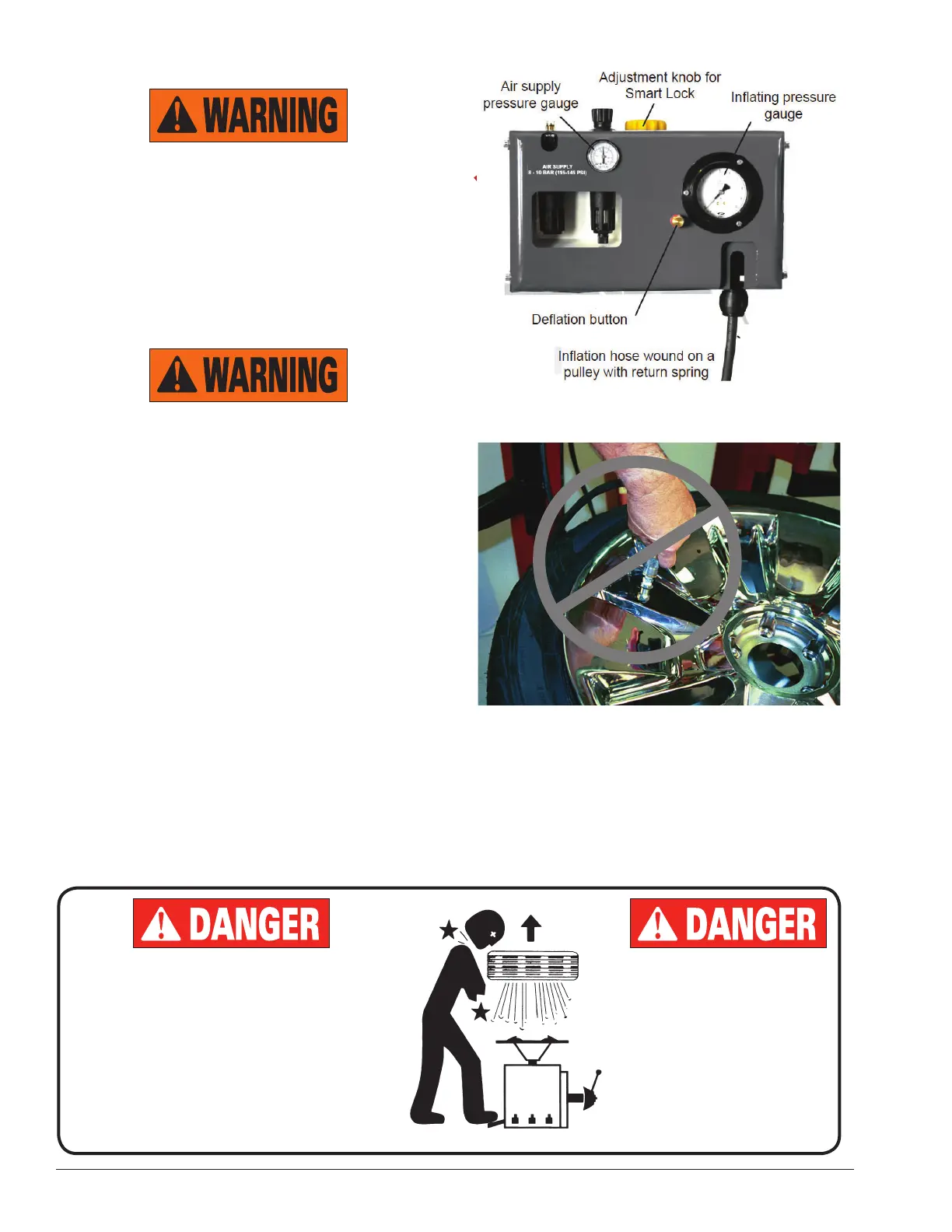
4. Release air pressure from tire by pressing the
manual deflation button (fig. 27). Inflation hose must
be attached to the valve stem. Never add or adjust tire
pressure using an air hose without a clip-on air chuck
and in-line valve. Do not use a hand-held style chuck
(figure 28).
5. Important: When inflating tires that require more
than 60 PSI, always use a safety cage and air hose with
a clip-on air chuck and in-line valve. The air hose must
have enough length between the chuck and the opera-
tion/in-line valve to allow the operator to stand outside
the trajectory.
Figure 27 - Location of Deflation Button
Figure 28 - Do Not Use a Hand-held Style Air Chuck
Manual Release Valve
Explosion Hazard
Never exceed 40 PSI while
seating beads. If you use
more than 40 PSI always
use safety cage.
Remember R.I.M.
(see page iv and back cover)
Explosion Hazard
Never infl ate tire
above
manufacturer’s
recommended
pressure after
bead is seated.



 To Next Page