Need help?
Do you have a question about the CODELOCKS CL100 and is the answer not in the manual?
On latch locks, if the outside knob/inside handle turn TOWARDS the door frame, the spindle is at the wrong angle.
The knob fails to turn after entering the correct code; the code does not match the card.
Knob fails to turn after a new code entry; tumblers may be incorrectly positioned.
Inside and outside knobs do not return to centre; spindle may be too long for door thickness.
The inside handle fails to retract the latch, possibly due to a short spindle.
The spindle must project at least 8mm (5/16") to engage the handle; it may be cut too short.
Latchbolt does not move smoothly; lock may be installed incorrectly or out of square.
Latch does not engage; it may not be entering the strike aperture, or the door/frame has shifted.
Remove the CL100 or CL200 lock from the door by unscrewing the 2 screws in the back plate.
Press 'C' button to reset, place lock case down on a flat surface.
Remove 2 red screws, lift code chamber plate, check springs and tumbler positions.
Hold lock, depress 'C' button, use tweezers to reposition tumblers with square notches facing outwards.
Carefully replace the code chamber plate with the 2 red screws.
Check new code operation, make a note, and insert spindle with spring on the code side.
No lubrication needed. Clean finish with soft cloth; use silicone spray for protection.
Codelocks mechanical locks are covered against manufacturing faults, repairable free of charge.
This document provides a comprehensive guide for the Codelocks CL100 and CL200 mechanical locks, covering their functions, technical specifications, usage, and maintenance.
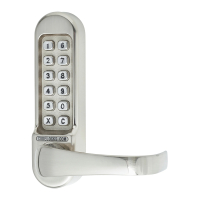
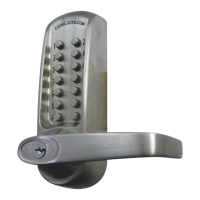
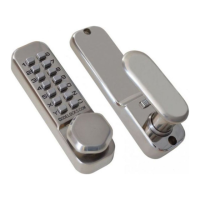
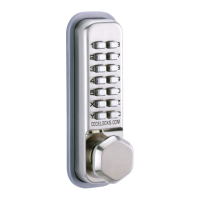
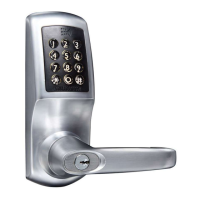
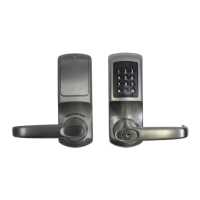
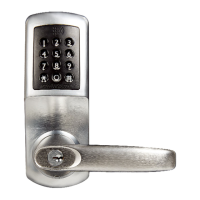
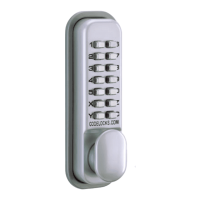
The Codelocks CL100 and CL200 are mechanical push-button locks designed for restricted access. They are suitable for various applications, including doors at home, garages, garden sheds, offices, workshops, and storerooms. These locks operate without the need for electricity, relying purely on a mechanical code entry system. The core function involves entering a specific code using a set of buttons to retract the latch or deadbolt, allowing access. The locks are available in Silver Grey, Polished Brass, and Stainless Steel finishes.
The code chamber for both CL100 and CL200 models consists of 13 numbered buttons and a 'C' button. The 'C' button serves two critical functions: it resets the chamber after an incorrect entry and must always be the first digit of any code. Buttons can only be used once within a single code (e.g., "1212" is not possible). Codes can be entered in any order or sequence (e.g., "1234" can be "4321" or "1342"). With 13 buttons, the system offers a total of 8,191 possible codes.
The number of digits in a code can vary:
The factory default code is a randomly selected 6-digit code starting with the 'C' button, and this code is not recorded by the factory. While codes can range from 1 to 13 digits, generally, codes are set between 4 and 7 digits, offering 5,434 combinations within this range. Shorter codes are not recommended for security reasons. The lock mechanism includes tumblers (coloured for code, silver for non-code) with square notches that must face outwards with the square tips on top during code changes. The spindle length is crucial for proper operation; it must not project more than 30mm (13/16") into the inside handle and must project at least 8mm (5/16") from the inside face of the door to engage the handle.
The primary usage feature is the ability to change the access code. This process involves several steps:
The manual also provides a diagnostics guide for common issues:
Codelocks CL100 and CL200 require minimal maintenance.

 To Next Page
 General