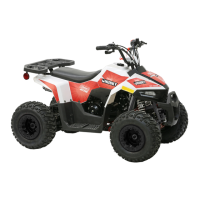
The Coleman Powersports AT110 is an All-Terrain Vehicle (ATV) designed for off-road recreational use by operators 10 years of age and older, requiring adult supervision. It is not a toy and is intended for family fun and reliable use.
Function Description
The AT110 is a single-cylinder, four-stroke, air-cooled ATV with an automatic centrifugal clutch. It is equipped with a 107CC engine and an electric start mode. The vehicle is designed for off-road use only and is not legal or safe to operate on public streets, roads, or highways.
Key operational features include:
- Engine Start/Stop Switch: Used to start or stop the engine. The engine will not start if this switch is in the stop position.
- Start Button: Pushed to crank the engine with the starter.
- Throttle Lever: Increases engine speed when pushed. It is spring-loaded to return to the start position when released.
- Choke Lever: Used for starting a cold engine by providing a richer air-fuel mixture. It should be moved to the left for cold starts and returned to the right (running position) once the engine warms up.
- Speed Limiter: Equipped with an adjustable screw to limit vehicle speed. Beginning riders should start with the red speed limiter screw for operation below 10 mph. The adjustable (black) speed limiter screw allows for gradual speed increases as the operator gains proficiency.
- Brakes: Features front drum brakes and rear disc brakes, operated by levers on the handlebars. A parking brake function is also available, applied by pushing a lock button on the rear brake lever.
- Fuel On/Off Valve: Controls the fuel supply to the engine.
- Wireless Engine Shut-off Switch: A remote key fob allows supervising adults to turn off the engine if the operator is riding recklessly or beyond their skill level. This is not intended as a full-time engine stop switch for the operator.
Important Technical Specifications
- Engine: Single-Cylinder Four-Stroke, Air-Cooled, Automatic Centrifugal Clutch
- Displacement: 107CC
- Bore X Stroke: 52.4 mm x 49.5 mm
- Idle Speed: 1500±150 RPM (Maximum safe operating idle speed: 1,850 rpm)
- Start Mode: Electric start
- Ignition Method: CDI
- Spark Plug Gap: 0.06~0.085mm
- Transfer Method: Chain Drive
- Compression Ratio: 9.5:1
- Valve Clearance: I-0.03~ E-0.05mm
- Spark Plug: NGK / CR6HSA
- Fuel Tank Capacity: 0.58 Gal (2.2L)
- Engine Oil: SE 15W40
- Tires: Front 16x8-7, Rear 16x8-7 (Recommended tire pressure: 10 PSI, max)
- Brakes: Front Drums, Rear Disc Brake
- Maximum Vehicle Load: 150 Lbs (68 kg) (includes weight of operator, cargo, and accessories)
- Maximum Cargo Rack Carrying Capacity: 11 LBS (5KG)
- Overall Length: 52.8 in. (1340mm)
- Overall Width: 31.1 in (790mm)
- Overall Height: 35.4 in (900mm)
- Seat Height: 23.6 in. (600mm)
- Weight: 231.5 lbs (105kg)
- Climbing Angle: ≥12°
- Acceleration Noise Level: ≤80dB
Usage Features
The AT110 emphasizes safety and proper riding techniques. Operators are advised to wear approved motorcycle helmets, eye protection, over-the-ankle boots, gloves, long-sleeved shirts or jackets, and long pants. The manual strongly warns against carrying passengers, as it significantly reduces the ability to balance and control the ATV.
Riding instructions cover:
- Terrain: Designed for off-road use only. Paved surfaces can seriously affect handling. Operators should avoid rough, slippery, or loose terrain until skills are developed.
- Speed: Operators should ride at speeds appropriate for their skills, conditions, and terrain. The speed limiter helps manage this for beginners.
- Steering: A special turning technique is required due to the rear wheels turning together. Operators should shift weight to the outside of the turn and lean their upper body into the turn.
- Uphill/Downhill Riding: Emphasizes weight transfer (forward and leaning over handlebars for uphill, rearward for downhill) and careful throttle control. Abrupt braking is discouraged on hills.
- Water Crossings: Can cross shallow, slow-moving water up to 11 cm (4 in) deep. Brakes should be tested after leaving water.
- Obstacles: Operators should check for obstacles in new areas and avoid large ones.
- Skidding/Sliding: Learning to control skidding at low speeds on smooth terrain is recommended.
The manual also highlights the dangers of carbon monoxide poisoning from engine exhaust and warns against operating the ATV under the influence of alcohol or drugs.
Maintenance Features
The manual provides a comprehensive periodic maintenance schedule to ensure the ATV remains in safe and reliable condition. Maintenance intervals are based on average riding conditions (approximately 10 miles per hour) and should be performed more frequently under severe conditions (wet or dusty areas).
Key maintenance items include:
- Fuel: Check level, use recommended fuel (91 octane min.), and use fuel stabilizer if using ethanol fuel. Check fuel line for leaks.
- Engine Oil: Check level and add as necessary. Change engine oil every 20 hours.
- Transmission Oil: Check level and add as necessary.
- Brakes: Check operation, free play, and fluid levels. Lubricate cables and replace pads as needed.
- Throttle Lever: Ensure smooth operation, lubricate cable and housing.
- Control Cables: Ensure smooth operation and lubricate.
- Drive Chain: Check slack, condition, and lubricate.
- Wheels & Tires: Check condition, tread depth, air pressure (10 PSI recommended), and runout. Replace tires when groove depth decreases to 3mm.
- Chassis Fasteners: Ensure all nuts, bolts, and screws are properly tightened.
- Instruments & Switches: Check operation.
- Fuel Filter: Check and replace if necessary.
- Valves: Check clearance and adjust if necessary.
- Crankcase Breather System: Check hose for cracks or damage.
- Exhaust System: Check for leakage, replace gaskets, and tighten clamps.
- Spark Arrester: Clean.
- Wheel Hub Bearings: Check for looseness or damage and replace if necessary.
- Shock Absorber Assemblies: Check operation, oil leakage, and replace if necessary.
- Stabilizer Bushings: Check for cracks or other damage and replace if necessary.
- Rear Knuckle Pivots: Lubricate with lithium-soap-based grease.
- Steering Shaft: Lubricate with lithium-soap-based grease.
- Steering System: Check operation, repair or replace if damaged, and adjust toe-in.
- Engine Mount: Check for cracks or other damage and replace if necessary.
- Lights and Switches: Check operation and adjust headlight beams.
The manual recommends that adjustments marked with a checkmark (√) on the maintenance chart be performed by an authorized Coleman Powersports service center due to the need for special tools, data, and technical skills. It also advises using genuine Coleman Powersports parts for replacements.
A Limited Warranty covers manufacturing defects for 90 days from the purchase date, and an Emission Control System Warranty covers emission components for 5,000 km or 30 months, whichever comes first, provided there is no abuse, neglect, or improper maintenance. The emission warranty is void if the vehicle is used in competitive events.

 Need help?
 General



 To Next Page