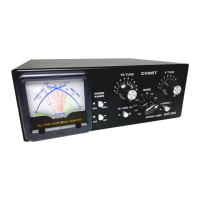
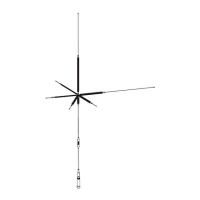
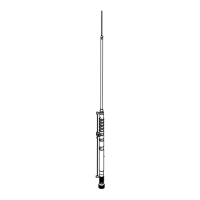
The H-422 is a 40/20/15/10M Quad-Band Trapped Dipole Antenna, designed for amateur radio enthusiasts. It offers a compact design suitable for restrictive mounting locations while providing wide bandwidth.
Function Description
The H-422 functions as a multi-band trapped dipole antenna, capable of operating on four amateur radio bands: 40 meters (7 MHz), 20 meters (14 MHz), 15 meters (21 MHz), and 10 meters (28 MHz). Its primary purpose is to efficiently transmit and receive radio signals across these bands. The antenna can be assembled in two main configurations: a "straight" dipole or a "V" shape. The "V" configuration is particularly noted for providing good performance even at a minimum height of 10 feet. The antenna includes a CBL-2000 high-power 2kW/SSB balun, which helps prevent Television Interference (TVI) and other forms of interference, ensuring cleaner signal transmission and reception. Specially designed high-power traps are integrated to assure consistent performance during high-power QSOs (amateur radio contacts). The manual illustrates three radiator lengths—Low, Mid, and High—to facilitate easy tuning.
Important Technical Specifications
- Frequencies: 7 MHz (40M), 14 MHz (20M), 21 MHz (15M), 28 MHz (10M).
- Impedance: 50 Ohm.
- VSWR (Voltage Standing Wave Ratio): Less than 1.5:1 at the center frequency for each band.
- Max Power Input: 1 kW SSB (Single Sideband) / 500 W FM (Frequency Modulation).
- Max Wind Survival: 67 MPH.
- Wind Load: 3.01 sq ft.
- Length:
- Straight Assembly: 33'10" (approximately 10.31 meters).
- V Assembly: 24'5" (approximately 7.44 meters).
- Weight: 11' 14" (This weight specification seems to be a typo and likely refers to 11 lbs 14 oz or a similar unit, not a length).
- Rotation Radius:
- Straight Assembly: 17'5" (approximately 5.31 meters).
- V Assembly: 12'6" (approximately 3.81 meters).
- Required Mount Mast: 1.5" – 2.5" diameter.
- Balun: CBL-2000 high power 2kW/SSB balun included.
- Radiator Lengths: Three illustrated lengths (Low, Mid, High) for tuning.
- Adjust Element for 7MHz:
- Straight Type: Ø10x1500 (Adjust Element B) and Ø10x1750 (Adjust Element A).
- V-Type: Ø10x1500 (Adjust Element B) and Ø10x1750 (Adjust Element A).
- Element 1: Ø30x1900.
- Trap for 14MHz: Included.
The manual provides detailed SWR (Standing Wave Ratio) characterization charts for both Straight and V-type configurations, measured at different heights (20m and 5m high from ground) and for various operating modes (CW, SSB, FM). These charts show the VSWR across the 7MHz, 14MHz, 21MHz, and 28MHz bands for different standard lengths and adjustment element settings. For instance, in the Straight-Type configuration, standard lengths of 1560mm, 1580mm, and 1600mm are shown, each with corresponding SWR curves. Similarly, for the V-Type, standard lengths of 1640mm, 1660mm, and 1680mm are presented. The charts consistently show VSWR values below 1.5 across the specified frequency ranges for each band, indicating efficient impedance matching.
Radiation patterns for the 40M band are provided for both horizontal (straight) and "V" configurations, at heights of 10 feet (3m) and 33 feet (10m) above ground. These patterns illustrate the antenna's directional characteristics and gain, showing typical dipole patterns with nulls off the ends and lobes broadside to the antenna.
Usage Features
- Compact Design: The antenna is designed to be compact, making it suitable for installations where space is limited.
- Flexible Configuration: It can be assembled as a "straight" dipole or in a "V" shape. The "V" configuration is highlighted for its good performance even at low heights (minimum 10 feet).
- Multi-Band Operation: Covers 40M, 20M, 15M, and 10M bands, offering versatility for amateur radio operators.
- Integrated Balun: The included CBL-2000 balun simplifies setup and helps mitigate interference issues.
- High Power Handling: Capable of handling 1kW SSB and 500W FM, suitable for most amateur radio transceivers.
- Tuning Flexibility: The 7MHz band allows for frequency adjustment by sliding the 7MHz Adjust Element. A 1cm slide of this element changes the frequency by approximately 15KHz. The manual specifies that the difference between the Left and Right 7MHz elements should be 200mm constantly for the Straight-Type and 300mm for the V-Type.
- Pre-tuned Bands: The 14MHz, 21MHz, and 28MHz bands are described as "Wide bands," generally requiring no frequency adjustment. However, it is recommended to check the preferred location for these bands.
- Antenna Location Influence: The manual notes that antenna location can significantly influence the 7MHz band's performance, emphasizing the importance of adjusting the 7MHz elements while monitoring the SWR meter.
Maintenance Features
- Drain Holes: It is crucial to assemble the trap coils with their drain holes facing downward. This prevents water from accumulating inside the traps, which could lead to damage or performance degradation.
- Waterproofing: Necessary waterproofing works should be performed on cable-joint sections and other vulnerable areas. This involves using self-melting tape and/or vinyl tapes to protect against moisture ingress, ensuring the longevity and reliable operation of the antenna.
- Regular SWR Checks: The frequency adjustment section implies that regular SWR checks are part of the operational maintenance, especially when adjusting the 7MHz elements or after changing the antenna's location. This helps ensure optimal performance and prevents damage to the transceiver.
- Component Identification: The detailed "PARTS LIST" and assembly diagrams facilitate easy identification of components, which would be helpful for troubleshooting or replacing parts if needed. For example, it lists specific bolts, nuts, washers, elements, traps, and the balun, along with their quantities.

 Need help?

 To Next Page
 General