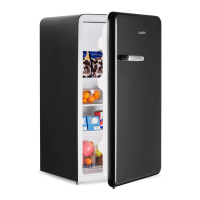
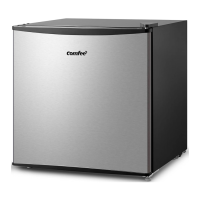
This document describes the Comfee CRR16S3ABB and CRR16S3ARD 1.6 Cu. ft Retro Compact Refrigerator, a household appliance designed for food storage.
Function Description
The refrigerator is intended for household and similar applications, including staff kitchen areas, farmhouses, hotels, motels, and bed and breakfast environments. It features a refrigerating chamber suitable for storing fruits, vegetables, beverages, and other short-term food items. A separate chiller compartment is also included. The appliance is designed with a self-closing door and a grab handle for convenience.
Important Technical Specifications
- Model Numbers: CRR16S3ABB, CRR16S3ARD
- Capacity: 1.6 Cu. ft
- Voltage/Hz: 115V~/60Hz
- Net Weight: 31.5 lbs
- Product Size: 19.1 x 17.3 x 19.7 inches
- Color Options: Black/Red
- Cooling System: Uses refrigerant and cyclopentane foam materials (combustible).
- Temperature Control: Mechanical temperature control with settings ranging from "COLD" (warmest) to "COLDER" (coldest), and an "OFF" setting to stop operation. "NORMAL" is the recommended gear.
Usage Features
- Retro Style Looking: The refrigerator boasts a retro aesthetic.
- Mechanical Temperature Control: Allows users to adjust the internal temperature. The higher the figure on the knob, the lower the actual temperature inside the refrigerator.
- Separate Chiller Compartment: Provides a dedicated space for items requiring colder temperatures.
- Self-closing Door: Enhances convenience and helps maintain internal temperature.
- Grab Handle: Facilitates easy opening of the door.
- Adjustable Leg: Allows for leveling the refrigerator on uneven surfaces. The legs can be turned clockwise to raise and counterclockwise to lower the refrigerator.
- Placement:
- Should be placed in a well-ventilated indoor area on a flat, sturdy ground.
- Keep away from heat sources and direct sunlight.
- Maintain at least 30cm of space above the refrigerator and more than 10cm from both sides and the back for proper heat dissipation.
- Avoid moist or watery places to prevent rust and insulation reduction.
- Initial Start-up:
- After unpacking, the refrigerator should remain stationary for half an hour before connecting to power.
- It should run for 2 to 3 hours before loading fresh or frozen foods, or more than 4 hours in summer due to higher ambient temperatures.
- Food Storage:
- Cooked foods should be cooled to room temperature before being placed in the refrigerating chamber.
- Foods are recommended to be sealed before storage.
- Bottled or canned drinks and other items can be placed on the door shelves.
- The convenient compartment can store food or drinks that need quick cooling but should not be used for items requiring freezing.
- Do not store explosive substances or aerosol cans with flammable propellants.
- Do not place bottled or sealed containers of fluid like beers and beverages to prevent bursts.
- Do not overload the appliance, as this forces the compressor to run longer.
- Wrap foods properly and wipe containers dry to prevent frost build-up.
- Avoid lining storage bins with aluminum foil, wax paper, or paper toweling as they interfere with cold air circulation.
- Organize and label food to reduce door openings and extended searches.
- Safety Warnings:
- Children should be supervised to prevent them from playing with the appliance.
- The supply cord, if damaged, must be replaced by the manufacturer or qualified persons.
- Keep ventilation openings clear of obstruction.
- Do not use mechanical devices or other means to accelerate defrosting, other than those recommended by the manufacturer.
- Do not damage the refrigerant circuit.
- Do not use electrical appliances inside food storage compartments unless recommended by the manufacturer.
- Ensure the supply cord is not trapped or damaged when positioning the appliance.
- Do not locate multiple portable socket-outlets or power supplies at the rear of the appliance.
- Do not use extension cords or ungrounded (two-prong) adapters.
- Before discarding an old refrigerator, remove doors and leave shelves in place to prevent child entrapment.
- The refrigerator must be disconnected from the electrical supply before installation or maintenance.
- Do not pull the power cord to unplug; grasp the plug directly.
- Ensure the power plug is firmly contacted with the socket and that the grounding electrode is reliable.
- In case of gas leakage, turn off the gas valve, open doors and windows, and do not unplug electrical appliances.
- Do not place regulators, rice cookers, microwave ovens, or other appliances on top of the refrigerator unless recommended by the manufacturer.
- Do not arbitrarily disassemble or reconstruct the refrigerator. Maintenance must be conducted by a specialist.
- Be gentle when opening the door to avoid falling articles.
- Do not pick foods or containers with wet hands in the freezing chamber to avoid frostbite.
- Do not allow children to enter or climb the refrigerator.
- Do not spray or wash the refrigerator with water.
- Do not place heavy objects on top of the refrigerator.
- Pull out the plug during power failure or cleaning. Do not reconnect within five minutes to prevent compressor damage.
- Do not put flammable, explosive, volatile, or highly corrosive items in the refrigerator.
- Do not place flammable items near the refrigerator.
- This product is for food storage only, not for blood, drugs, or biological products.
Maintenance Features
- Cleaning:
- Timely clean dust behind the refrigerator and on the ground to improve cooling effect and energy saving.
- Regularly check and clean the door gasket with a soft cloth dampened with soapy water or diluted detergent.
- The interior should be cleaned regularly to avoid odor.
- Turn off power and remove all foods, drinks, shelves, and drawers before cleaning the interior.
- Use a soft cloth or sponge with two tablespoons of baking soda and a quart of warm water to clean the inside. Rinse and wipe clean, then leave the door open to air dry naturally.
- For hard-to-reach areas, use a soft rag, soft brush, or auxiliary tools (like thin sticks).
- Do not use soap, harsh detergents, scrub powder, spray cleaner, hard brushes, steel balls, wire brushes, abrasives (like toothpastes), organic solvents (like alcohol, acetone, banana oil), boiling water, acid, or alkaline items, as these can damage surfaces or cause odors.
- Do not rinse directly with water or other liquids to avoid short circuits.
- Unplug the refrigerator for defrost and cleaning.
- Defrost:
- The refrigerator is manually defrosted.
- Disconnect the plug, open the door, and remove all food.
- Remove frost with a plastic scraper or allow it to melt naturally.
- Wipe away remaining ice and water, then plug in the refrigerator.
- The drain tray should be used to collect defrosting water.
- Do not use mechanical devices or other means to accelerate defrosting, other than those recommended by the manufacturer, to avoid damaging the refrigerant circuit.
- Stop Using:
- Power failure: Foods can be preserved for a couple of hours. Reduce door openings and avoid putting fresh foods in the refrigerator.
- Long-time nonuse: Unplug the refrigerator and leave the door open to prevent bad odors.
- Moving: Do not turn upside down or vibrate the refrigerator excessively (carrying angle not greater than 45°). Do not hold the door and hinge when moving.
- Continuous operation is recommended once started to maintain service life.
Troubleshooting
The manual provides guidance for common issues:
- Inoperation: Check power connection, voltage, temperature control knob setting, and circuit.
- Odor: Ensure foods are wrapped, check for rotten foods, and clean the interior.
- Long-term operation of compressor: Normal in summer, avoid overloading, ensure foods are cooled before storage, limit frequent door openings, and defrost if frost layer is thick.
- Refrigerator door not closing properly: Check for food packages obstructing the door, too much food, or an unbalanced refrigerator.
- Loud noises: Check if the floor is flat, if the refrigerator is stable, and if accessories are properly placed.
- Transient difficulty in door opening: Normal physical phenomenon due to pressure difference after refrigeration.
- Refrigerator enclosure heat/condensation: Normal in summer due to condenser radiation. Condensation on exterior surfaces and door seals is normal in high humidity and can be wiped away.
- Airflow sound/Buzz/Clatter: Normal sounds from refrigerants circulating, compressor starting/shutting down, or solenoid/electric switch valves.

 Need help?
 General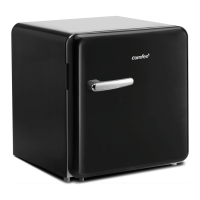

 To Next Page