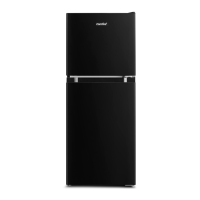
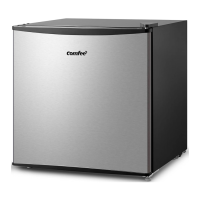
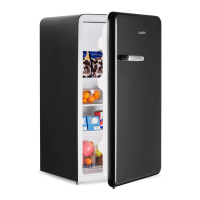
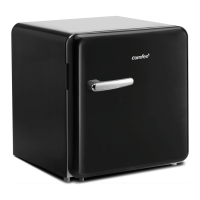
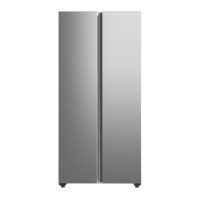
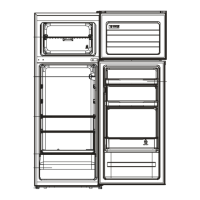
This document provides comprehensive instructions for the safe and proper use, maintenance, and troubleshooting of your Comfee 3.3 cu.ft. All Refrigerator, models CRM33S3ABB and CRM33S3AST.
Safety Warnings
Before operating the appliance, it is crucial to read and understand all safety warnings. This refrigerator is designed for household and similar applications, including staff kitchen areas, farmhouses, hotels, motels, and bed and breakfast environments. It is not intended for use by individuals with reduced physical, sensory, or mental capabilities, or lack of experience, unless supervised. Children should be supervised to prevent them from playing with the appliance.
Electrical Safety:
- If the supply cord is damaged, it must be replaced by the manufacturer, its service agent, or similarly qualified persons to avoid hazards.
- Do not store explosive substances, such as aerosol cans with flammable propellants, inside the appliance.
- Always unplug the appliance after use and before performing any user maintenance.
- Do not use extension cords or ungrounded (two-prong) adapters.
- Do not locate multiple portable socket-outlets or portable power supplies at the rear of the appliance.
- Ensure the supply cord is not trapped or damaged when positioning the appliance.
- Do not arbitrarily disassemble or reconstruct the refrigerator, nor damage the refrigerant circuit. Maintenance must be conducted by a specialist.
- Do not connect the freezer to the power supply within five minutes of a power failure or cleaning to prevent damage to the compressor due to successive starts.
General Safety:
- Keep ventilation openings in the appliance enclosure or built-in structure clear of obstruction.
- Do not use mechanical devices or other means to accelerate the defrosting process other than those recommended by the manufacturer.
- Do not damage the refrigerant circuit.
- Do not use electrical appliances inside the food storage compartments unless they are of the type recommended by the manufacturer.
- Abandon the refrigerator according to local regulations, as it uses flammable blowing gas and refrigerant.
- Risk of child entrapment: Before disposing of an old refrigerator, remove the doors and leave shelves in place to prevent children from climbing inside.
- The refrigerator must be disconnected from the electrical supply before installing accessories.
- The refrigerant and cyclopentane foaming material used are flammable. When scrapping the appliance, keep it away from fire sources and ensure it is recovered by a special company.
- For doors or lids with locks and keys, keep keys out of reach of children and not in the vicinity of the refrigerating appliance to prevent entrapment.
- To avoid instability, the appliance must be fixed in accordance with the instructions.
- Connect to a potable water supply only (if applicable for ice making).
- To prevent child entrapment, keep children out of reach and away from the vicinity of the freezer (or refrigerator) if it has locks.
Usage Warnings:
- Do not put flammable, explosive, volatile, and highly corrosive items in the refrigerator to prevent damage or fire.
- Do not place flammable items near the refrigerator.
- The refrigerator is intended for household use for food storage and should not be used for other purposes like storing blood, drugs, or biological products.
- The gaps between the refrigerator door and cabinet are small; avoid putting your hand in these areas to prevent finger squeezing. Close the door gently to prevent articles from falling.
- Do not pick foods or containers in the freezing chamber when the refrigerator is running, especially metal containers, to avoid frostbite.
- Do not allow children to get into or climb the refrigerator, as this may cause suffocation or falling injury.
- Do not place heavy objects on top of the refrigerator, as they may fall when opening or closing the door, causing accidental injuries.
- Pull out the plug in case of power failure or cleaning.
Proper Use of Refrigerator
Placement:
- Before use, remove all packing materials, including bottom cushions, foam pads, and tapes. Peel off the protective film from the doors and body.
- Keep the refrigerator away from heat sources and direct sunlight. Avoid placing it in moist or watery areas to prevent rust or reduced insulation.
- Do not spray or wash the refrigerator with water, especially in moist areas, to avoid affecting electrical insulation.
- Place the refrigerator in a well-ventilated indoor area on a flat, sturdy ground. Use the adjustable feet for leveling if unstable.
- Ensure the top space of the refrigerator is greater than 30cm, and it is placed against a wall with a free distance of more than 10cm to facilitate heat dissipation.
Leveling Feet:
The refrigerator is equipped with leveling feet to ensure stability.
- To raise the refrigerator, turn the feet clockwise.
- To lower the refrigerator, turn the feet counterclockwise.
- Adjust the right and left feet to achieve a horizontal level.
Door Right-Left Change (Optional):
The door hinge can be reversed to open from the left or right side. This process requires specific tools: a cross screwdriver, putty knife/thin-blade screwdriver, 5/16" socket spanner, and masking tape.
- Power off the refrigerator and remove all objects from the door trays.
- Dismantle the hinge cover, screws, and upper hinge. Remove the hole cap and pins from the opposite side.
- Remove the door, then remove the lower hinge assembly and leveling foot. Interchange their positions and reinstall them.
- Install the door on the lower hinge assembly, then install the upper hinge, hinge cover, pins, and hole cap in sequence.
Changing the Light (Optional):
To replace an incandescent lamp:
- Disconnect the power supply.
- Hold and remove the light bulb cover.
- Unscrew the old bulb counterclockwise.
- Replace with a new bulb (Max. 15W) by screwing it clockwise, ensuring it is tightly fixed.
- Reassemble the light cover and reconnect the refrigerator to the power supply.
Starting:
- After initial placement, keep the refrigerator still for half an hour before connecting it to the power supply.
- Before storing any fresh or frozen foods, allow the refrigerator to run for 2-3 hours, or for over 4 hours in summer when ambient temperatures are high.
- Ensure enough space for convenient opening of doors and drawers.
Energy Saving Tips:
- Locate the appliance in the coolest area of the room, away from heat-producing appliances, heating ducts, and direct sunlight.
- Allow hot foods to cool to room temperature before placing them in the appliance. Overloading forces the compressor to run longer, which can lead to food spoilage.
- Wrap foods properly and wipe containers dry before placing them in the appliance to reduce frost build-up.
- Do not line appliance storage bins with aluminum foil, wax paper, or paper toweling, as liners interfere with cold air circulation and reduce efficiency.
- Organize and label food to minimize door openings and extended searches. Remove multiple items at once and close the door promptly.
Structure and Functions
Key Components:
The refrigerator features a temperature control knob, multiple shelves, toolbars, and leveling feet.
Refrigerating Chamber:
- Suitable for storing various fruits, vegetables, beverages, and other short-term consumed foods.
- Cooked foods should be cooled to room temperature before being placed in the refrigerating chamber.
- Foods are recommended to be sealed before placing them in the refrigerator.
- The glass shelves can be adjusted up or down to optimize storage space.
Functions:
The temperature control knob allows adjustment of the internal temperature.
- Turning the knob to "MAX" lowers the internal temperature.
- Turning the knob to "MIN" raises the internal temperature.
- The letters on the knob represent levels, not specific temperatures. "OFF" means the refrigerator stops working.
- The recommended gear setting is "MED".
Maintenance and Care of the Refrigerator
Cleaning:
Regular cleaning ensures optimal performance and hygiene.
- The ground beneath the refrigerator should be cleaned regularly to improve cooling efficiency and save energy.
- Check the door gasket regularly to ensure no debris. Clean the door gasket with a soft cloth dampened with soapy water or diluted detergent.
- The interior of the refrigerator should be cleaned regularly to avoid odor. Remove all foods, drinks, shelves, and drawers before cleaning.
- Use a soft cloth or sponge with warm water and a small amount of neutral detergent to clean the interior. Rinse with water and wipe clean. Open the door and let it dry naturally before turning on the power.
- For areas difficult to clean, such as narrow sandwiches, gaps, or corners, use a soft rag, soft brush, etc., and, if necessary, auxiliary tools (like thin sticks) to ensure no contaminants or bacteria accumulate.
- Do not spray or wash the refrigerator with water, as this may cause damage to electrical insulation properties.
- Do not use hard brushes, steel wool, wire brushes, abrasives (such as toothpastes), organic solvents (such as alcohol, acetone, banana oil, etc.), boiling water, acid, or alkaline items, as these may corrode the refrigerator surface and interior.
- Do not rinse directly with water or other liquids during cleaning to avoid short circuits or affect electrical insulation.
- Unplug the refrigerator for defrosting and cleaning.
Stop Using:
- In case of power failure, if it is for a short duration, foods inside the appliance should remain cold. If the power failure is prolonged, remove all food and place it in a cool, dry place.
- For long-term non-use, unplug the appliance and leave the doors open to prevent odors.
- Before moving the refrigerator, remove all objects inside, fix the glass partitions, vegetable holder, freezing chamber drawers, and other accessories with tape. Tighten the leveling feet, close the doors, and fix them with tape. During moving, do not tilt the appliance horizontally or beyond 45 degrees to avoid damage to the compressor.
Troubleshooting
If you encounter problems, try the following simple solutions before contacting customer service.
Not Working:
- Check if the appliance is connected to power and if the plug is in good contact.
- Verify that the voltage is not too low.
- Check for power failure or tripped circuits.
Odor:
- Ensure odorous foods are tightly wrapped.
- Check for rotten food.
- Clean the inside of the refrigerator.
Long-time Operation of Compressor:
- Long operation is normal in summer when ambient temperature is high.
- Avoid putting too much food in the appliance at once.
- Allow food to cool before placing it in the appliance.
- Avoid opening the doors too frequently.
Light Not Working:
- Check if the refrigerator is connected to power.
- Check if the illuminating light is damaged.
- If damaged, have the light replaced by a specialist.
Doors Cannot Be Properly Closed:
- Check if the door is stuck by food packages.
- Ensure not too much food is placed inside.
- Check if the refrigerator is tilted.
Loud Noise:
- Check if the floor is level and if the refrigerator is placed stably.
- Ensure accessories are placed at proper locations.
- Buzzing from the compressor during operation (especially at start/stop) is normal.
- Creaking from refrigerant flowing inside the appliance is normal.
Gasket Gap:
- Remove any foreign matters from the door seal.
- Heat the door seal and then cool it for restoration (e.g., with an electrical dryer or hot towel).
Water Pan Overflows:
- Too much food in the chamber or food containing too much water can lead to heavy defrosting.
- Ensure doors are closed properly to prevent frosting due to air entry and increased water.
Overheat on Sidewall:
- Heat dissipation from the built-in condenser via the housing is normal.
- If the housing becomes hot due to high ambient temperature, too much food, or compressor shutdown, provide sound ventilation.
Surface Condensation:
- Condensation on the exterior surface and door seals is normal when ambient humidity is too high. Wipe the condensate with a clean towel.

 Need help?
 General

 To Next Page