EasyManua.ls Logo

Commodore PC - Page 180

Commodore PC
414 pages
Print Icon
To Next Page IconTo Next Page
To Previous Page IconTo Previous Page
Loading...
108
MS-DOS
User's
Reference
Using
temporary
files
How
to
Use
Temporary
Files
When
using
batch
files,
you
may
often
want
to
use
a
temporary
file
to
hold
your
work.
You
could
use
the
same
name
each
time
you
wanted
to
use
a
temporary
file.
However,
if
you
are
using
more
than
one
batch
file
that
uses
the
same
temporary
file,
you
might
lose
the
contents
of
this
tem
porary
file.
To
avoid
this
problem,
you
should
use
a
replaceable
parameter
to
specify
the
name
of
the
temporary
file.
Then
each
time
you
run
the
batch
file,
you'll
be
able
to
substitute
a
unique
filename
and
you
won't
have
to
worry
about
information
from
one
batch
file
getting
into
another.
It's
also
a
good
idea
to
delete
temporary
files
once
you
finish
using
them.
Otherwise,
these
files
would
eventually
take
up
all
the
space
on
your
disk.
U
u
Using
the
batch
processing
commands
Batch
Processing
Commands
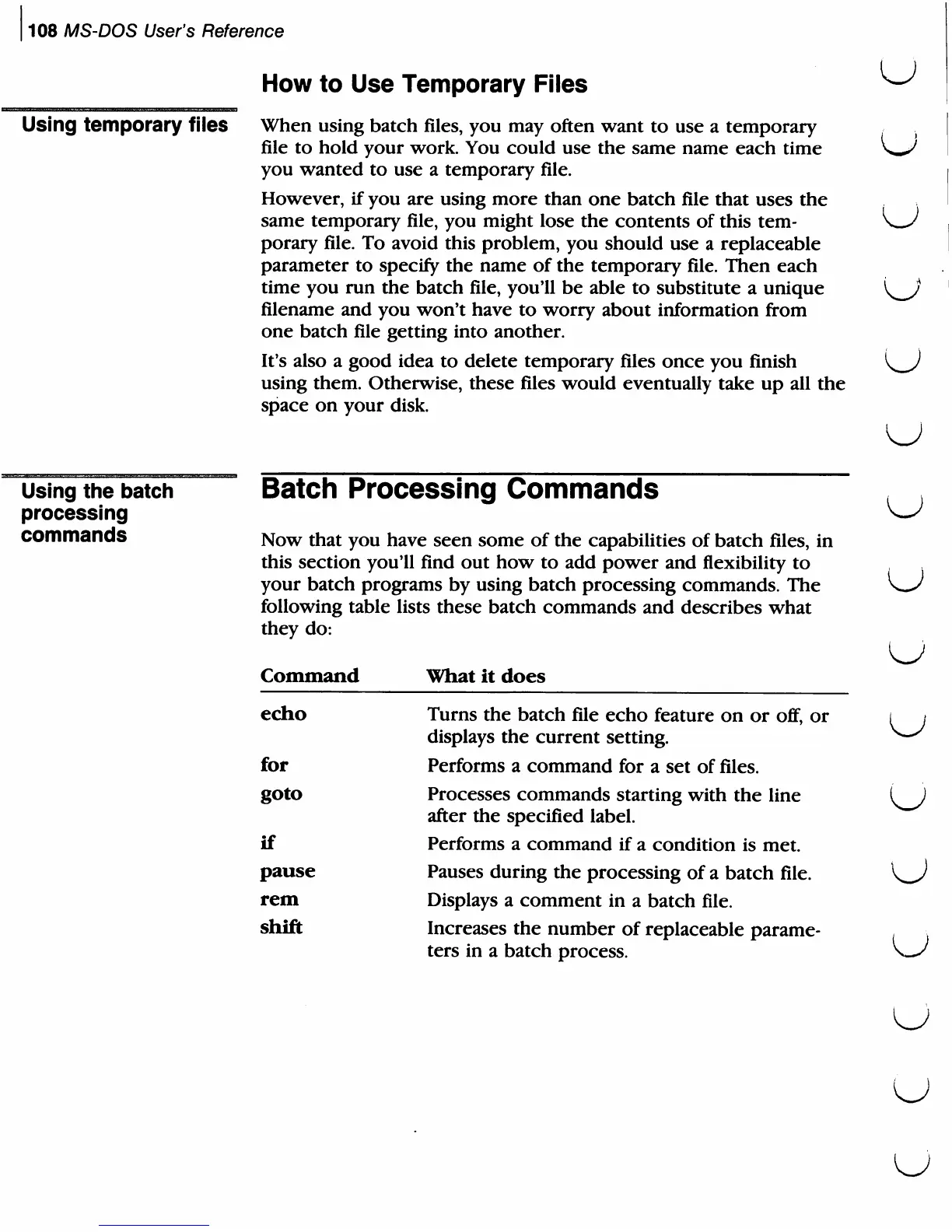
Now
that
you
have
seen
some
of
the
capabilities
of
batch
files,
in
this
section
you'll
find
out
how
to
add
power
and
flexibility
to
your
batch
programs
by
using
batch
processing
commands.
The
following
table
lists
these
batch
commands
and
describes
what
they
do:
Command
echo
for
goto
if
pause
rem
shift
What
it
does
Turns
the
batch
file
echo
feature
on
or
off,
or
displays
the
current
setting.
Performs
a
command
for
a
set
of
files.
Processes
commands
starting
with
the
line
after
the
specified
label.
Performs
a
command
if
a
condition
is
met.
Pauses
during
the
processing
of
a
batch
file.
Displays
a
comment
in
a
batch
file.
Increases
the
number
of
replaceable
parame
ters
in
a
batch
process.
u
u
u

Related product manuals