EasyManua.ls Logo

Commodore PC - Page 255

Commodore PC
414 pages
Print Icon
To Next Page IconTo Next Page
To Previous Page IconTo Previous Page
Loading...
Link:
A
Unker
183
|
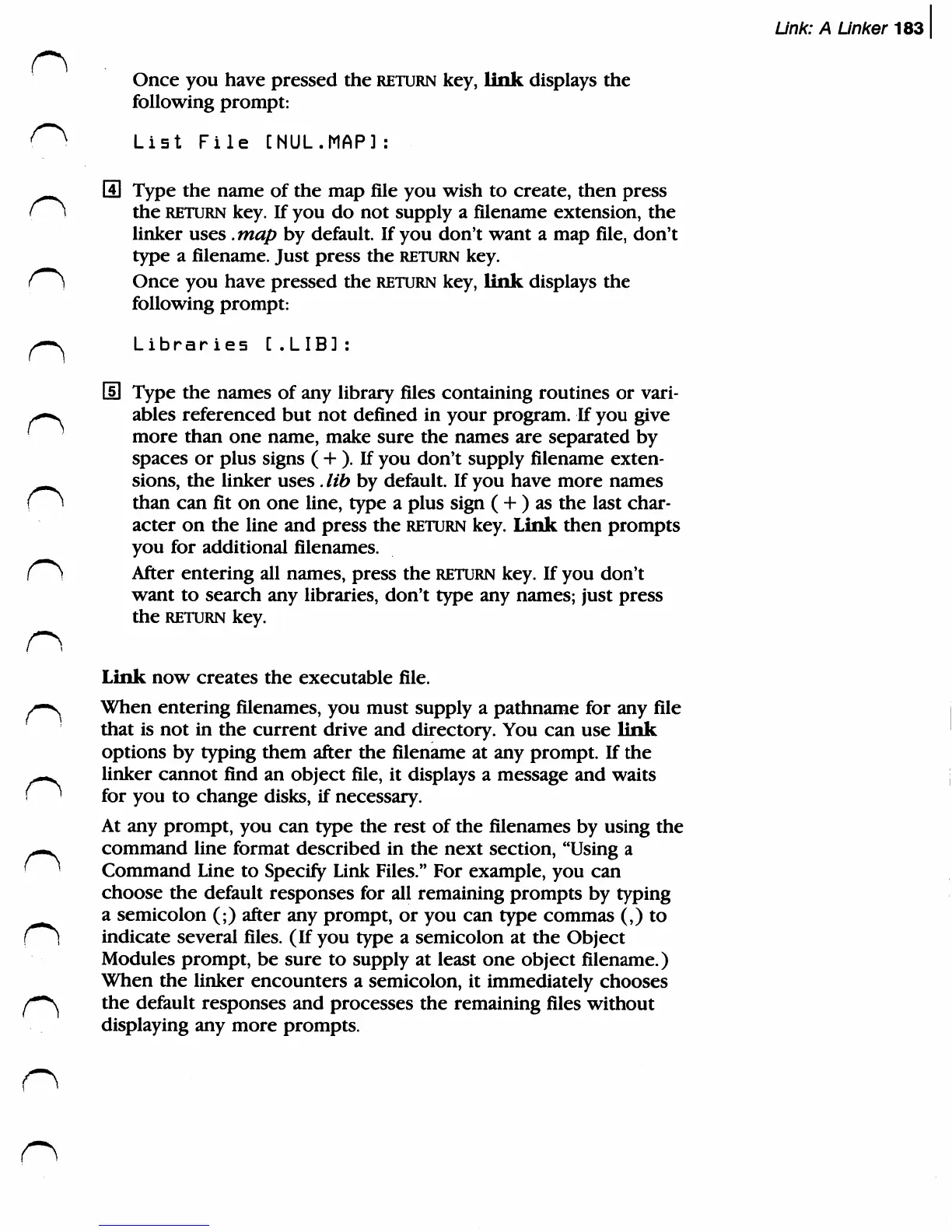
Once
you
have
pressed
the
return
key,
link
displays
the
following
prompt:
O
List
File
[NUL.MAP]:
^^
H
Type
the
name
of
the
map
file
you
wish
to
create,
then
press
<\
the
return
key.
If
you
do
not
supply
a
filename
extension,
the
linker
uses
.map
by
default.
If
you
don't
want
a
map
file,
don't
type
a
filename.
Just
press
the
return
key.
/***)
Once
you
have
pressed
the
return
key,
link
displays
the
following
prompt:
C\
Libraries
[.LIB]:
H]
Type
the
names
of
any
library
files
containing
routines
or
vari
ables
referenced
but
not
defined
in
your
program.
If
you
give
more
than
one
name,
make
sure
the
names
are
separated
by
spaces
or
plus
signs
(
+
).
If
you
don't
supply
filename
exten
sions,
the
linker
uses
.lib
by
default.
If
you
have
more
names
than
can
fit
on
one
line,
type
a
plus
sign
(
+
)
as
the
last
char
acter
on
the
line
and
press
the
return
key.
Link
then
prompts
you
for
additional
filenames.
After
entering
all
names,
press
the
return
key.
If
you
don't
want
to
search
any
libraries,
don't
type
any
names;
just
press
the
return
key.
Link
now
creates
the
executable
file.
When
entering
filenames,
you
must
supply
a
pathname
for
any
file
that
is
not
in
the
current
drive
and
directory.
You
can
use
link
options
by
typing
them
after
the
filename
at
any
prompt.
If
the
linker
cannot
find
an
object
file,
it
displays
a
message
and
waits
for
you
to
change
disks,
if
necessary.
At
any
prompt,
you
can
type
the
rest
of
the
filenames
by
using
the
command
line
format
described
in
the
next
section,
"Using
a
Command
line
to
Specify
Link
Files."
For
example,
you
can
choose
the
default
responses
for
all
remaining
prompts
by
typing
a
semicolon
(;)
after
any
prompt,
or
you
can
type
commas
(,)
to
indicate
several
files.
(If
you
type
a
semicolon
at
the
Object
Modules
prompt,
be
sure
to
supply
at
least
one
object
filename.)
When
the
linker
encounters
a
semicolon,
it
immediately
chooses
the
default
responses
and
processes
the
remaining
files
without
displaying
any
more
prompts.

Related product manuals