EasyManua.ls Logo

Commodore PC - Enter

Commodore PC
414 pages
Print Icon
To Next Page IconTo Next Page
To Previous Page IconTo Previous Page
Loading...
218
MS-DOS
User's
Reference
u
(E)nter
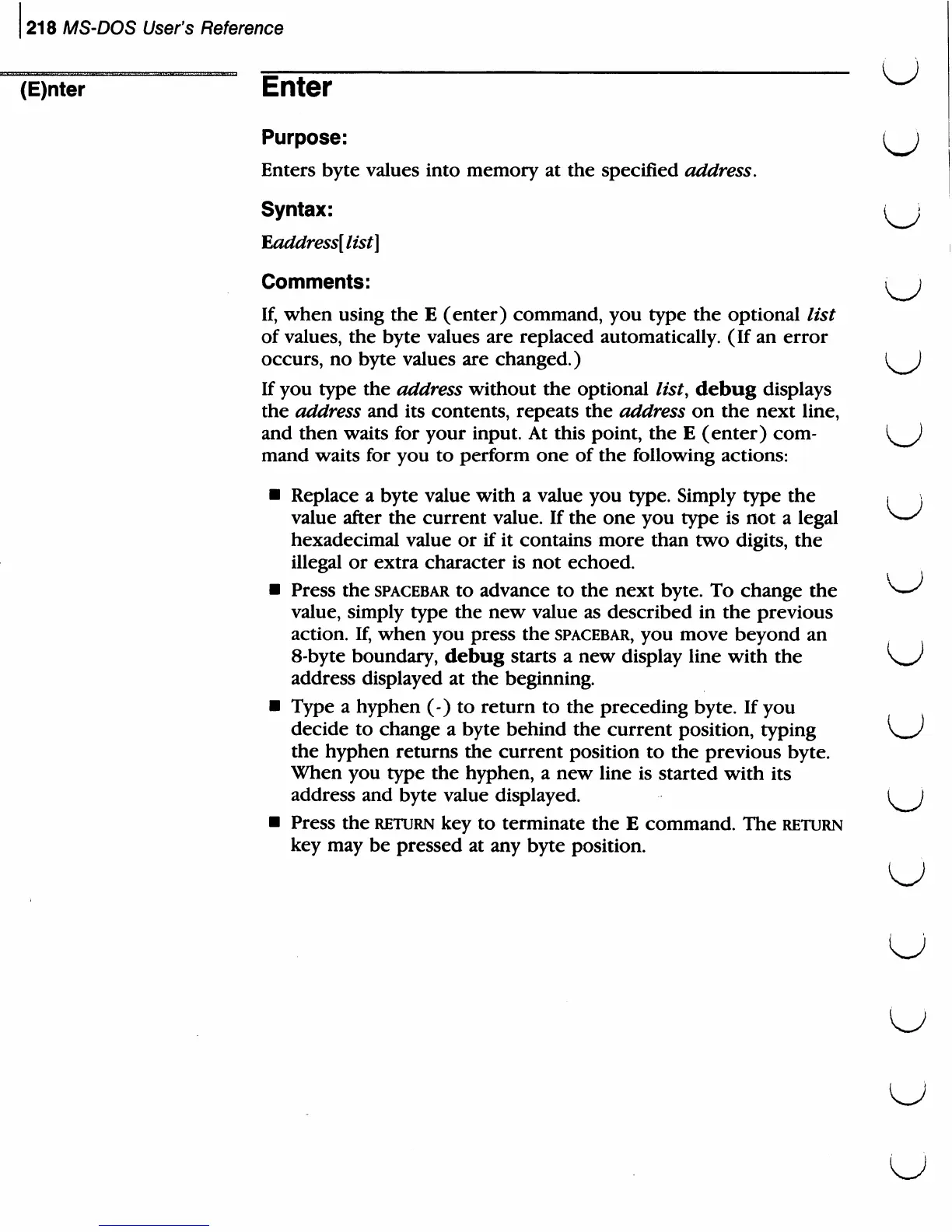
Enter
Purpose:
(J
Enters
byte
values
into
memory
at
the
specified
address.
Syntax:
(j
Eaddress[list]
Comments:
ij
If,
when
using
the
E
(enter)
command,
you
type
the
optional
list
of
values,
the
byte
values
are
replaced
automatically.
(If
an
error
occurs,
no
byte
values
are
changed.)
li
If
you
type
the
address
without
the
optional
list,
debug
displays
the
address
and
its
contents,
repeats
the
address
on
the
next
line,
and
then
waits
for
your
input.
At
this
point,
the
E
(enter)
com-
[^J
mand
waits
for
you
to
perform
one
of
the
following
actions:
Replace
a
byte
value
with
a
value
you
type.
Simply
type
the
,
j
value
after
the
current
value.
If
the
one
you
type
is
not
a
legal
^—^
hexadecimal
value
or
if
it
contains
more
than
two
digits,
the
illegal
or
extra
character
is
not
echoed.
Press
the
spacebar
to
advance
to
the
next
byte.
To
change
the
^—
value,
simply
type
the
new
value
as
described
in
the
previous
action.
If,
when
you
press
the
spacebar,
you
move
beyond
an
8-byte
boundary,
debug
starts
a
new
display
line
with
the
\^J
address
displayed
at
the
beginning.
Type
a
hyphen
(-)
to
return
to
the
preceding
byte.
If
you
decide
to
change
a
byte
behind
the
current
position,
typing
\_J
the
hyphen
returns
the
current
position
to
the
previous
byte.
When
you
type
the
hyphen,
a
new
line
is
started
with
its
address
and
byte
value
displayed.
t)
Press
the
return
key
to
terminate
the
E
command.
The
return
key
may
be
pressed
at
any
byte
position.
O
U

Related product manuals