EasyManua.ls Logo

Commodore PC - Go

Commodore PC
414 pages
Print Icon
To Next Page IconTo Next Page
To Previous Page IconTo Previous Page
Loading...
Debug
221
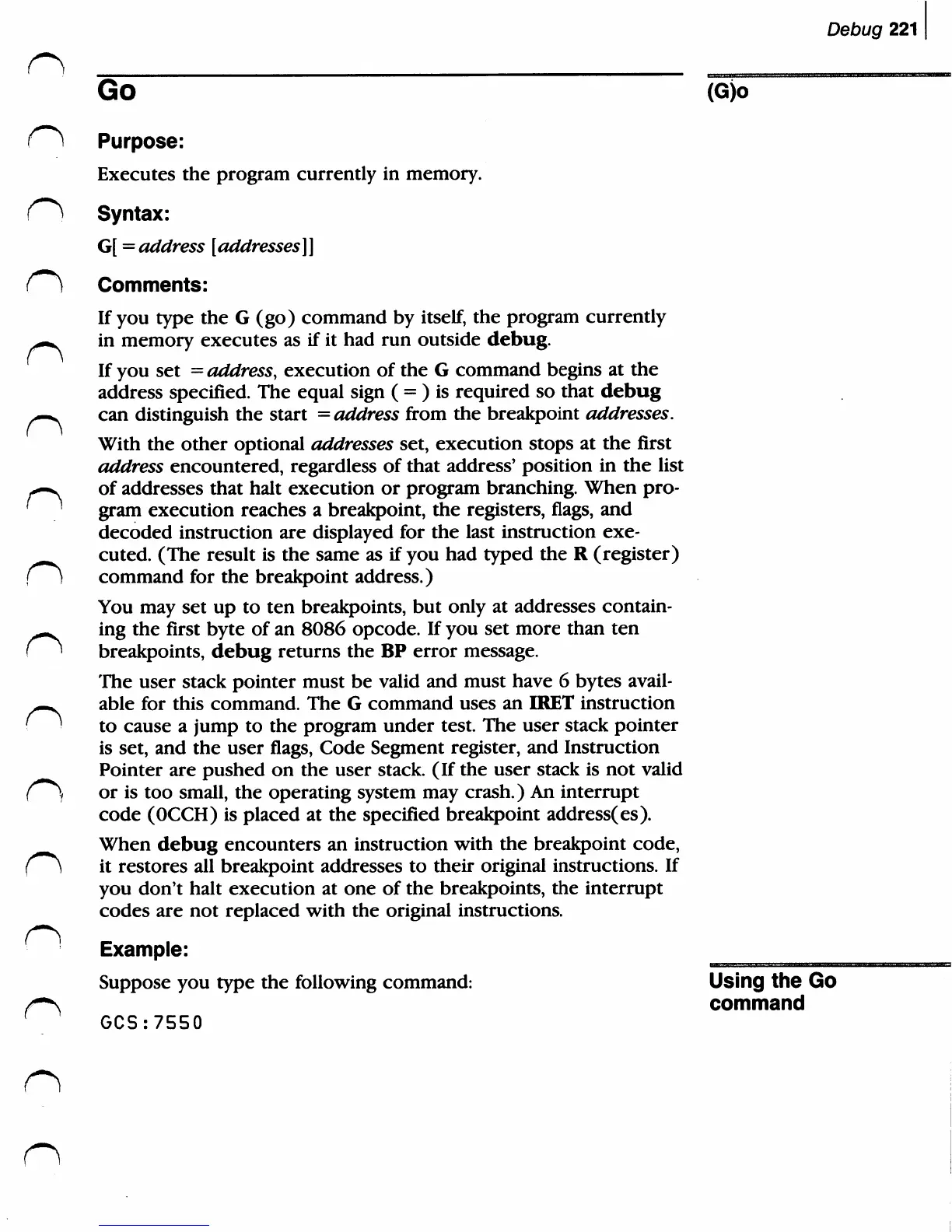
Go
(^
Purpose:
Executes
the
program
currently
in
memory.
r**)
Syntax:
G[
=
address
[addresses]]
r**)
Comments:
If
you
type
the
G
(go)
command
by
itself,
the
program
currently
^m^
in
memory
executes
as
if
it
had
run
outside
debug.
If
you
set
=
address,
execution
of
the
G
command
begins
at
the
address
specified.
The
equal
sign
(
=
)
is
required
so
that
debug
>-v^
can
distinguish
the
start
=
address
from
the
breakpoint
addresses.
With
the
other
optional
addresses
set,
execution
stops
at
the
first
address
encountered,
regardless
of
that
address'
position
in
the
list
f—K
of
addresses
that
halt
execution
or
program
branching.
When
pro-
'
'
gram
execution
reaches
a
breakpoint,
the
registers,
flags,
and
decoded
instruction
are
displayed
for
the
last
instruction
exe-
^^^
cuted.
(The
result
is
the
same
as
if
you
had
typed
the
R
(register)
f)
command
for
the
breakpoint
address.)
You
may
set
up
to
ten
breakpoints,
but
only
at
addresses
contain-
-^
ing
the
first
byte
of
an
8086
opcode.
If
you
set
more
than
ten
breakpoints,
debug
returns
the
BP
error
message.
The
user
stack
pointer
must
be
valid
and
must
have
6
bytes
avail-
-».
able
for
this
command.
The
G
command
uses
an
IRET
instruction
(
'
to
cause
a
jump
to
the
program
under
test.
The
user
stack
pointer
is
set,
and
the user
flags,
Code
Segment
register,
and
Instruction
Pointer
are
pushed
on
the
user
stack.
(If
the
user
stack
is
not
valid
f~*)
or
is
too
small,
the
operating
system
may
crash.)
An
interrupt
code
(OCCH)
is
placed
at
the
specified
breakpoint
address(es).
When
debug
encounters
an
instruction
with
the
breakpoint
code,
(~*\
it
restores
all
breakpoint
addresses
to
their
original
instructions.
If
you
don't
halt
execution
at
one
of
the
breakpoints,
the
interrupt
codes
are
not
replaced
with
the
original
instructions.
Example:
Suppose
you
type
the
following
command:
*^
GCS:7550
(G)o
Using
the
Go
command
n

Related product manuals