EasyManua.ls Logo

Commodore PC - The Del Command

Commodore PC
414 pages
Print Icon
To Next Page IconTo Next Page
To Previous Page IconTo Previous Page
Loading...
28
MS-DOS
User's
Guide
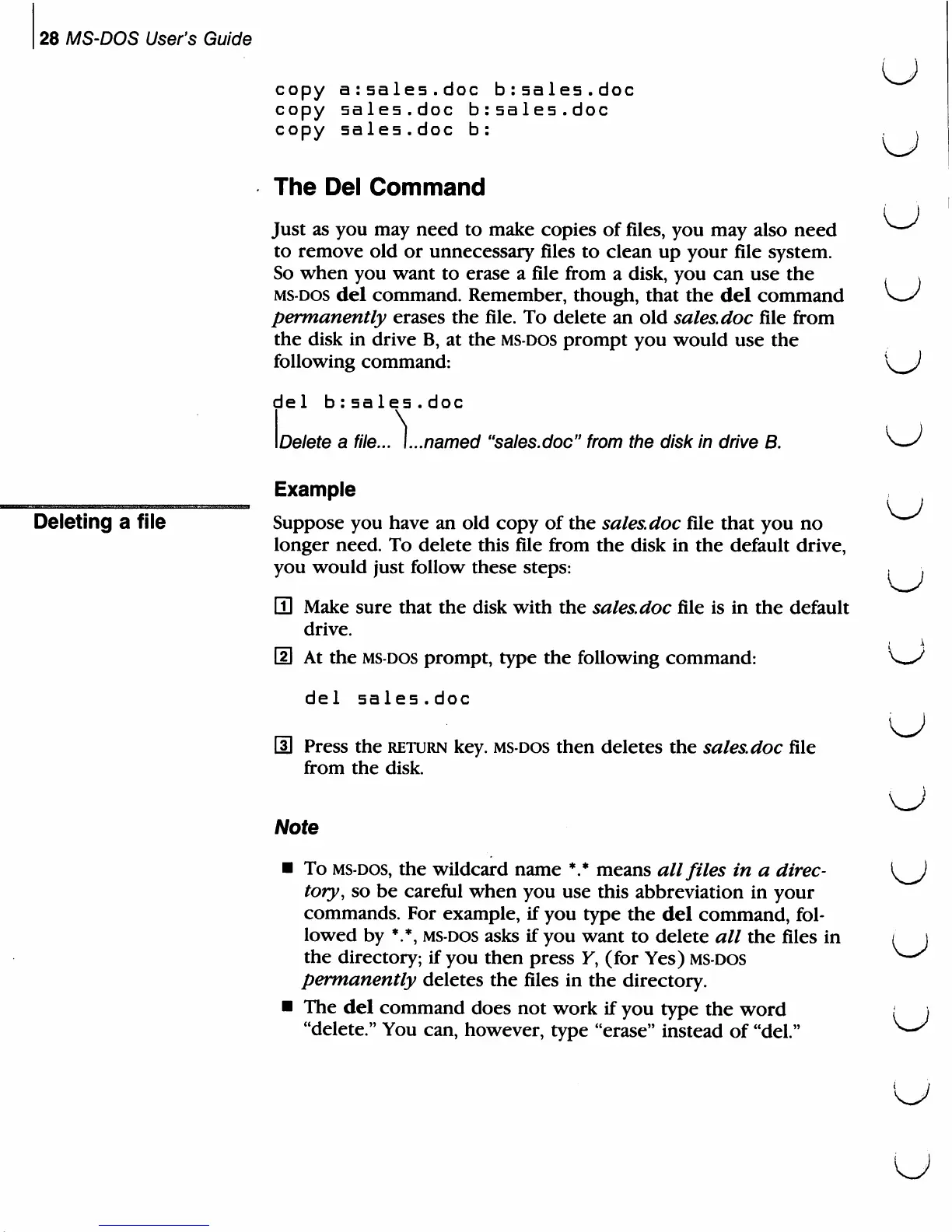
copy
a:sales.doc
b:sale5.doc
copy
sales.doc
b:sales.doc
copy
sales.doc
b:
,
,
The
Del
Command
Just
as
you
may
need
to
make
copies
of
files,
you
may
also
need
^-^
to
remove
old
or
unnecessary
files
to
clean
up
your
file
system.
So
when
you
want
to
erase
a
file
from
a
disk,
you
can
use
the
,
}
ms-dos
del
command.
Remember,
though,
that
the
del
command
v_y
permanently
erases
the
file.
To
delete
an
old
sales,
doc
file
from
the
disk
in
drive
B,
at
the
ms-dos
prompt
you
would
use
the
following
command:
\^J
del
b:sales.doc
\Delete
a
file...
I...named
"sales.doc"
from
the
disk
in
drive
B.
^—'
Example
Deleting
a
file
Suppose
you
have
an
old
copy
of
the
sales.doc
file
that
you
no
longer
need.
To
delete
this
file
from
the
disk
in
the
default
drive,
you
would
just
follow
these
steps:
,
,
CD
Make
sure
that
the
disk
with
the
sales,
doc
file
is
in
the
default
drive.
[H
At
the
ms-dos
prompt,
type
the
following
command:
V^y
del
sales.doc
[U
Press
the
return
key.
ms-dos
then
deletes
the
sales,
doc
file
from
the
disk.
\J
Note
To
ms-dos,
the
wildcard
name
*.*
means
all
files
in
a
direc-
K^^J
tory,
so
be
careful
when
you
use
this
abbreviation
in
your
commands.
For
example,
if
you
type
the
del
command,
fol
lowed
by
*.*,
ms-dos
asks
if
you
want
to
delete
all
the
files
in
/
1
the
directory;
if
you
then
press
F,
(for
Yes)
MS-DOS
permanently
deletes
the
files
in
the
directory.
The
del
command
does
not
work
if
you
type
the
word
/ \
"delete."
You
can,
however,
type
"erase"
instead
of
"del."
^-^

Related product manuals