EasyManua.ls Logo

Commodore PC - Page 93

Commodore PC
414 pages
Print Icon
To Next Page IconTo Next Page
To Previous Page IconTo Previous Page
Loading...
MS-DOS
Commands
21
n
J
n
n
n
n
n
n
n
n
O
n
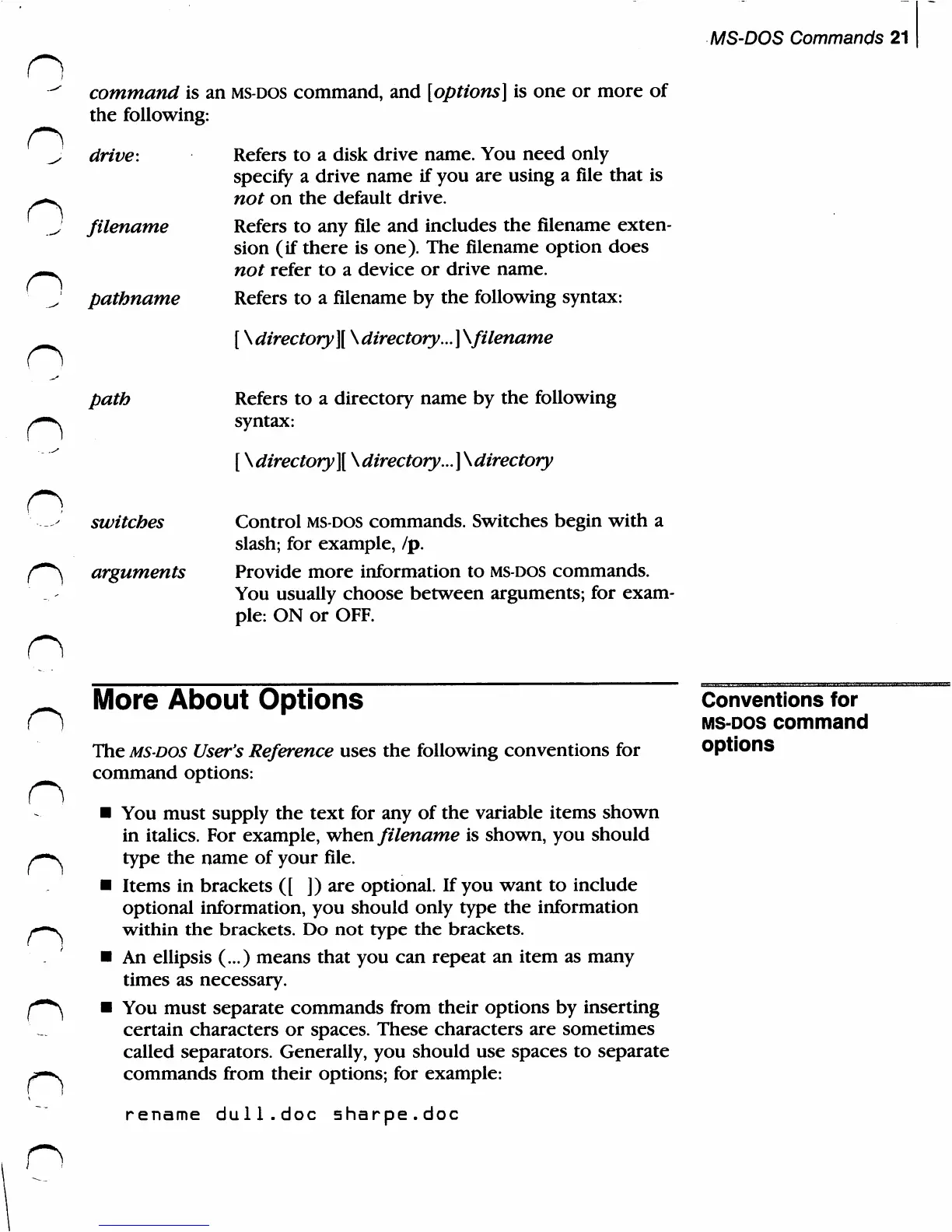
command
is
an
ms-dos
command,
and
[options]
is
one
or
more
of
the
following:
drive:
Refers
to
a disk
drive
name.
You
need
only
specify
a
drive
name
if
you
are
using
a
file
that
is
not
on
the
default
drive.
filename
Refers
to
any
file
and
includes
the
filename
exten
sion
(if
there
is
one).
The
filename
option
does
not
refer
to
a
device or
drive
name.
pathname
Refers
to a
filename
by
the
following
syntax:
[
\directory\
\directory...\\filename
path
Refers
to
a
directory
name
by
the following
syntax:
[
\directory][
\directory..\\directory
switches
Control
ms-dos
commands.
Switches
begin
with
a
slash;
for
example,
/p.
arguments
Provide
more
information
to
ms-dos
commands.
You
usually
choose
between
arguments;
for
exam
ple:
ON
or
OFF.
More
About
Options
The
MS-DOS
User's
Reference
uses
the
following
conventions
for
command
options:
You
must
supply
the
text
for
any
of
the
variable
items
shown
in
italics.
For
example,
when
filename
is
shown,
you
should
type
the
name
of
your
file.
Items
in
brackets
([
])
are
optional.
If
you
want
to
include
optional
information,
you
should
only
type
the
information
within
the
brackets.
Do
not
type
the
brackets.
An
ellipsis
(...)
means
that
you
can
repeat
an
item
as
many
times
as
necessary.
You
must
separate
commands
from
their
options
by
inserting
certain
characters
or
spaces.
These
characters
are
sometimes
called
separators.
Generally,
you
should use
spaces
to
separate
commands
from
their
options;
for
example:
rename
dull.doc
sharpe.doc
Conventions
for
ms-dos
command
options

Related product manuals