EasyManua.ls Logo

Commodore Plus 4 - Getting to know the switches and sockets

Commodore Plus 4
464 pages
Print Icon
To Next Page IconTo Next Page
To Previous Page IconTo Previous Page
Loading...
4
The
BASIC
Language
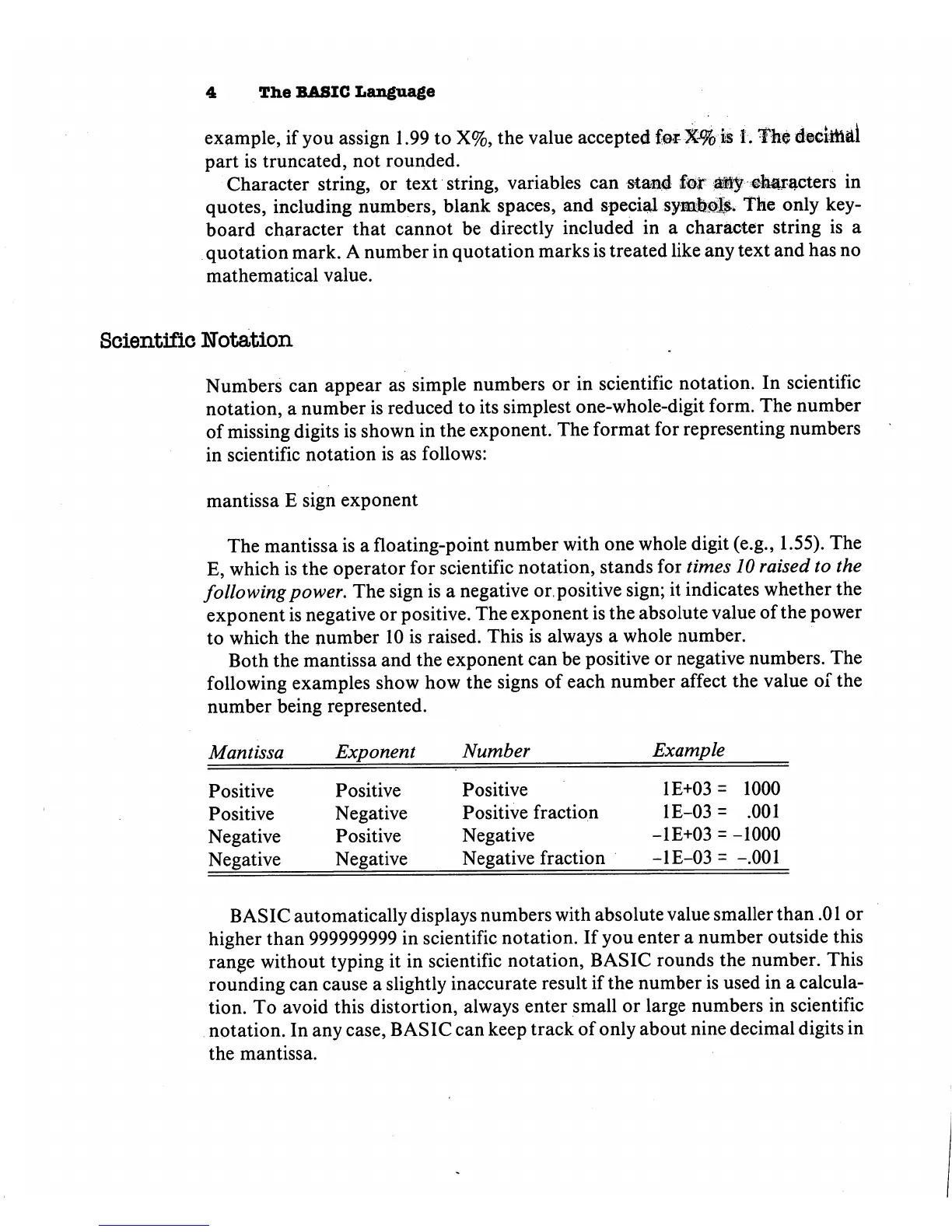
example,
if
you
assign
1.99
to
X%,
the
value
accepted
fe*X%
is
1.
part
is
truncated,
not
rounded.
Character
string,
or
text
string,
variables
can
stand
for
My
characters
in
quotes,
including
numbers,
blank
spaces,
and
special
symbols.
The
only
key
board
character
that
cannot
be
directly
included
in
a
character
string
is
a
quotation
mark.
A
number
in
quotation
marks
is
treated
like
any
text
and
has
no
mathematical
value.
Scientific
Notation
Numbers
can
appear
as
simple
numbers
or
in
scientific
notation.
In
scientific
notation,
a
number
is
reduced
to
its
simplest
one-whole-digit
form.
The
number
of
missing
digits
is
shown
in
the
exponent.
The
format
for
representing
numbers
in
scientific
notation
is
as
follows:
mantissa
E
sign
exponent
The
mantissa
is
a
floating-point
number
with
one
whole
digit
(e.g.,
1.55).
The
E,
which
is
the
operator
for
scientific
notation,
stands
for
times
10
raised
to
the
following
power.
The
sign
is
a
negative
or,
positive
sign;
it
indicates
whether
the
exponent
is
negative
or
positive.
The
exponent
is
the
absolute
value
of
the
power
to
which
the
number
10
is
raised.
This
is
always
a
whole
number.
Both
the
mantissa
and
the
exponent
can
be
positive
or
negative
numbers.
The
following
examples
show
how
the
signs
of
each
number
affect
the
value
of
the
number
being
represented.
Mantissa
Exponent
Number
Example
Positive
Positive
Negative
Negative
Positive
Negative
Positive
Negative
Positive
Positive
fraction
Negative
Negative
fraction
1E+03
1E-03
-1E+03
-1E-03
=
1000
=
.001
=
-1000
=
-.001
BASIC
automatically
displays
numbers
with
absolute
value
smaller
than
.01
or
higher
than
999999999
in
scientific
notation.
If
you
enter
a
number
outside
this
range
without
typing
it
in
scientific
notation,
BASIC
rounds
the
number.
This
rounding
can
cause
a
slightly
inaccurate
result
if
the
number
is
used
in
a
calcula
tion.
To
avoid
this
distortion,
always
enter
small
or
large
numbers
in
scientific
notation.
In
any
case,
BASIC
can
keep
track
of
only
about
nine
decimal
digits
in
the
mantissa.

Other manuals for Commodore Plus 4

Related product manuals