EasyManua.ls Logo

Commodore Plus 4 - Page 195

Commodore Plus 4
464 pages
Print Icon
To Next Page IconTo Next Page
To Previous Page IconTo Previous Page
Loading...
XJnNEWing
Programs
183
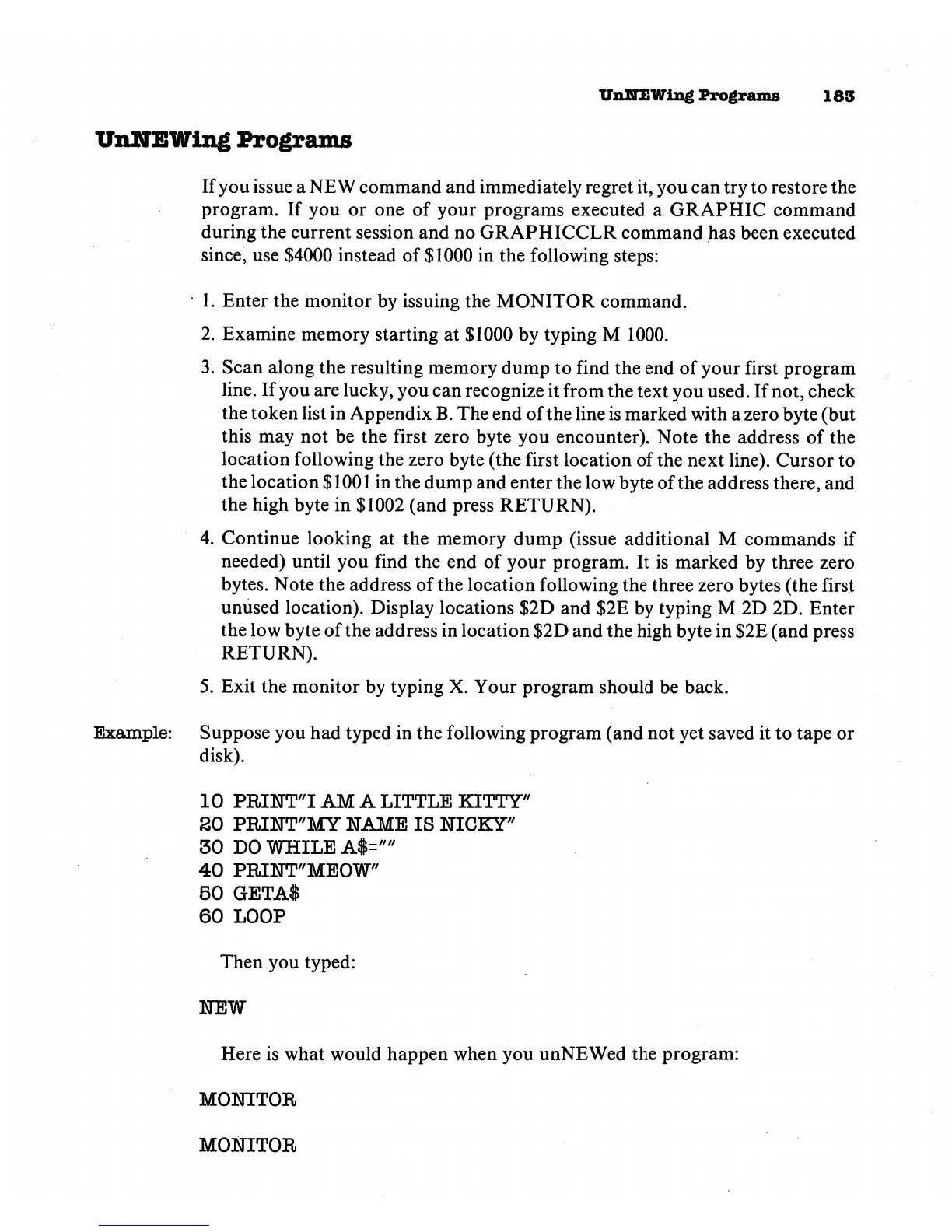
UnNEWing
Programs
If
you
issue
a
NEW
command
and
immediately
regret
it,
you
can
try
to
restore
the
program.
If
you
or
one
of
your
programs
executed
a
GRAPHIC
command
during
the
current
session
and
no
GRAPHICCLR
command
has
been
executed
since,
use
$4000
instead
of
$1000
in
the
following
steps:
1.
Enter
the
monitor
by
issuing
the
MONITOR
command.
2.
Examine
memory
starting
at
$1000
by
typing
M
1000.
3.
Scan
along
the
resulting
memory
dump
to
find
the
end
of
your
first
program
line.
If
you
are
lucky,
you
can
recognize
it
from
the
text
you
used.
If
not,
check
the
token
list
in
Appendix
B.
The
end
of
the
line
is
marked
with
a
zero
byte
(but
this
may
not be
the
first
zero byte
you
encounter).
Note
the
address
of
the
location
following
the
zero
byte
(the
first
location
of
the
next
line).
Cursor
to
the
location
$1001
in
the
dump
and
enter
the
low
byte
of
the
address
there,
and
the
high
byte
in
$1002
(and
press
RETURN).
4.
Continue
looking
at
the
memory
dump
(issue
additional
M
commands
if
needed)
until
you
find
the
end
of
your
program.
It
is
marked
by
three
zero
bytes.
Note
the
address
of
the
location
following
the
three
zero
bytes
(the
first
unused
location).
Display
locations
$2D
and
$2E
by
typing
M
2D
2D.
Enter
the
low
byte
of
the
address
in
location
$2D
and
the
high
byte
in
$2E
(and
press
RETURN).
5.
Exit
the
monitor
by
typing
X.
Your
program
should
be
back.
Example:
Suppose
you
had
typed
in
the
following
program
(and
not
yet
saved
it
to
tape
or
disk).
10
PRINT"I
AM
A
LITTLE
KITTY"
SO
PRINT"MY
NAME
IS
NICKY"
30
DO
WHILE
A$=""
40
PRINT'MEOW"
50
GETA$
60
LOOP
Then
you
typed:
NEW
Here
is
what
would
happen
when
you
unNEWed
the
program:
MONITOR
MONITOR

Other manuals for Commodore Plus 4

Related product manuals