EasyManua.ls Logo

Commodore Plus 4 - Page 216

Commodore Plus 4
464 pages
Print Icon
To Next Page IconTo Next Page
To Previous Page IconTo Previous Page
Loading...
204
Programming
Graphics
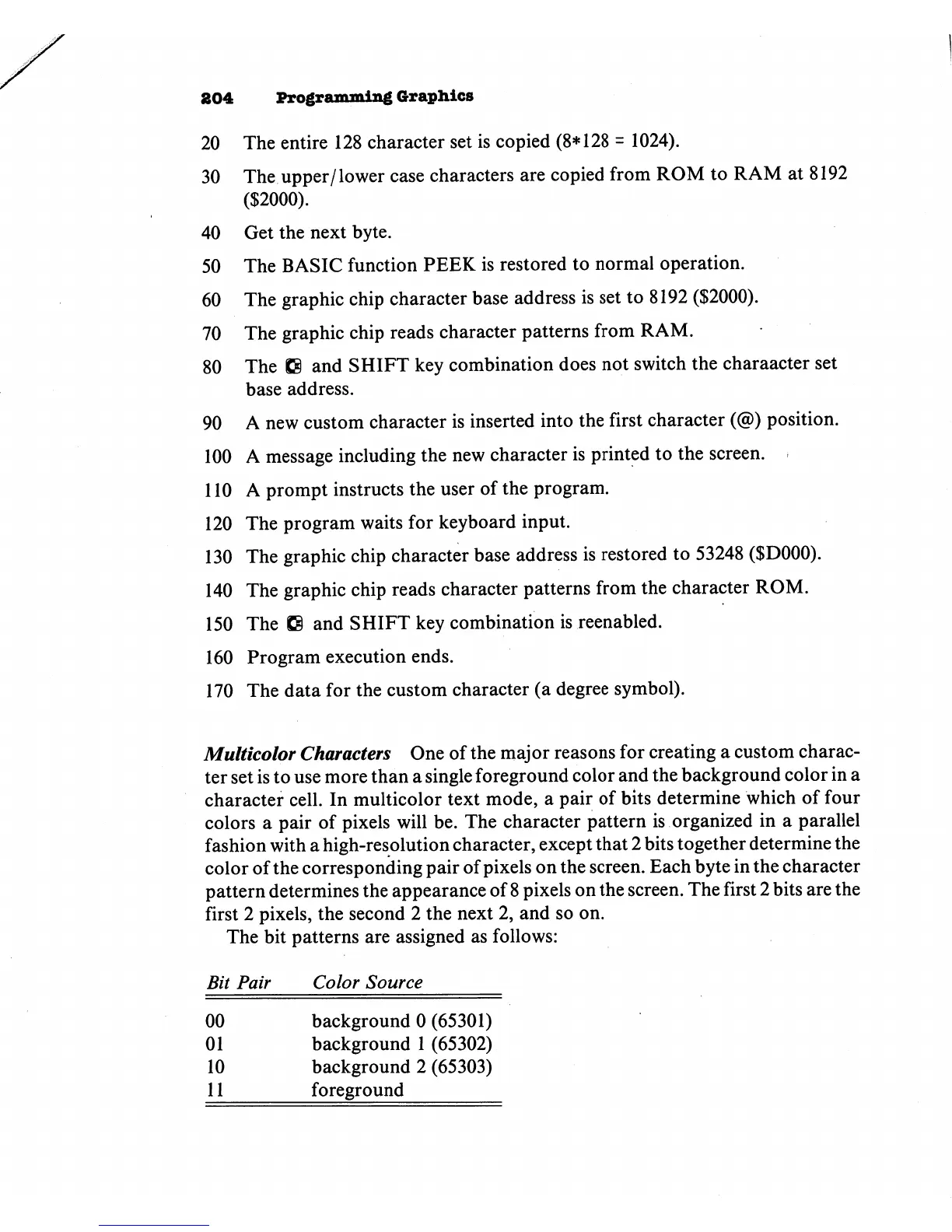
20
The
entire
128
character
set
is
copied
(8*128
=
1024).
30
The
upper/lower
case
characters
are
copied
from
ROM
to
RAM
at
8192
($2000).
40
Get
the
next
byte.
50
The
BASIC
function
PEEK
is
restored
to
normal
operation.
60
The
graphic
chip
character
base
address
is
set
to
8192
($2000).
70
The
graphic
chip
reads
character
patterns
from
RAM.
80
The
and
SHIFT
key
combination
does
not
switch
the
charaacter
set
base
address.
90
A
new
custom
character
is
inserted
into
the
first
character
(@)
position.
100
A
message
including
the
new
character
is
printed
to
the
screen.
110
A
prompt
instructs
the
user
of
the
program.
120
The
program
waits
for
keyboard
input.
130
The
graphic
chip
character
base
address
is
restored
to
53248
($D000).
140
The
graphic
chip
reads
character
patterns
from
the
character
ROM.
150
The
CS
and
SHIFT
key
combination
is
reenabled.
160
Program
execution
ends.
170
The
data
for
the
custom
character
(a
degree
symbol).
Multicolor
Characters
One
of
the
major
reasons
for
creating
a
custom
charac
ter
set
is
to
use
more
than
a
single
foreground
color
and
the
background
color
in
a
character
cell.
In
multicolor
text
mode,
a
pair
of
bits
determine
which
of
four
colors
a
pair
of
pixels
will
be.
The
character
pattern
is
organized
in
a
parallel
fashion
with
a
high-resolution
character,
except
that
2
bits
together
determine
the
color
of
the
corresponding
pair
of
pixels
on
the
screen.
Each
byte
in
the
character
pattern
determines
the
appearance
of
8
pixels
on
the
screen.
The
first
2
bits
are
the
first
2
pixels,
the
second
2
the
next
2,
and
so
on.
The
bit
patterns
are
assigned
as
follows:
Bit
Pair
Color
Source
00
background
0
(65301)
01
background
1(65302)
10
background
2
(65303)
11
foreground

Other manuals for Commodore Plus 4

Related product manuals