EasyManua.ls Logo

Commodore Plus 4 - Page 233

Commodore Plus 4
464 pages
Print Icon
To Next Page IconTo Next Page
To Previous Page IconTo Previous Page
Loading...
Graphics
Programming
in
Machine
Language
ZZ1
the
last
to
the
bottom
row.
The
high
bit
of
each
byte
corresponds
to
the
leftmost
dot
in
the
character
cell
and
the
low
bit
to
the
rightmost
dot.
When
a
bit
is
off,
the
color
of
the
corresponding
dot
comes
from
the
background
color
register
$FF15.
When
a
bit
is
on,
the
color
of
its
dot
comes
from
the
byte
of
color
memory
associated
with
the
character
cell.
Therefore,
each
character
cell
on
the
screen
has
its
own
independent
color
and
a
common
background
color.
Normally,
if
the
screen
code
in
screen
memory
is
greater
than
127,
the
chip
subtracts
128
to
determine
where
the
character's
pattern
is
stored.
But,
when
the
chip
retrieves
the
pattern,
it
reverses
the
roles
of
on
and
off
bits.
Thus,
only
128
patterns
need
to
be
stored
to
obtain
256
characters.
The
second
128
characters
are
exactly
the
reversed
image
of
the
first
128.
If
you
do
not
need
this
reversing
and
would
like
to
have
256
different
characters,
set
bit
7
of
$FF07
to
1,
as
described
in
a
previous
section.
The
color
memory
controls
three
functions.
When
bit
7
is
set,
the
character
is
flashed.
The
next
three
bits
determine
the
luminance
of
the
color
chosen
with
the
low
4
bits.
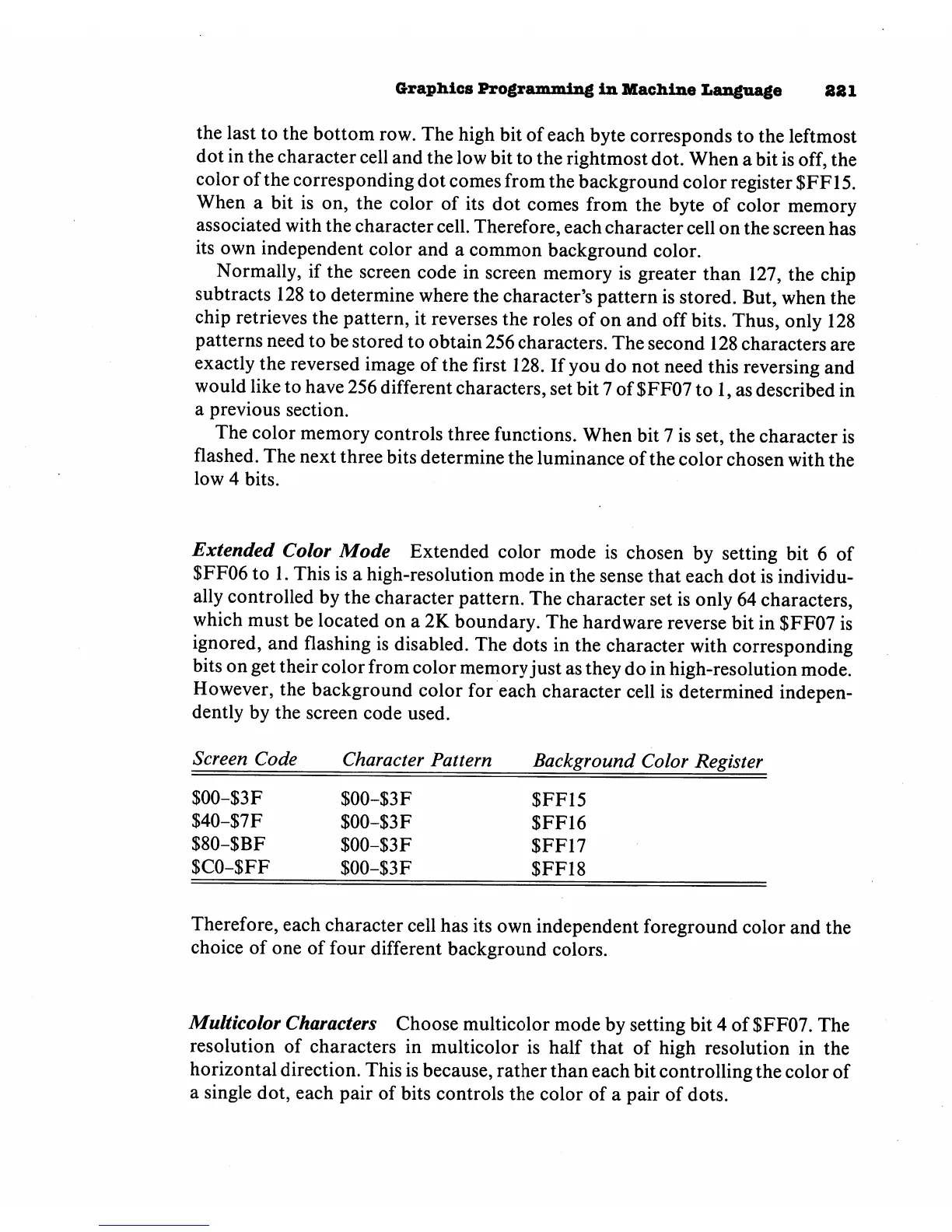
Extended
Color
Mode
Extended
color
mode
is
chosen
by
setting
bit
6
of
$FF06
to
1.
This
is
a
high-resolution
mode
in
the
sense
that
each
dot
is
individu
ally
controlled
by
the
character
pattern.
The
character
set
is
only
64
characters,
which
must
be
located
on
a
2K
boundary.
The
hardware
reverse
bit
in
$FF07
is
ignored,
and
flashing
is
disabled.
The
dots
in
the
character
with
corresponding
bits
on
get
their
color
from
color
memory
just
as
they
do
in
high-resolution
mode.
However,
the
background
color
for
each
character
cell
is
determined
indepen
dently
by
the
screen
code
used.
Background
Color
Register
Screen
Code
$00-$3F
$40-$7F
S80-SBF
$C0-$FF
Character
Pattern
$00-$3F
$00-$3F
$00-$3F
$00-$3F
Backgi
$FF15
$FF16
SFF17
SFF18
Therefore,
each
character
cell
has
its
own
independent
foreground
color
and
the
choice
of
one
of
four
different
background
colors.
Multicolor
Characters
Choose
multicolor
mode
by
setting
bit
4
of
$FF07.
The
resolution
of
characters
in
multicolor
is
half
that
of
high
resolution
in
the
horizontal
direction.
This
is
because,
rather
than
each
bit
controlling
the
color of
a
single
dot,
each
pair
of
bits
controls
the
color
of
a
pair
of
dots.

Other manuals for Commodore Plus 4

Related product manuals