EasyManua.ls Logo

Commodore Plus 4 - Page 234

Commodore Plus 4
464 pages
Print Icon
To Next Page IconTo Next Page
To Previous Page IconTo Previous Page
Loading...
Bit
Maps
ZZZ
Programming
Graphics
Bit
Pair
Color
Source
00
$FF15
01
$FF16
10
$FF17
11
color
memory
The
bits
of
color
memory
are
interpreted
differently.
The
high
(flashing)
bit
is
ignored.
The
next
three
bits
determine
luminance
as
usual.
But
the
foreground
color
is
determined
only
by
the
lower
3
bits
of
the
low
nybble.
The
high
bit
from
the
low
nybble
determines
whether
this
character
is
interpreted
as
high
resolution
or
multicolor.
Thus,
high-resolution
characters
and
multicolor
characters
may
be
mixed,
but
only
the
first
eight
colors
are
available
for
both
types.
There
is
no
hardware
reverse,
but
that
bit
(bit
7
of
$FF07)
still
determines
the
size
of
the
character
set.
If
it
is
clear,
screen
codes
from
128
to
255
result
in
the
same
characters
as
0
through
127.
When
it
is
set,
the
full
256
codes
correspond
to
separate
character
definitions.
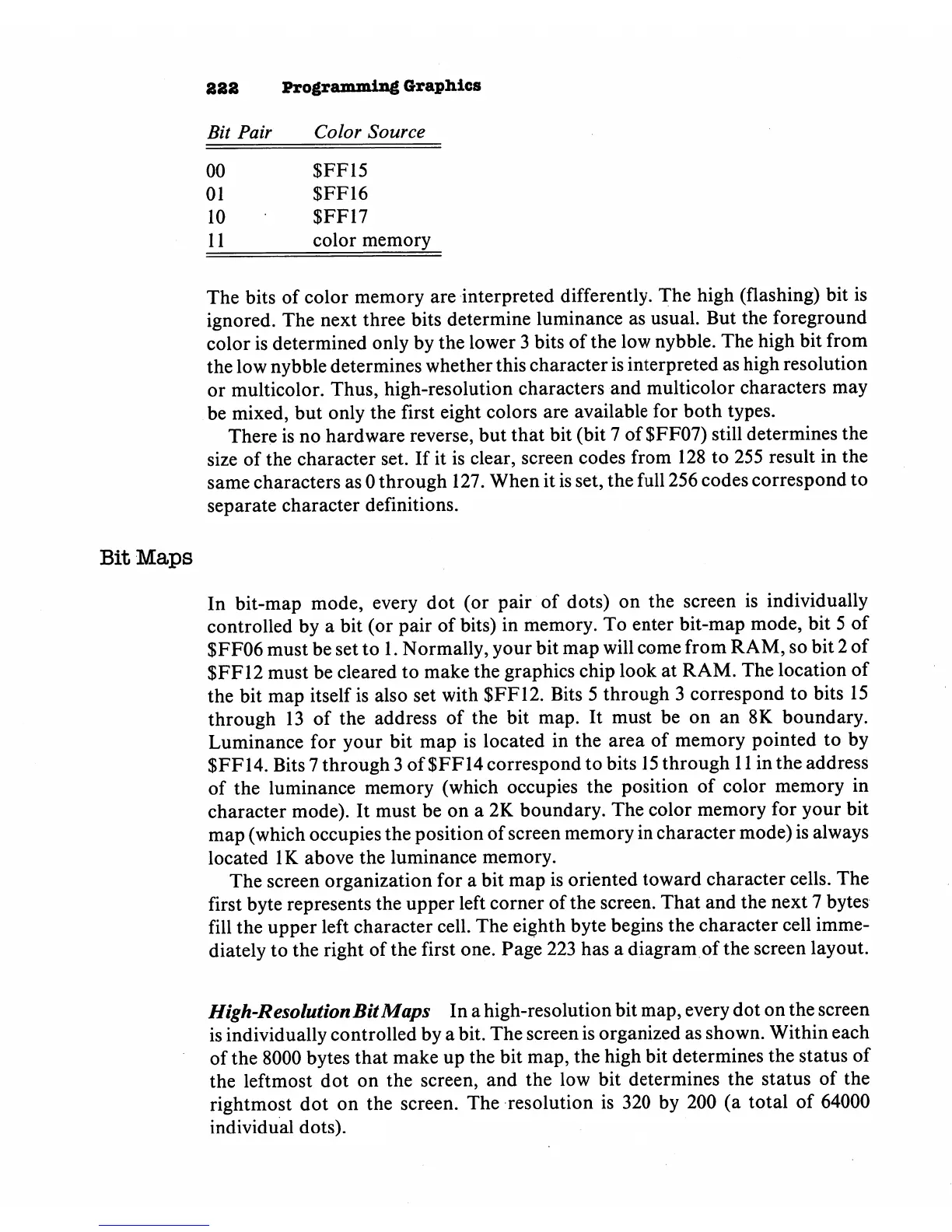
In
bit-map
mode,
every
dot
(or
pair
of
dots)
on
the
screen
is
individually
controlled
by
a
bit
(or
pair
of
bits)
in
memory.
To
enter
bit-map
mode,
bit
5
of
$FF06
must
be
set
to
1.
Normally,
your
bit
map
will
come
from
RAM,
so
bit
2
of
$FF12
must
be
cleared
to
make
the
graphics
chip
look
at
RAM.
The
location
of
the
bit
map
itself
is
also
set
with
$FF12.
Bits
5
through
3
correspond
to
bits
15
through
13
of
the
address
of
the
bit
map.
It
must
be
on
an
8K
boundary.
Luminance
for
your
bit
map
is
located
in
the
area
of
memory
pointed
to
by
$FF14.
Bits
7
through
3
of
$FF14
correspond
to
bits
15
through
11
in
the
address
of
the
luminance
memory
(which
occupies
the
position
of
color
memory
in
character
mode).
It
must
be
on
a
2K
boundary.
The
color
memory
for
your
bit
map
(which
occupies
the
position
of
screen
memory
in
character
mode)
is
always
located
IK
above
the
luminance
memory.
The
screen
organization
for
a
bit
map
is
oriented
toward
character
cells.
The
first
byte
represents
the
upper
left
corner
of
the
screen.
That and
the
next
7
bytes
fill
the
upper
left
character
cell.
The
eighth
byte begins
the
character
cell
imme
diately
to
the
right
of
the
first
one.
Page
223
has a
diagram
of
the
screen
layout.
High-Resolution
Bit
Maps
In a
high-resolution
bit
map,
every
dot
on
the
screen
is
individually
controlled
by
a
bit.
The
screen
is
organized
as
shown.
Within
each
of
the
8000
bytes
that
make
up
the
bit
map,
the
high
bit
determines
the
status
of
the
leftmost
dot
on
the
screen,
and
the
low
bit
determines
the
status
of
the
rightmost
dot
on
the
screen.
The
resolution
is
320
by
200
(a
total
of
64000
individual
dots).

Other manuals for Commodore Plus 4

Related product manuals