EasyManua.ls Logo

Commodore Plus 4 - Page 241

Commodore Plus 4
464 pages
Print Icon
To Next Page IconTo Next Page
To Previous Page IconTo Previous Page
Loading...
Machine-Language
Monitor
Commands
229
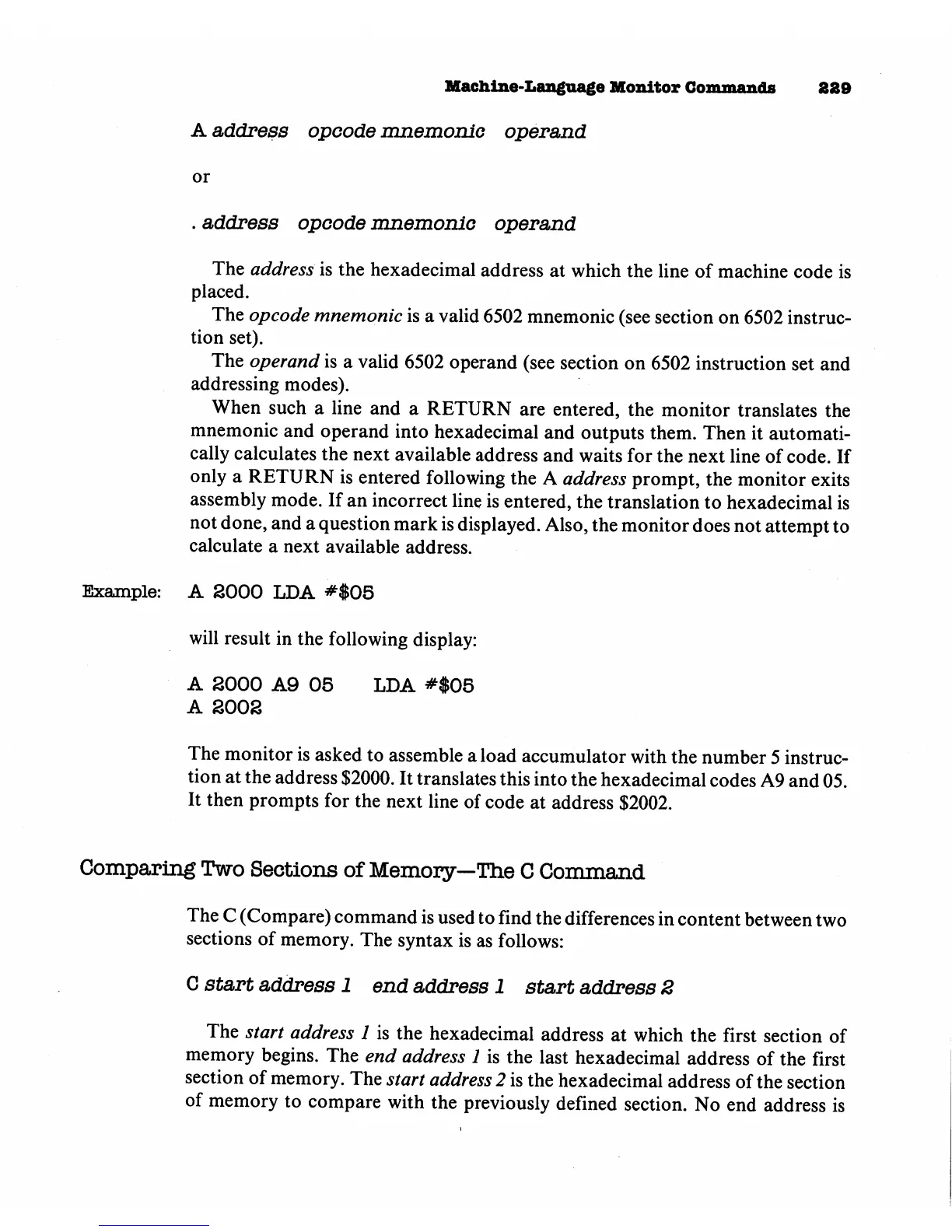
A
address
opcode
mnemonic
operand
or
.
address
opcode
mnemonic
operand
The
address
is
the
hexadecimal
address
at
which
the
line
of
machine
code
is
placed.
The
opcode
mnemonic
is
a
valid
6502
mnemonic
(see
section
on
6502
instruc
tion
set).
The
operand
is
a
valid
6502
operand
(see
section
on
6502
instruction
set
and
addressing
modes).
When
such
a
line
and
a
RETURN
are
entered,
the
monitor
translates
the
mnemonic
and
operand
into
hexadecimal
and
outputs
them.
Then
it
automati
cally
calculates
the
next
available
address
and
waits
for
the
next
line
of
code.
If
only
a
RETURN
is
entered
following
the
A
address
prompt,
the
monitor
exits
assembly
mode.
If
an
incorrect
line
is
entered,
the
translation
to
hexadecimal
is
not
done,
and
a question
mark
is
displayed.
Also,
the
monitor
does
not
attempt
to
calculate
a next
available
address.
Example:
A
2000
LDA
#$05
will
result
in
the
following
display:
A
2000
A9
05
LDA
#$05
A
SOOS
The
monitor
is
asked
to
assemble
a
load
accumulator
with
the
number
5
instruc
tion
at
the
address
$2000.
It
translates
this
into
the
hexadecimal
codes
A9
and
05.
It
then
prompts
for
the
next
line
of
code
at
address
$2002.
Comparing
Two
Sections
of
Memory—The
C
Command
The
C
(Compare)
command
is
used
to find
the
differences
in
content
between
two
sections
of
memory.
The
syntax
is
as
follows:
C
start
address
1
end
address
1
start
address
2
The
start
address
1
is
the
hexadecimal
address
at
which
the
first
section
of
memory
begins.
The
end
address
1
is
the
last
hexadecimal
address of
the
first
section
of
memory.
The
start
address
2
is
the
hexadecimal
address
of
the
section
of
memory
to
compare
with
the
previously defined
section.
No
end
address
is

Other manuals for Commodore Plus 4

Related product manuals