EasyManua.ls Logo

Commodore Plus 4 - Page 242

Commodore Plus 4
464 pages
Print Icon
To Next Page IconTo Next Page
To Previous Page IconTo Previous Page
Loading...
230
Machine
Language
on
the
Commodore
Plus/4
needed
for
the
second
section
of
memory;
it
is
assumed
to
be
the
same
length
as
the
first
section.
The
specified
end
and
start
points
are
included
in
the
Compare.
The
monitor
reports
in
ascending
order
all
addresses
from
the
first
section
that
do
not
have
the
same
contents
as
the
corresponding
address
in
the
second
section.
If
the
two
sections
of
memory
are
found
to
be
identical,
only
a
RETURN
is
output.
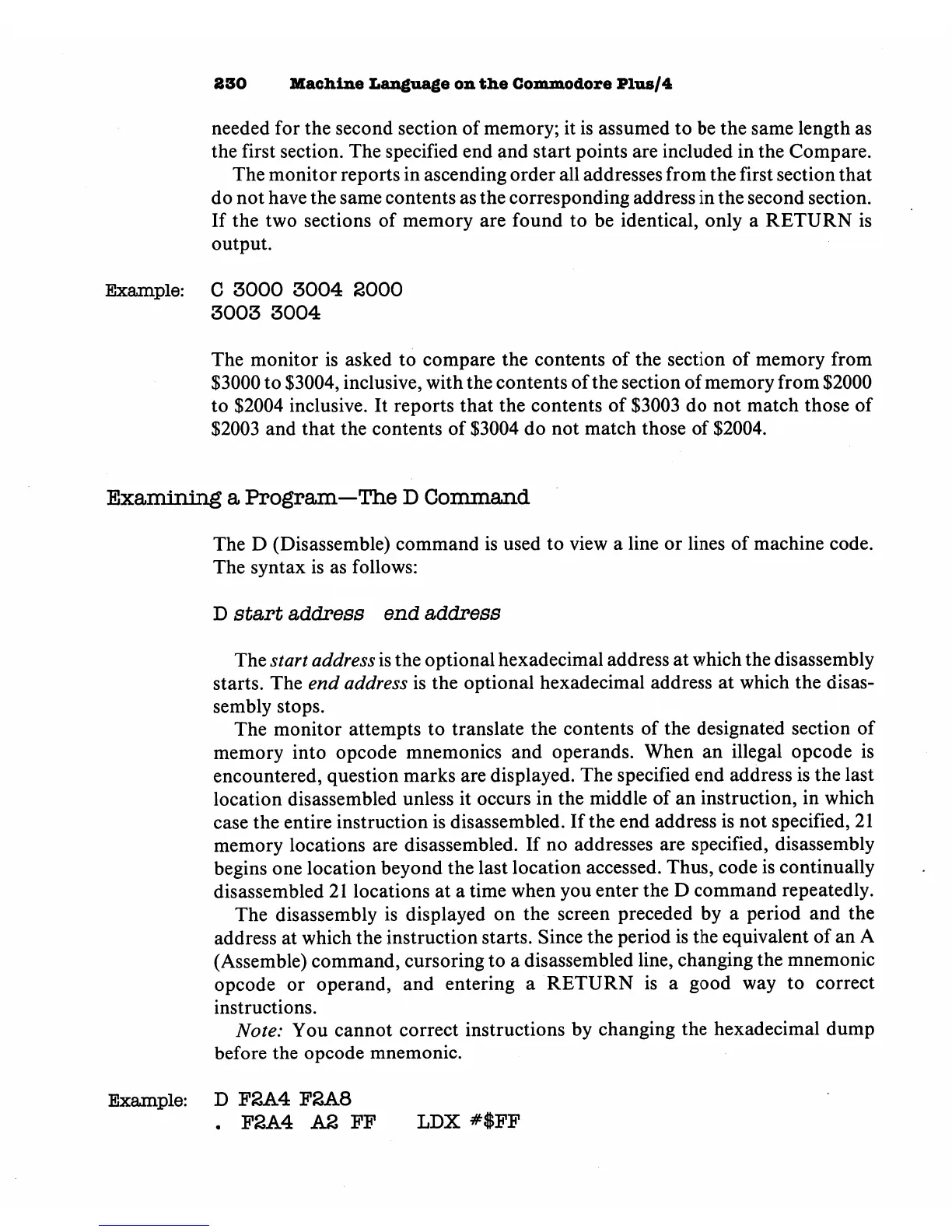
Example:
C
3000
3004
2000
3003
3004
The
monitor
is
asked
to
compare
the
contents
of
the
section
of
memory
from
$3000
to
$3004,
inclusive,
with
the
contents
of
the
section
of
memory
from
$2000
to
$2004
inclusive.
It
reports
that
the
contents
of
$3003
do
not
match
those
of
$2003
and
that
the
contents
of
$3004
do
not
match
those
of
$2004.
Examining
a
Program—The
D
Command
The
D
(Disassemble)
command
is
used
to
view
a
line
or
lines
of
machine
code.
The
syntax
is
as
follows:
D
start
address
end
address
The
start
address
is
the
optional
hexadecimal
address
at
which
the
disassembly
starts.
The
end
address
is
the
optional
hexadecimal
address
at
which
the
disas
sembly
stops.
The
monitor
attempts
to
translate
the
contents
of
the
designated
section
of
memory
into
opcode
mnemonics
and
operands.
When
an
illegal
opcode
is
encountered,
question
marks
are
displayed.
The
specified
end
address
is
the
last
location
disassembled
unless
it
occurs
in
the
middle
of
an
instruction,
in
which
case
the
entire
instruction
is
disassembled.
If
the
end
address
is
not
specified,
21
memory
locations
are
disassembled.
If
no
addresses
are
specified,
disassembly
begins
one
location
beyond
the
last
location
accessed.
Thus,
code
is
continually
disassembled
21
locations
at
a
time
when
you
enter
the
D
command
repeatedly.
The
disassembly
is
displayed
on
the
screen
preceded
by
a
period
and
the
address
at
which
the
instruction
starts.
Since
the
period
is
the
equivalent
of
an
A
(Assemble)
command,
cursoring
to
a
disassembled
line,
changing
the
mnemonic
opcode
or
operand,
and
entering
a
RETURN
is
a
good
way
to
correct
instructions.
Note:
You
cannot
correct
instructions
by
changing
the
hexadecimal
dump
before
the
opcode
mnemonic.
Example:
D
F2A4
F&A8
.
F2A4
AS
FF
LDX
#$FF

Other manuals for Commodore Plus 4

Related product manuals