EasyManua.ls Logo

Commodore Plus 4 - Page 344

Commodore Plus 4
464 pages
Print Icon
To Next Page IconTo Next Page
To Previous Page IconTo Previous Page
Loading...
332
Using
Peripheral
Devices
where
filenumber
is
the
logical
file
number
to
be
associated
with
the
command
channel
and
device
is
the
device
number
of
the
disk.
As
usual,
when
communica
tion
through
the
command
channel
is
complete
it
must
be
closed
as
follows:
CLOSE
filenumber
where
filenumber
is
the
same
logical
file
number
used
to
open
the
channel.
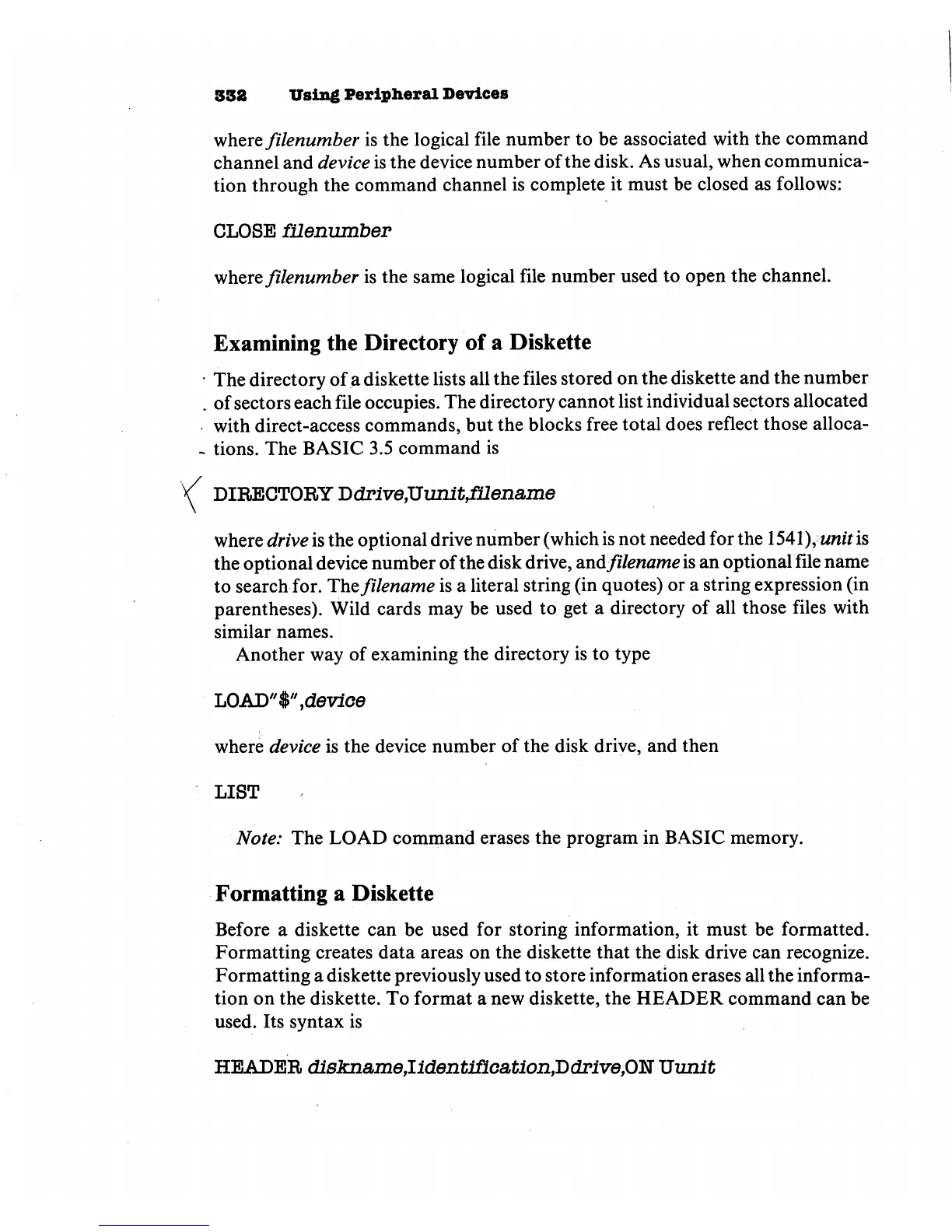
Examining
the
Directory
of
a
Diskette
The
directory
of
a
diskette
lists
all
the
files
stored
on
the
diskette
and
the
number
of
sectors
each
file
occupies.
The
directory
cannot
list
individual
sectors
allocated
with
direct-access
commands,
but
the
blocks
free
total
does
reflect
those
alloca
tions.
The
BASIC
3.5
command
is
DIRECTORY
DdrivePunitfflename
where
drive
is
the
optional
drive
number
(which
is
not
needed
for
the
1541),
unit
is
the
optional
device
number
of
the
disk
drive,
and
filename
is
an
optional
file
name
to
search
for.
The
filename
is
a
literal
string
(in
quotes)
or
a
string
expression
(in
parentheses).
Wild
cards
may
be
used
to
get
a
directory
of
all
those
files
with
similar
names.
Another
way
of
examining
the
directory
is
to
type
LOAD"
$",device
where
device
is
the
device
number
of
the disk
drive,
and
then
LIST
Note:
The
LOAD
command
erases
the
program
in
BASIC
memory.
Formatting
a
Diskette
Before
a
diskette
can
be
used
for
storing
information,
it
must
be
formatted.
Formatting
creates
data
areas
on
the
diskette
that
the
disk
drive
can
recognize.
Formatting
a
diskette
previously
used
to
store
information
erases
all
the
informa
tion
on
the
diskette.
To
format
a
new
diskette,
the
HEADER
command
can
be
used.
Its
syntax
is
HEADER
diskname
^identification,!^
drive,ON
Uunifc