EasyManua.ls Logo

Commodore Plus 4 - Page 345

Commodore Plus 4
464 pages
Print Icon
To Next Page IconTo Next Page
To Previous Page IconTo Previous Page
Loading...
The
Disk
Drive
333
where
the
diskname
is
a
string
of
up
to
16
characters
that
is
displayed
whenever
a
directory
of
the
disk
is
requested.
The
disknameis
a
literal
string
(in
quotes)
or
a
string
expression
(in
parentheses).
The
identification
is
two
characters
that
the
DOS
uses
to identify
the
disk.
It
is
a
good
idea
to
give
a
different
identification
to
each
disk.
For
a
brand
new
disk,
an
identification
must
be
given,
but
an
old
disk
can
be
cleared
of
information
more
quickly
by
omitting
the
identification
parameter.
The
drive
number
is
required
(for
the
1541,
use
0).
The
unit
number,
which
is
optional,
is
the
device
number
for
the
disk
drive.
It
is
set
by
the
factory
to
8.
The
device
number
can
be
changed
in
the
hardware
according
to
instructions
in
the
disk
drive
manual.
The
device
number
can
also
be
changed
temporarily
by
the
disk
address
change
utility
program
on
the
diskette
that
comes
with
the
drive.
Whenever
the
device
number
is
optional
in
a
command,
it
is
assumed
to
be
8
if
omitted.
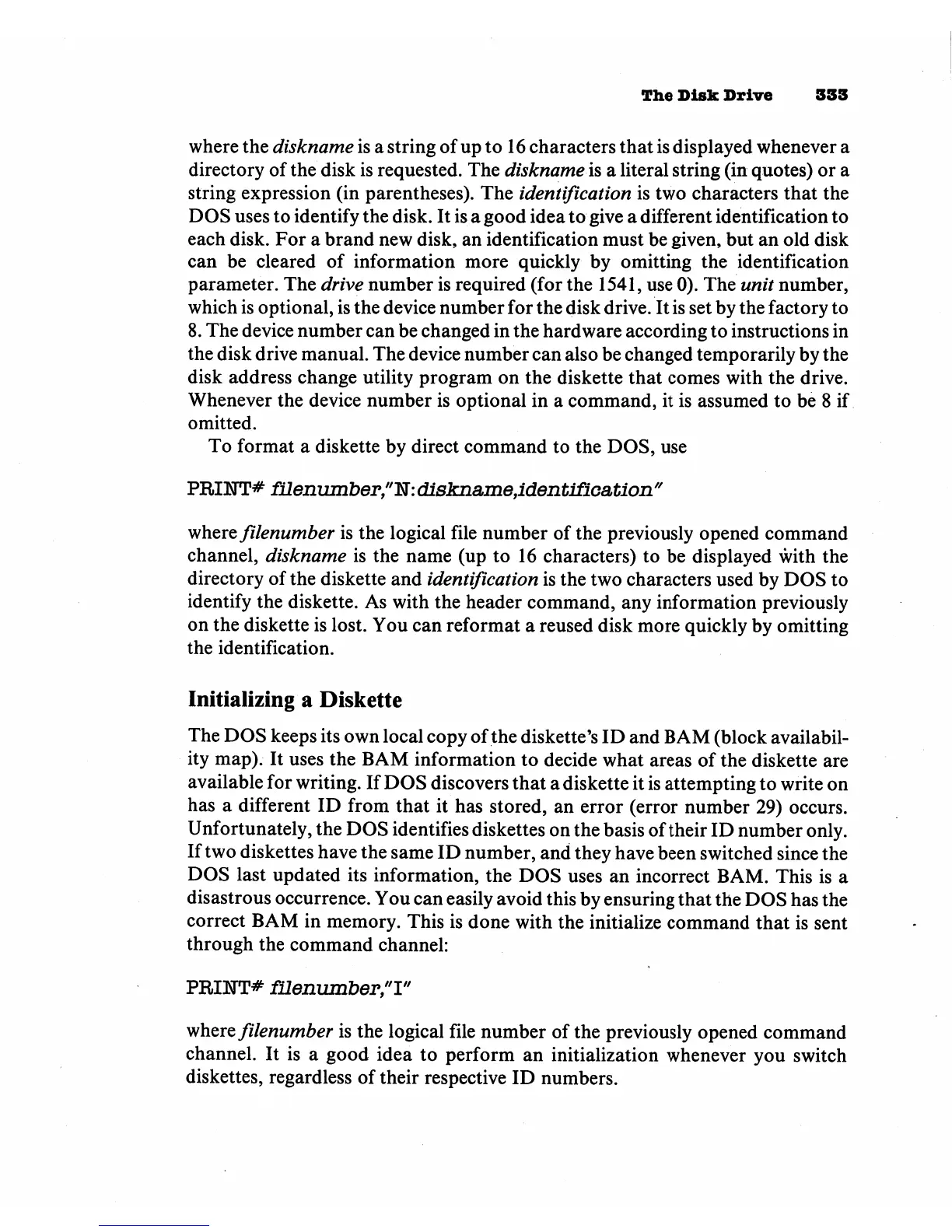
To
format
a
diskette
by
direct
command
to
the
DOS,
use
PRIWT#
where
filenumber
is
the
logical
file
number
of
the
previously
opened
command
channel,
diskname
is
the
name
(up
to
16
characters)
to
be
displayed
with
the
directory
of
the
diskette
and
identification
is
the
two
characters
used
by
DOS
to
identify
the
diskette.
As
with
the
header
command,
any
information
previously
on
the
diskette
is
lost.
You
can
reformat
a
reused
disk
more
quickly
by
omitting
the
identification.
Initializing
a
Diskette
The
DOS
keeps
its
own
local
copy
of
the
diskette's
ID
and
BAM
(block
availabil
ity
map).
It
uses
the
BAM
information
to
decide
what
areas
of
the
diskette
are
available
for
writing.
If
DOS
discovers
that
a
diskette
it
is
attempting
to
write
on
has
a
different
ID
from
that
it
has
stored,
an
error
(error
number
29)
occurs.
Unfortunately,
the
DOS
identifies
diskettes
on
the
basis
of
their
ID
number
only.
If
two
diskettes
have
the
same
ID
number,
and
they
have been
switched
since
the
DOS
last
updated
its
information,
the
DOS
uses
an
incorrect
BAM.
This
is
a
disastrous
occurrence.
You
can
easily
avoid
this
by
ensuring
that
the
DOS
has
the
correct
BAM
in
memory.
This
is
done
with
the
initialize
command
that
is
sent
through
the
command
channel:
PRINT*
filenumber/'I"
where
filenumber
is
the
logical
file
number
of
the
previously
opened
command
channel.
It
is
a
good
idea
to
perform
an
initialization
whenever
you
switch
diskettes,
regardless
of
their
respective
ID
numbers.