EasyManua.ls Logo

Commodore Plus 4 - Page 196

Commodore Plus 4
234 pages
Print Icon
To Next Page IconTo Next Page
To Previous Page IconTo Previous Page
Loading...
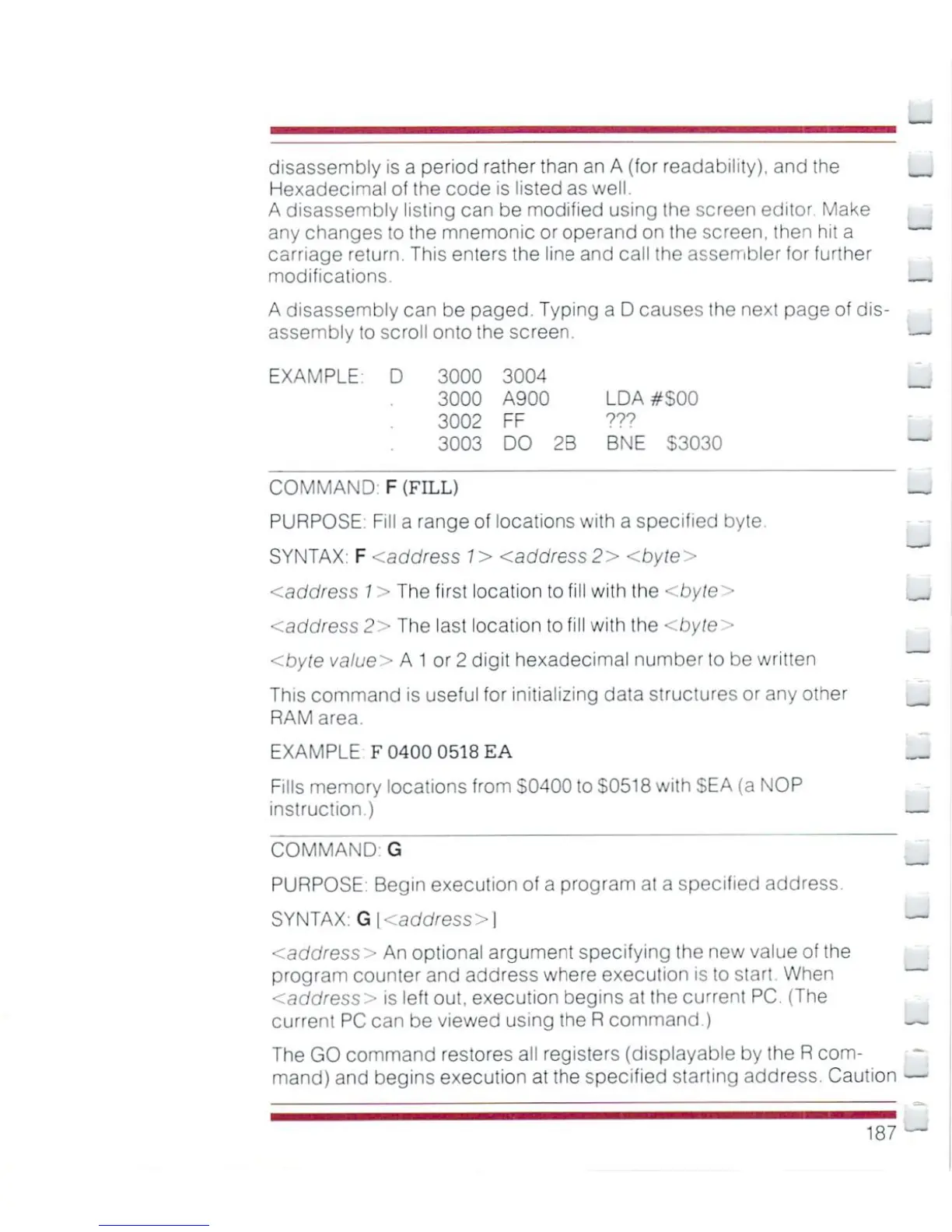
disassembly
is
a
period
rather
than
an
A
(for
readability),
and
the
Hexadecimal
of
the
code
is
listed
as
well.
A
disassembly
listing
can
be
modified
using
the
screen
editor.
Make
any
changes
to
the
mnemonic
or
operand
on
the
screen,
then
hit
a
carriage
return.
This
enters
the
line
and
call
the
assembler
(or
further
modifications
A
disassembly
can be
paged.
Typing
a
D
causes
the
next
page
of
dis
assembly
to scroll
onto
the
screen
—-
EXAMPLE:
D
3000 3004
3000
A900
LDA#S00
3002
FF
TO.
3003
DO
2B
BNE
$3030
COMMAND:
F
(FILL)
__
PURPOSE.
Fill
a
range
of
locations
with
a
specified
byte.
i
SYNTAX:
F
oddress
1>
oddress
2>
<byte>
oddress
1
>
The
firs!
location
to
fill
with
the
<by!e>
oddress
2>
The
last
location
to
fill
with
the
<byte>
<by(e valued
A
1
or
2
digit
hexadecimal
number
to
be
written
This
command
is
useful
for
initializing
data
structures
or
any
other
RAM
area.
EXAMPLE
F
0400
0518
EA
Fills
memory
locations
from
50400
to
S0518
with
SEA
(a
NOP
instruction
)
COMMAND:
G
PURPOSE
Begin
execution
of
a
program
at
a
specified
address.
SYNTAX:
G[
oddress
>}
Oddress
>
An
optional
argument
specifying
the
new
value
of
the
program
counter
and
address
where
execution
is
to
start
When
<address>
is
left
out.
execution
begins
at
the
current
PC. (The
current
PC
can
be
viewed
using
the
R command.)
The
GO
command
restores
all
registers
{displayable
by
the
R
com
mand)
and
begins
execution
at
the
specified
starting
address.
Caution
_
187"

Other manuals for Commodore Plus 4

Related product manuals