EasyManua.ls Logo

Commodore VIC-20 - Page 34

Commodore VIC-20
308 pages
Print Icon
To Next Page IconTo Next Page
To Previous Page IconTo Previous Page
Loading...
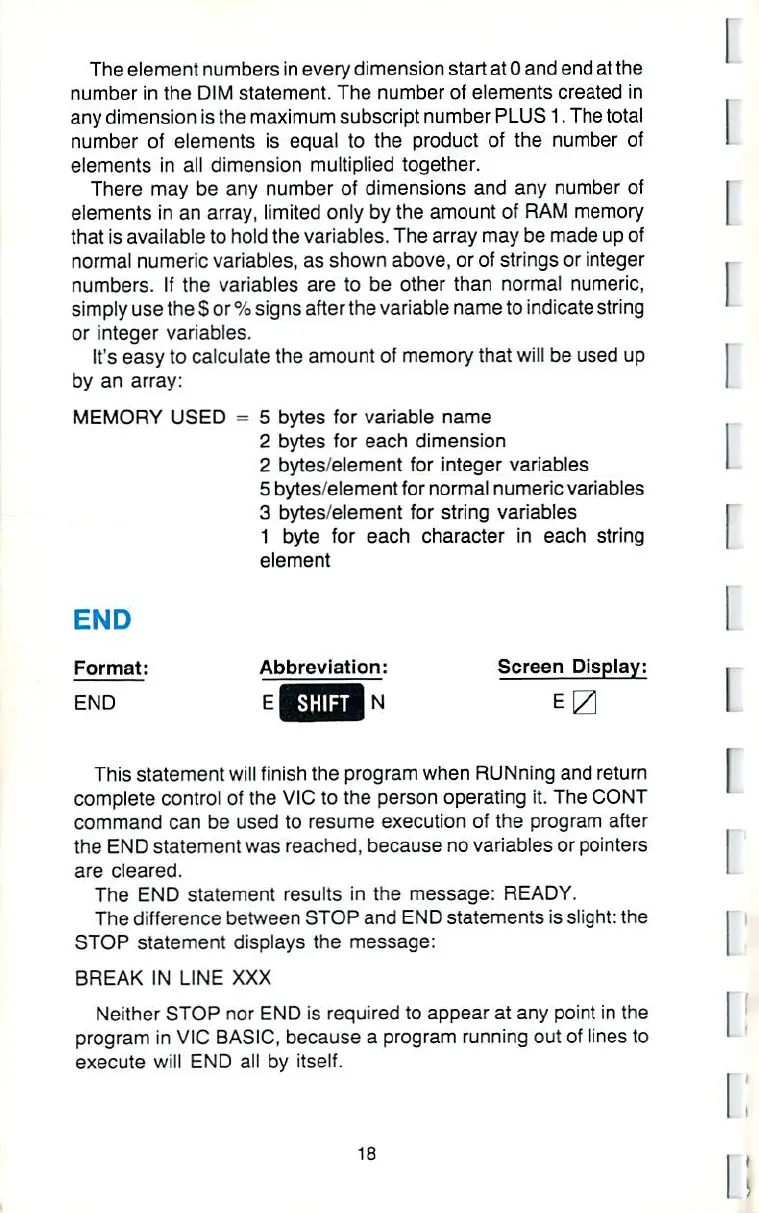
The
element
numbers
in
every
dimension
start
at
0
and
end
at
the
number
in
the
D!M
statement.
The
number
of
elements
created
in
any
dimension
is
the
maximum
subscript
number
PLUS
1.
The
total
number
of
elements
is
equal
to
the
product
of
the
number
of
elements
in
ah
dimension
multiplied
together.
There
may
be
any
number
of
dimensions
and
any
number
of
elements
in
an
array,
limited
only
by
the
amount
of
RAM
memory
that
is
available
to
hold
the
variables.
The
array
may
be
made
up
of
normal
numeric
variablesI
as
shown
above,
or
o1
strings
or
integer
numbers.
If
the
variables
are
to
be
other
than
normal
numeric,
simply
use
the
S
or
%
signs
after
the
variable
name
to
indicate
string
or
integer
variables.
It's
easy
to
calculate
the
amount
oi
memory
that
will
be
used
up
by an
array:
MEMORY
USED
-
5
bytes
for
variable
name
2
bytes
for
each
dimension
2
bytes/element
for
integer
variables
5
bytes/element
for
normal
numeric
variables
3
bytes/element
for
string
variables
1
byle
for
each
character
in
each
string
element
END
Format;
Abbreviation:
Screen
Display:
i
END
eRV^|n
E0
This
statement
will
finish
the
program
when
RUNning
and
return
complete
control
of
the
VIC
to
the
person
operating
it.
The
CONT
command
can
be
used
to
resume
execution
of
the
program
after
the
END
statement
was
reached,
because
no
variables
or
pointers
are
cleared.
The
END
statement
results
in
the
message:
READY.
The
difference
between
STOP
and
END
statements
is
slight:
the
STOP
statement
displays
the
message:
BREAK
IN
LINE
XXX
Neither
STOP
nor
END
is
required
to
appear
at
any
point
in
the
program
in
VIC
BASIC,
because
a
program
running
out
of
lines
to
execute
will
END
all
by
itself.
i;

Other manuals for Commodore VIC-20

Related product manuals