EasyManua.ls Logo

Commodore VIC-20 - Page 73

Commodore VIC-20
308 pages
Print Icon
To Next Page IconTo Next Page
To Previous Page IconTo Previous Page
Loading...
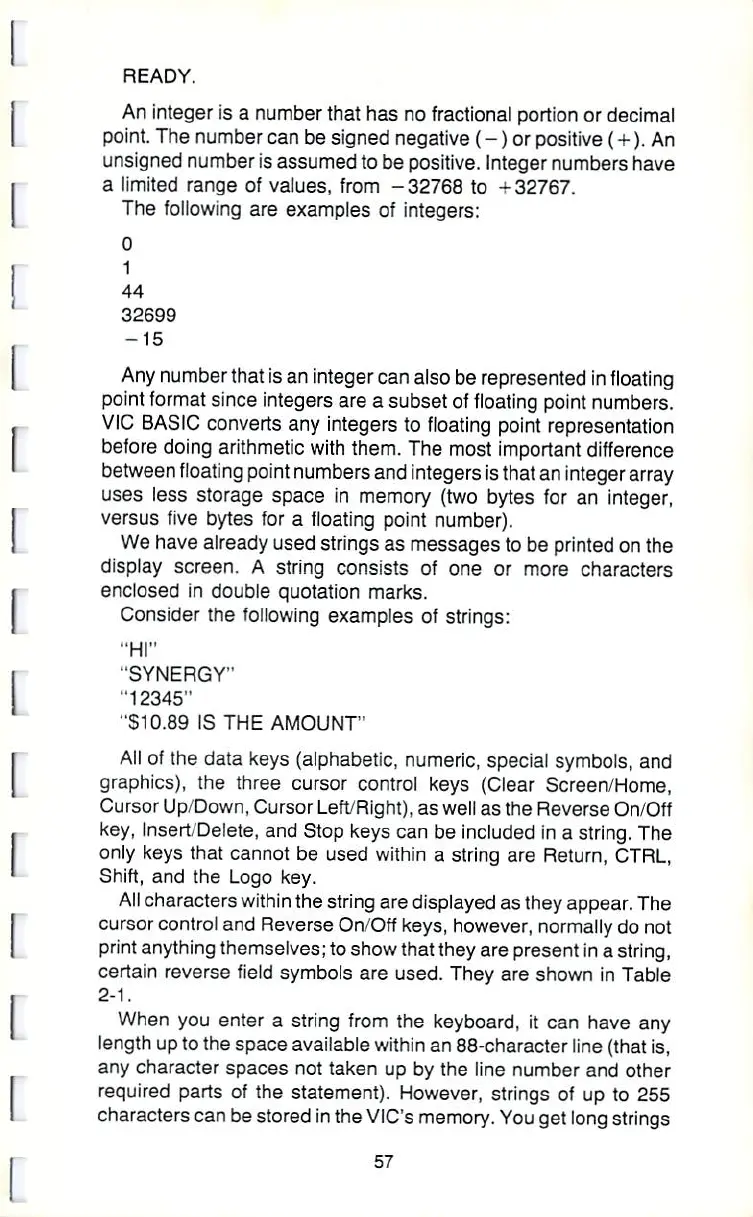
READY.
An
integer
is
a
number
that
has
no
fractional
portion
or
decimal
point.
The number
can
be
signed
negative
(-)
or
positive
(+).
An
unsigned
number
is
assumed
to
be
positive.
Integer
numbers
have
a
limited
range
of
values,
from
-32768
to
+
32767.
The
following
are
examples
of
integers:
0
1
44
32699
-15
Any
number
that
is
an
integer
can
also
be
represented
in
floating
point
format
since
integers
are
a subset
of
floating
point
numbers.
VIC
BASIC
converts
any
integers
to
floating
point
representation
before
doing
arithmetic
with
them.
The
most
important
difference
between
floating
point
numbers
and
integers
is
that
an
integer
array
uses
less
storage
space
in
memory
(two
bytes
for
an
integer,
versus
five
bytes
for
a
floating
point
number).
We
have
already
used
strings
as
messages
to
be
printed
on
the
display
screen.
A
string
consists
of
one
or
more
characters
enclosed
in
double
quotation
marks.
Consider
the
following
examples
of
strings:
â– 'HI"
"SYNERGY"
"
12345"
â– $10.89
IS
THE
AMOUNT"
All
of
the
data
keys
(alphabetic,
numeric,
special
symbols,
and
graphics),
the three
cursor
control
keys
(Clear
Screen/Home,
Cursor
Up/Down,
Cursor
Left/Right),
as
well
as
the
Reverse
On/Off
key,
Insert/Delete,
and
Stop
keys
can
be
included
in
a
string.
The
only
keys
that
cannot
be used
within
a
siring
are
Return,
CTRL,
Shift,
and
the
Logo
key.
All
characters
within
the
string
are
displayed
as
they
appear.
The
cursor
control
and
Reverse
On/Off
keys,
however,
normally
do
not
print
anything
themselves;
to
show
that
they
are
present
in
a
string,
certain
reverse
field
symbols
are
used.
They
are
shown
in
Table
2-1.
When
you
enter
a
string
from
the
keyboard,
it
can
have
any
length
up
to
the
space
available
within
an
88-character
line
(that
is,
any
character
spaces
not
taken
up
by
the
line
number
and
other
required
parts
of
the
statement).
However,
strings
of
up
to
255
characters
can
be
stored
in
the
VIC's
memory.
You
get
long
strings
57

Other manuals for Commodore VIC-20

Related product manuals