EasyManua.ls Logo

Commodore VIC-20 - Page 75

Commodore VIC-20
308 pages
Print Icon
To Next Page IconTo Next Page
To Previous Page IconTo Previous Page
Loading...
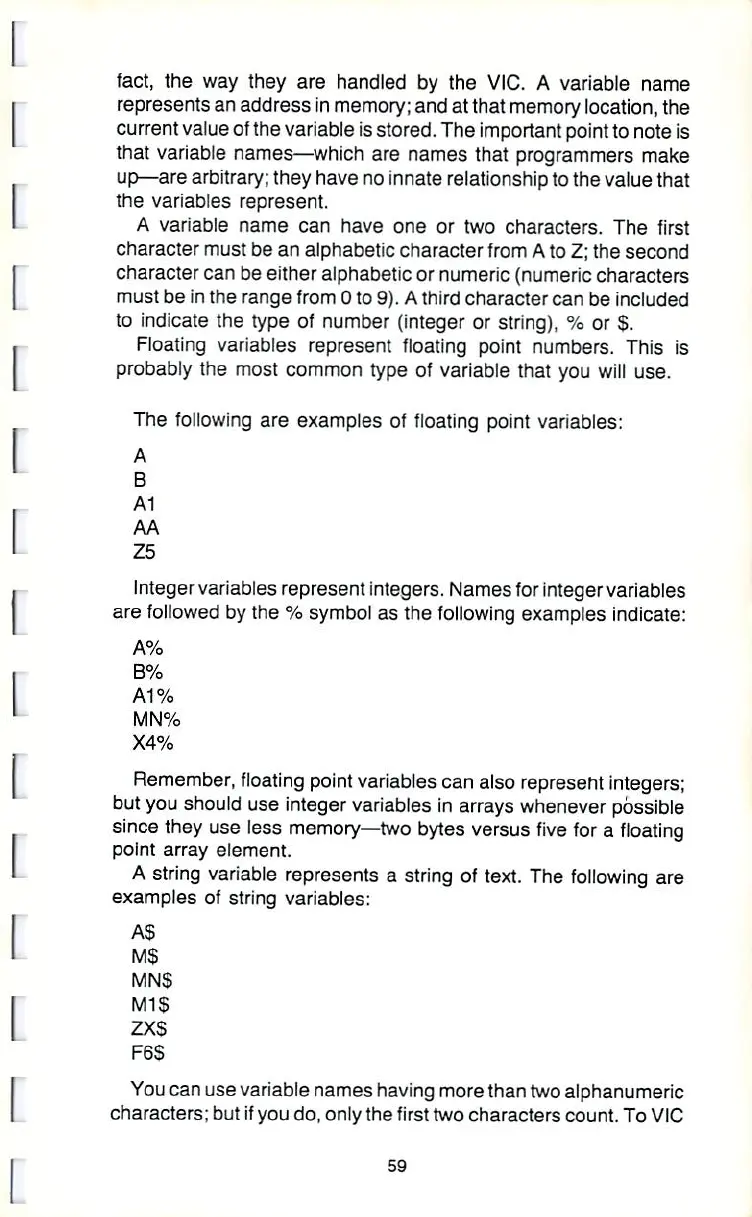
fact,
the
way
they
are
handled
by
the
VIC.
A
variable
name
represents
an
address
in
memory;
and
at
that
memory
location,
the
current
value
of
the variable
is
stored.
The
important
point
to
note
is
that
variable
names—which
are
names
that
programmers
make
up—are
arbitrary;
they
have
no
innate
relationship
to
the
value
that
the
variables represent.
A
variable
name
can
have
one
or
two
characters.
The
first
character
must
be
an
alphabetic
character
from
A
to Z;
the
second
character
can
be
either
alphabetic
or
numeric
{numeric
characters
must
be
in
the
range
from 0
to
9).
A
third
character
can
be
included
to
indicate
the
type
of
number
(integer
or
string),
%
or
S.
Floating
variables
represent
floating
point
numbers.
This
is
probably
the
most
common
type
of
variable
that
you
will
use.
The
following
are
examples
of
floating
point
variables:
A
B
A1
AA
Z5
Integer
variables
represent
integers.
Names
for
integer
variables
are
followed
by
the
%
symbol
as
the
following
examples
indicate:
A%
B%
A1%
MN%
X4%
Remember,
floating
point
variables
can
also
represent
integers;
but
you
should
use
integer
variables
in
arrays
whenever
possible
since
they
use
less
memory—two
bytes
versus
five
for
a
floating
point
array
element.
A
string
variable
represents
a
string
of
text.
The
following
are
examples
of
string
variables:
A$
M$
MNS
M1$
2XS
F6S
You
can
use
variable
names
having
more
than
two
alphanumeric
characters;
but
if
you
do,
only
the
first
two
characters
count.
To
VIC
59

Other manuals for Commodore VIC-20

Related product manuals