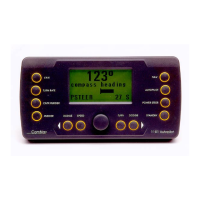
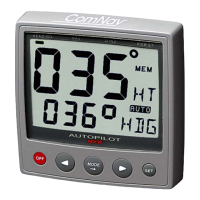
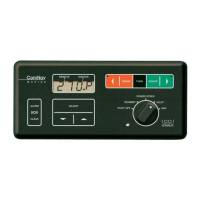
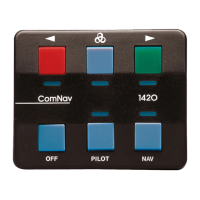
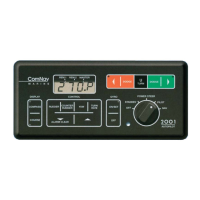
ComNav 1101 Autopilot BASIC OPERATIONS 6 - 8
Transfer to Aux/Remote Control
To take control at a Remote or Auxiliary Station that is not currently
in command you must press and hold the two PORT/STBD DODGE
buttons at the same time. The Autopilot will beep once and you
should be able to use the Remote/Auxiliary Station to control the
vessel. The Unit that was in control will now be flashing NOT IN
COMMAND. To reclaim command at another station, you must once
again press and hold the two PORT/STBD DODGE buttons at the
other station.
Sea Trials in AUTOPILOT Mode
You are now ready to optimize steering per formance in AUTOPILOT
mode for your vessel. Ensure that you have completed all the setup
and Sea Trail procedures in the Getting Started section before
attempting these Sea Trials. In this section you will set the Speed
Trip Point, adjust the yaw, rudder, counter rudder and turn rate
settings, and select the type of Special Turn for your vessel.
Many ComNav owners choose to have their ComNav dealers
conduct initial Sea Trials to optimize the per formance of their 1101
Autopilot.
Effects of Speed on Turning Performance
You will know from having steered your boat manually that it takes
much less rudder movement to turn your vessel when traveling at
high speed. Therefore, the Fast settings for rudder and counter
rudder should be lower than the Slow settings. Turn rate should be
set for the maximum safe turn rate when traveling at high speed.
Your vessel is unlikely to be able to turn as quickly at low speed, so
the same turn rate setting may be used for both Fast and Slow.
Because vessels usually decrease their speed as the weather
worsens (and the effects of wave action increase), the Fast setting
for yaw normally should be lower than the Slow setting.
Larger vessels with displacement hulls and modest cruising speeds
may not display much variation in turning performance as speed
increases. Turning characteristics of small, fast vessels,
particularly those with semi-displacement or planing hulls, can vary
quite dramatically with speed. Before setting your speed trip point
be sure that you understand how your vessel handles through its
entire speed range and at what point the turning characteristics
change noticeably. Set the trip point low to begin with; you may
choose to increase it later as you gain experience using your
ComNav Autopilot.
Make sure your vessel
is well clear of any
obstacles and other
marine traffic before
commencing Sea Trials


 To Next Page
 Loading...