
 Need help?
Do you have a question about the Conquip Trench Box and is the answer not in the manual?
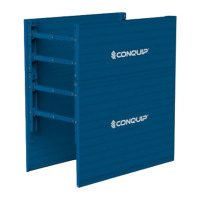
Details the Conquip 3.5m Trench Box as a two-sided lining support system for utility pipes, installed via excavator.
Lists product codes, dimensions, weight, and load capacity for Trench Base Box and Extension Box.
Illustrates and lists components of the Trench Base Box, including panels, rocker assemblies, and pins.
Illustrates and lists components of the Trench Extension Box, including panels, rocker assemblies, and connecting brackets.
Key considerations for assembling Trench Boxes, including strut fitting and handling.
Detailed instructions for assembling the Trench Box, from panel placement to final securing.
Mandatory safety and operational guidelines for installing Trench Boxes.
Step-by-step guide for excavating and installing the Trench Box using the 'dig and push' method.
Steps 1-6 for safely lifting and extracting the extension box, including backfilling and edge protection.
Instructions for attaching Edge Protection panels to the Trench Box during excavation.
Steps 9-11 for detaching and removing the extension box from the base box.
Steps 12-17 for removing the base box, considering wind loading and final site work.
Essential safety precautions and recommended Personal Protective Equipment (PPE) for operating the Trench Box.
Guidelines for personnel competency, fitness, and equipment inspection/maintenance.
Information on the 12-month warranty, including coverage, exclusions, and modification policies.
Notes on the user guide's applicability, planning for movements, and personnel briefing.
Requirements for personnel competency and fitness, plus contact details for support.
The Conquip Trench Box is a robust and versatile trench lining support system designed for safe and efficient excavation work, particularly for installing utility pipes where ground movement is not critical. This system is engineered for ease of assembly and installation, primarily utilizing an excavator with a "dig and push" technique, or by lowering the box into a pre-excavated trench. Its modular design allows for adaptability to various trench depths and widths, making it a flexible solution for a range of construction projects.
The primary function of the Conquip Trench Box is to provide a safe working environment within an excavation by preventing trench collapse. It consists of two main components: base boxes and extension boxes, which are assembled to form a protective enclosure. The system is designed to support the trench walls, ensuring stability for personnel working inside and protecting against the hazards of unstable ground. The trench box is particularly suited for utility pipe installations, where it can be progressively installed as excavation proceeds. The "dig and push" method involves the excavator digging between the box panels and simultaneously pushing the box downwards, allowing for continuous and efficient trenching. Alternatively, the box can be lowered into an already excavated trench. The rocker assemblies integrated into the design allow for both vertical and horizontal movement when force is applied by the excavator bucket, which helps to prevent damage to the box panels during installation and ensures a snug fit against the trench walls. This dynamic movement capability is crucial for adapting to varying ground conditions and maintaining the integrity of the support system.
The Conquip Trench Box is designed with several features to enhance its usability and safety during operation. Assembly is straightforward, beginning with laying timber bearers on the ground to support the panels. A certified 4-leg chain sling is used to lift and position the panels. Rocker assemblies are then inserted into panel brackets and secured with 40mm pins and R-clips. The pre-assembled struts are lowered onto the rocker assemblies and secured, followed by connecting the remaining rocker assemblies to the struts. Once assembled, the lifting sling is connected to the top lifting points to bring the box to an upright working position, ready for deployment.
During installation, the ground is first excavated to a depth of approximately 90cm or more, depending on ground conditions. The assembled trench box is then lowered into the trench using a certified 4-leg chain sling. The excavator operator progressively digs between the box panels, and the box is pushed downwards. This "dig and push" technique continues until the desired depth is achieved. For deeper trenches, extension boxes can be added. Connectors are attached to each corner inside the base box and secured with pins and R-clips. An extension box is then lowered on top of the base box using a certified 4-leg chain, and secured with pins and R-clips. It is critical that lifting chains are only removed once the extension box is fully secured. The system is designed to protrude about 1m above ground level before adding an extension box, which acts as a safety barrier. Edge protection panels can also be attached to the trench box to further enhance safety.
Extraction of the trench box involves backfilling the excavation around the extension box. A certified lifting chain is attached to one of the top lifting points of the extension box, and the corner is slowly lifted. This process is repeated for each lifting point until the extension box is approximately 90cm above ground level. Telescopic clamps are then loosened, and edge protection panels are removed. The extension box is disconnected from the base box by removing R-clips and pins, and then slowly lifted away from the excavation. To prevent instability due to wind loading, Conquip recommends connecting a lifting sling to the top lifting points of the extension box and lowering it on its side once it's out of the trench. The R-clips, pins, and connectors are then removed from the base box. The trench is backfilled, and the base box is extracted using the same method as the extension box. Once all trench boxes are extracted, the remainder of the trench is filled, and all equipment is removed from the area.
Maintaining the Conquip Trench Box is crucial for ensuring its continued safe and effective operation. Regular thorough examinations by a qualified engineer are mandatory to comply with relevant regulations; Conquip recommends these examinations every six months. Before each use, the equipment must be inspected by a responsible person, and regularly thereafter, as determined by risk assessment or working practice. Any concerns about the condition or suitability of the equipment should lead to its immediate withdrawal from service.
The product may incorporate various loose and detachable items of lifting gear, each requiring adherence to separate requirements for safe use. When not in use, the unit should be stored in a clean, upright condition in a safe place, protected from theft and unauthorized access. It is important to note that any third-party modifications or alterations, including drilling, welding, cutting, or distortion of materials, require full written approval from Conquip Engineering Group prior to being carried out. Furthermore, any alterations, modifications, additions, or repairs must be performed by Conquip Engineering Group's recognized distributors if the work is not carried out by Conquip themselves. This ensures that the structural integrity and safety standards of the trench box are maintained. The equipment's serial plate indicates the maximum Working Load Limit (WLL), which must never be exceeded, and the WLL on individual lift points must also be respected. Before lifting, the load must be checked to ensure it is secured, balanced, and stable, allowing for movement if the load shifts. This proactive approach to maintenance and inspection helps to extend the lifespan of the equipment and uphold safety standards on site.
 General
| Type | Trench Box |
|---|---|
| Material | Steel |
| Weight | Varies by size |
| Depth Rating | Varies by model |
| Width | Varies by model |
| Length | Varies by model |

 To Next Page