2
S225-10-10
6-2
Function Code 56, Reverse Sensing Mode. Set it
to 0, if it is not there already. Retry the automatic
mode of operation.
2. Verify that Function Code 69 (Auto Blocking) is set
to 0 (Off). Retry the automatic mode of operation.
3. Measure the voltage from V
S
to G on lower terminal
board TB
2
.
a. A measurement of approximately the set
voltage value at V
S
to G indicates that the
problem is in the control.
b. If there is no voltage present at V
S
to G, the
trouble is in the V
1
disconnect or ratio correcting
transformer of the rear signal circuit. Replace
them.
4. If check “a” indicates that the trouble is in the
control, refer to Control Troubleshooting.
5. Check the hold switch circuit.
a. The tap changer will complete a tap change by
placing the control function switch to MANUAL
and toggling and holding the raise/lower switch
in the desired direction for 2 seconds.
b. If the raise/lower switch must be held in the
RAISE or LOWER position to complete a tap
change, the problem is in the “hold switch”
circuit.
c. Check for voltage between TB
2
-HS and G,
and TB
1
-HS and G. If voltage is present at
TB
1
-HS and not on TB
2
-HS, the problem is in
the back panel wiring harness. Replace the
orange HS lead from TB
1
-HS to TB
2
-HS. If no
voltage is present at TB
1
-HS, the problem is in
the control cable, junction box cover or the
hold switch (located inside the regulator) itself.
Check cable continuity up to the junction box. If
it appears normal, the problem is the hold
switch. Adjust or replace it (See S225-10-2). If all
appears to be in order, the problem is not in the
hold switch, but most likely in the control.
The Regulator Operates Manual-
ly but Operates Incorrectly
When Set On Automatic
Diagnosing Trouble:
Run the regulator to the neutral position with the control
switch. Check for voltage between V
4
and G on TB
1
.
This is the sensing circuit supplying voltage from the
output of RCT
1
on the rear panel. If this voltage is more
than 10% above or below the programmed voltage level
setting of the control, then the source is beyond the
range of the regulator. An absence of voltage would
indicate a wiring problem such as an open somewhere in
the control power supply. If these checks are correct,
then the malfunction is probably in the control. Refer to
Control Troubleshooting, following.
Control Troubleshooting
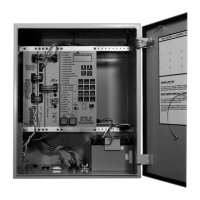
At this point, the problem has been determined to be in
the control, so the front panel should be taken out of the
control cabinet to a service bench for troubleshooting.
Figure 6-2, page 6-7 can be used to aid the trouble-
shooting process. The panel components are checked
by using an external voltage of approximately 120 V ac,
60/50 Hz, applied to the external source terminals of
the control.
To gain access to the front panel components, first
remove the back shield. This is accomplished by
removing the cable clamp attached to the shield side,
and then removing the four nuts which secure the shield
to the front panel.
1. Check the motor and panel fuses to ensure they
have not blown.
2. Connect the power source to the external source
terminals, observing the proper polarity.
Place the power switch on the EXTERNAL position.
3. The control display should light. If the display does
not light, measure the voltage on the printed circuit
board from terminals P
5
-4 to P
5
-3, expecting to
measure approximately 120 V ac.
4. If the display does not light and no voltage is
measured from terminals P
5
-4 to P
5
-3, then the
problem is in the power switch. The power
(Internal-Off-External) switch can be checked by
measuring the voltage from switch terminal PS
2
to
ground, switch terminal PS
5
to ground, and switch
terminal PS
8
to ground. These measurements
should equal the external voltage applied. If not,
the power switch is defective.
5. If the display does not light and voltage is
measured from terminals P
5
-4 to P
5
-3, then the
circuit board is defective and must be returned to
the factory for repair.
6. If the display does light, but reports the FAIL
message, then the internal diagnostics have
detected a problem. When the word FAIL appears,
it does not necessarily indicate the control is
malfunctioning.
Display Function Code 95.
WARNING: Correct polarity must be adminis-
tered to the control. Failure to do so will cause
a short circuit of the users’ voltage supply and
possible damage to the control.


 To Next Page
 Loading...