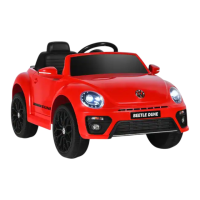
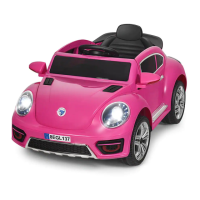
This document provides a comprehensive guide for the assembly, operation, and maintenance of the Mercedes-AMG G63 licensed battery-powered ride-on car. Designed for children aged 3 and above, this toy vehicle offers an engaging and realistic driving experience, emphasizing safety and ease of use. Adult supervision is required for all aspects of installation, charging, and operation to ensure a secure environment for the child.
Function Description
The ride-on car is a battery-powered vehicle designed to simulate the experience of driving a Mercedes-AMG G63. It features a foot pedal for acceleration and braking, a steering wheel for directional control, and a shift switch to change between forward, stop, and backward movements. The vehicle is equipped with a control board that includes various functions such as a power display, light control, music playback, and speed settings.
The power display allows users to monitor the battery level, indicating when charging is necessary. A dedicated light button enables turning the vehicle's lights on or off, enhancing the realism of the driving experience. The music button activates pre-loaded songs, while "last song" and "next song" buttons allow for track selection. Long pressing these buttons adjusts the volume. The power button serves to turn the vehicle on and off with a long press, and a short press stops the music.
For speed control, the vehicle offers "high speed" and "low speed" buttons, allowing the child to drive at different paces. Additionally, the ride-on car incorporates wireless technology, enabling connection to a mobile phone for playing music through the vehicle's speakers. An FM radio function is also available.
The vehicle comes with a remote control, which provides an alternative method of operation. The remote control allows an adult to steer the car, control its speed (low, middle, high), and apply an emergency brake. This feature is particularly useful for younger children who may not yet have full control over the vehicle, ensuring their safety and allowing parents to intervene if necessary. The remote control also has an energy-saving mode, automatically shutting off after 10 seconds of inactivity.
Usage Features
The ride-on car is designed for use in safe riding areas, such as flat surfaces within a house, garden, or playground. It should never be used on roadways, near motor vehicles, on steep inclines or steps, or near swimming pools or other bodies of water. Operation is recommended during the daytime or in well-lit areas to avoid unexpected obstacles and potential accidents.
The vehicle is equipped with adjustable play seat belts, and children should be instructed on how to properly fasten them to ensure security during operation. Protective equipment, such as a helmet, gloves, knee pads, and elbow pads, is recommended to prevent injuries from falls or collisions.
The assembly process involves installing various components such as the front bumper trim, front bumper, steering wheel, trunk, windshield, tailstock, car windows, rearview mirrors, foot pedals, drive motors, and wheels. Each step is clearly outlined with diagrams to guide the user. The steering wheel requires connecting wires from the steering column, and the trunk is fixed to the car body with screws. The car windows are clipped into the doors and secured with screws, and rearview mirrors are clipped into the car windows. Foot pedals are installed in designated positions and fixed with screws, with a note to distinguish between left and right pedals.
The drive motors and wheels are installed by inserting the rear axle into the car body, then placing the drive motors onto the rear axle and securing them into the body slots. The front and rear wheels are then attached using gaskets and nuts, which are tightened with a M10 wrench, and finally covered with wheel caps.
Electrical connections are crucial for the vehicle's operation. The main power cord under the seat needs to be plugged into the receiver's corresponding socket. The drive motor cable is also docked with the receiver's plug, which does not distinguish between left and right.
Charging the battery is a straightforward process. The charger jack is inserted into the charging hole of the car, and the charger plug is connected to a stable AC power supply. It is emphasized that only an adult should perform charging and recharging. Before first-time use, the battery requires an initial charge of 4 to 6 hours, not exceeding 15 hours.
Maintenance Features
Regular maintenance is essential to ensure the longevity and safe operation of the ride-on car. Users are advised to periodically inspect wires and connections of the vehicle. All screws, cap nuts, and protective coverings should be checked regularly and tightened as required.
The product is equipped with a self-resetting protector that automatically cuts off the power supply for 15-20 seconds in case of overload or improper use, then restarts. To prevent power loss, users should avoid overloading the vehicle (maximum 130 lbs) and refrain from towing anything behind it. It is also crucial not to immerse electrical components, such as wiring and batteries, in water or other liquids.
Battery maintenance is critical. Only the supplied rechargeable battery and charger should be used; substituting with other brands can lead to fire or explosion. The battery and charger should not be used for any other product. The electric circuit system should never be modified, as tampering can cause shock, fire, explosion, or permanent damage. Direct contact between battery terminals must be avoided, and no liquid should come into contact with the battery or its components. Charging should always occur in a well-ventilated area, away from flammable materials, as explosive gases are created during charging.
Rechargeable batteries must be removed from the toy before charging and should only be charged under adult supervision. If the vehicle is not used for an extended period, the battery should be charged at least once a month to prolong its life.
Cleaning the vehicle should be done with a dry, soft cloth. Non-waxy furniture polishing material can be used to wipe plastic parts for a surface finish effect. Chemical solvents, soap, and water should not be used to clean plastic parts or the vehicle, as water can damage motors, electrical systems, and batteries. The vehicle should not be driven in rainy or snowy weather.
When the product is not in use or being stored, the power supply should be cut off, and all switches should be in the stop or closed position. It is important not to use fuses that do not conform to the product's specifications. Any alterations to the structure or circuit system of the product without authorization are prohibited. Maintenance work, if required, must be carried out under the guidance of professional or technical personnel.
Troubleshooting guidance is provided for common issues such as the car moving without sound or light, wheels not moving, intermittent movement, and remote control unresponsiveness. For instance, if the car moves but has no sound or light, users are advised to check the acoustooptic switch and the battery connections. If wheels do not move, checking the drive rotation and gearbox is recommended. If the vehicle moves intermittently, checking the rider's weight and the terrain is suggested. For remote control issues, checking the brake function, battery power, and wiring harness is advised.



 To Next Page
 General