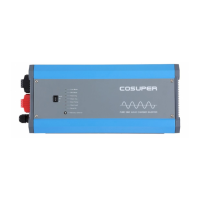
The CPT series inverter charger is a pure sine wave device designed to convert 12V DC input into AC power, available in 2000W and 3000W models. This versatile unit combines an inverter, a battery charger, and an AC autotransfer switch into a single system, boasting a peak conversion efficiency of 88%. It is specifically designed for applications where a reliable and clean AC power source is critical, such as in renewable energy systems, RVs, marine environments, and for emergency appliances.
Function Description
At its core, the CPT inverter charger functions as a power conversion and management system. As an inverter, it transforms 12V DC power from a battery bank into pure sine wave AC power, suitable for sensitive electronics and motor-driven appliances. The pure sine wave output ensures that connected devices operate smoothly without the static or interference often associated with modified sine wave inverters. This makes it ideal for running laptop computers, medical equipment, televisions, and fluorescent lights.
The integrated battery charger allows the unit to replenish the connected battery bank when an external AC utility power source or generator is available. It supports various battery types, including Lithium, Gel, AGM, and Wet, and features a multi-stage charging process (Bulk, Absorption, Float) to optimize battery health and longevity. The charge current can be adjusted, offering flexibility based on battery capacity and charging requirements.
A key feature of the CPT series is its automatic and uninterruptible transfer switch. In the event of a utility power failure or when the generating set is switched off, the device seamlessly switches from utility power to inverter operation, ensuring a continuous power supply to connected devices. This rapid transfer prevents interruptions to computers and other electronic equipment, effectively providing Uninterruptible Power Supply (UPS) functionality. This makes it highly suitable for critical applications where power continuity is essential.
The device also incorporates a Power Factor Corrected (PFC) multistage battery charger, which helps to optimize the charging process and improve overall system efficiency. It can manage output power based on input AC voltage, ensuring stable operation even with fluctuating utility power.
Usage Features
The CPT inverter charger is designed for ease of use and adaptability across various applications. It supports a wide range of power tools, including circular saws, drills, grinders, and air compressors, as well as office equipment like computers, printers, and scanners. For household use, it can power vacuum cleaners, fans, lights, TVs, refrigerators, microwaves, and coffee machines. Industrial applications include metal halide lamps and high-pressure sodium lamps.
One of its notable usage features is the battery priority customization via a DIP switch. This allows users to configure the system to prioritize drawing maximum power from the battery in renewable energy setups, optimizing energy utilization. The DIP switches also allow for adjustment of output frequency (50Hz/60Hz), AC output voltage (110V/120V or 220V/230V), and DC/AC priority, providing significant flexibility to match regional power standards and specific application needs. However, it is explicitly stated that modifications to these switches should only be made with authorization, as frequency changes can be dangerous.
The device includes an auto gen start function. When the battery voltage drops to a low level, the inverter will alarm and send a boost signal to start a connected backup generator. Once the battery voltage recovers to the rated level, the generator will automatically turn off. This feature enhances reliability and ensures continuous power in off-grid or backup power scenarios.
Monitoring the inverter's status is facilitated by a 7-LED indicator system and an audible alarm. The LEDs provide visual cues for various operating modes, including Line Mode, Inverter Mode, Fast Charging, Float Charging, Over Temperature, Overload, and Save On mode. The audible alarm system provides alerts for conditions such as low battery voltage, high battery voltage, inverter mode overload, and over temperature, with distinct beep patterns to indicate the severity and type of alert. For example, a low battery triggers a 0.5s beep every 5s, while an overload can lead to more frequent beeps and eventual shutdown.
Remote control options are available through RJ45 communication ports, supporting both PTM-12 and CR10 remote panels. These remote controllers allow users to monitor system overview, input/output status, battery voltage, output frequency, load percentage, and work mode, as well as manage alarms and faults. The inverter charger can be controlled from either the main unit or the remote panel, but it is crucial not to cut the communication cable during operation or when the inverter is off, as this can damage the remote PCB.
Maintenance Features
The CPT inverter charger is designed with several features that contribute to its maintainability and safe operation. The manual emphasizes the importance of proper installation, including mounting in a dry, cool, and ventilated area, and ensuring secure cable connections. It also highlights the necessity of installing an ANL type fuse and fuse holder close to the positive battery bank terminal to protect against accidental DC cable shorts and potential battery explosions.
For troubleshooting, the manual provides a comprehensive table linking symptoms (e.g., inverter not turning on, low AC output voltage, charger inoperative) to possible causes (e.g., loose battery connections, low battery voltage, improper charger controls) and suggested solutions (e.g., checking battery connections, verifying AC voltage, adjusting charge rate). This structured approach helps users diagnose and resolve common issues efficiently.
The device includes internal protection mechanisms such as overcharge protection for the battery and automatic shutdown in case of overload or over temperature. The fan operation is temperature and current controlled, with different speeds (50% or 100%) activated based on heat sink temperature, charge current, and load percentage, ensuring optimal cooling and preventing overheating.
Regarding internal components, the manual explicitly states that the inverter charger should not be disassembled by the user. Internal capacitors can remain charged even after power is disconnected, posing a risk of electrical shock. Any servicing should be performed by a qualified electrical appliance repairer. Before any repair, the DC supply must be disconnected, and the ON/OFF switch of the inverter should be turned ON to discharge the capacitors.
The manual also addresses common user questions, such as why the inverter turns off (often due to overload, low battery voltage, or insufficient cable size) and why certain appliances might not run despite drawing less power than the inverter's rating (due to different load types like resistive, inductive, and capacitive). It also explains the importance of correct battery polarity to prevent damage to sensitive electronic components and advises against reverse connections.
Finally, the CPT series is built to meet safety and EMC standards, including UL458: 2015 Ed.6, CSA C22.2, and FCC part15 Class A, ensuring its reliability and compliance with regulatory requirements.



 To Next Page
 General