INSTALLATION
4
CL491 (11-04-19)
Risk of electric shock and explosion.
Disconnect all power to pump and bleed all pressure
from system before working on pump, tank, or piping.
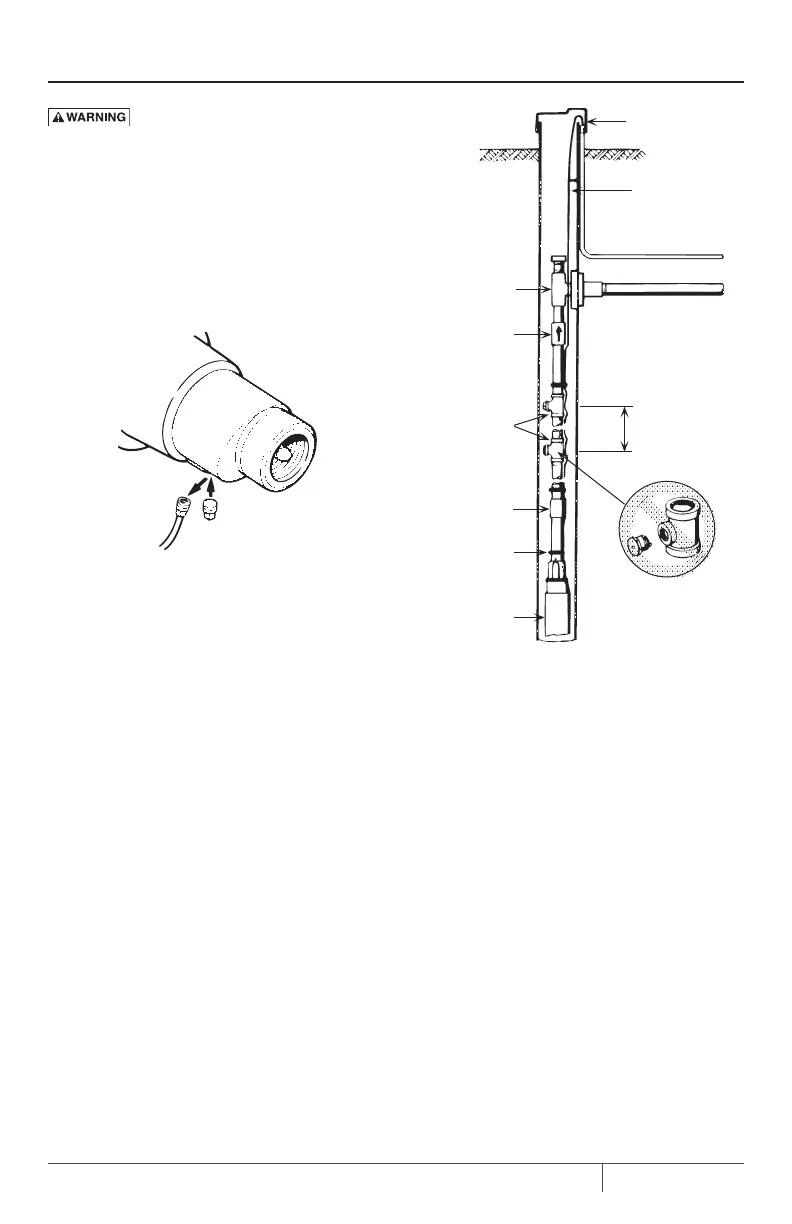
For jet pump installation, remove AVC tube from port in
pump body or jet body and plug port (see Figure 3). New
pumpscomewithpluginstalled.
NOTICE: When working on submersible pumps in wells,
be sure safety rope is solidly connected to pump and
securely anchored at the well head at all times. Do not
dropthepumpdownthewell!
Bleeder Orifices
For submersible pump installations, there may be
bleeder orifices in the vertical discharge pipe. They
must be removed and the tees plugged when a pre-
charged tank is installed in the system. To do this, raise
the pump and discharge piping enough to bring the
bleeder orifices clear of the well. Remove the bleeder
orifices from tees and replace with plugs (see Figure
4). Bleeder orifices may be any of several sizes. Have a
supply of 1/2”, 3/4”, and 1” plugs available. Replace pump
and reconnect the discharge pipe.
Adjusting Tank Pre-charge
In areas where temperature is high for long periods
of time, tank pre-charge pressure may increase. This
may reduce tank drawdown (amount of water available
per cycle). If this occurs, adjust pre-charge pressure
according to Chart 1.
Flush all air out of piping system and water reservoir
portion of pre-charged tank. Adjustment of tank pre-
charge is required on new installations, pumps requiring
re-priming, and pumps disassembled for service.
Adjusttankprechargeasfollows:
1. Open faucets furthest from tank and run pump.
2. Run pump until sputtering stops and steady stream of
water flows.
3. Open and close faucets repeatedly until all air has been
removed.
4. If stream does not become steady, air may be leaking
into system; check for leaks in piping on suction side
of pump.
NOTICE: To prevent waterlogging, check tank air charge
annually.
To Check Tank Air Charge
Ifdrawdowndecreasessignificantly,checkasfollows:
1. To check air charge in tank, shut off electric power to
pump, open faucet near tank, and drain completely.
2. At air valve, check tank air pressure with tire gauge.
See
Chart 1
for correct pressure setting. If needed,
adjust tank pressure up or down.
3. Use soap or liquid detergent to check for air leaks
around air valve. Continuous bubbling indicates leak.
If necessary, release air pressure and install new core
in air valve (same type used for automobile tubeless
tires).
Testing for Bladder Leakage
1. Disconnect power to pump.
2. Drain water from tank bladder by opening faucet
closest to tank.
Figure 3 - Plug AVC Port when installing pre-charged
tank on existing pumps. New pumps come with plug
installed.
Pitless
adaptor
Check valve
Bleeder orifice
and tee
Pipe coupling
Tape cable
to pipe
Pump
Ventilated
well cap
Submersible
cable
2 ft.
(.6m)
Figure 4



 To Next Page