Need help?
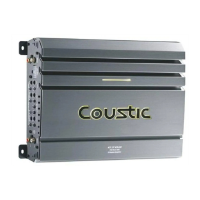
Do you have a question about the Coustic Power Logic AMP-420XR and is the answer not in the manual?
Controls signal routing to front and rear channels.
Selects full-range, high-pass, or low-pass for front channels.
Adjusts front channel high-pass crossover frequency from 40 to 400 Hz.
Boosts low/high frequencies for front channels to compensate vehicle acoustics.
Adjusts input sensitivity for front channels from 300 mV to 5 volts.
Connects to pre-amp outputs from source unit for front channels.
Selects full-range, high-pass, or low-pass for rear channels.
Adjusts rear channel high-pass crossover frequency from 40 to 400 Hz.
Boosts low/high frequencies for rear channels to compensate vehicle acoustics.
Adjusts input sensitivity for rear channels from 300 mV to 5 volts.
Connects to pre-amp outputs from source unit for rear channels.
Connects to speaker outputs from source unit when pre-amp is unavailable.
Provides line level output for connecting to another amplifier.
Adjusts the line output level for balancing with other amplifiers.
Selects low-pass crossover frequency for front, rear, and line outputs.
Connects to the optional remote subwoofer volume control.
Connects to the positive terminal of the vehicle battery.
Connects to the vehicle chassis for ground.
Connects to remote control wire or power antenna for amplifier ON/OFF.
Houses the fuse for the amplifier's power protection.
Connects to the front speaker system.
Connects to the rear speaker system.
Features built-in electronic crossovers for front and rear channels.
Describes a system using active crossovers and multiple amplifiers.
Details the versatility of configuring the amplifier for different system setups.
Describes how line output filter mode selection relates to front channel mode.
Advises on recommended speaker impedance for stereo and bridged modes.
Discusses traditional passive crossover systems and their limitations.
Explains how the amplifier can be configured for 3-channel operation.
States the amplifier is for 12-Volt negative ground systems only.
Explains alternator compatibility requirements for the audio system.
Advises installing a circuit breaker near auxiliary batteries.
Recommends using AWG 8 or bigger gauge power cables.
Emphasizes using high current terminals for safe connections.
Advises installing AGC fast blow fuses for speaker protection.
Covers ventilation, vibration, and moisture considerations for mounting.
Guides planning wire routes for accessibility and avoiding interference.
Recommends reviewing precautions and gathering tools before installation.
Provides detailed steps for physically mounting the amplifier.
Advises on routing audio and power cables separately and protecting them.
Recommends using a Volt/Ohm meter to test speakers and wiring.
Details connecting the amplifier to the source unit and speakers.
Instructions for connecting the amplifier's power input to the battery.
Details connecting the amplifier's ground terminal to the vehicle chassis.
Connects the remote terminal for amplifier ON/OFF control.
Final step to reconnect the battery ground after checking connections.
Instructions for connecting an optional remote subwoofer level control.
Basic checks and adjustments after installation before full operation.
Describes the meaning of the red and yellow protection indicator lights.
Guides matching source unit output to amplifier input for optimal performance.
Explains how to check and correct speaker phasing for better sound.
Details steps to check for and identify system noise issues.

 To Next Page
 General